The shift that changes everything: AI isn’t here to make you faster so you can think less. It’s here to sharpen your judgment — if you use it thoughtfully. I was a skeptic. Now I use AI to sharpen judgment, not outsource it.
Many people use AI to think less. Over time, that risks atrophying critical thinking skills.
In this reflection, I’ll share a practical framework I’ve found helpful for getting smarter with AI. Here are the four steps.
Step One: Intelligent Laziness
A study in Harvard Business Review found that CEOs waste 57% of their time in meetings that don’t move the needle. We’ve all experienced those meetings, haven’t we? The 1-hour meeting that needed only 15 minutes to get to a decision, but it’s hard to stop.
So why do some of the most accomplished folks feel trapped this way? Because we all suffer from this biological glitch called completion bias. Your brain is wired to seek an immediate dopamine hit that you get from finishing a task. So we end up treating all tasks as equal because we’re going to get roughly the same amount of dopamine when you spend time on redrafting an internal email or a million-dollar strategy document.
Everything is priority one. So none of it is. So how do you avoid this priority blindness?
The Two Curves
A good way to think about tasks is to see two curves.
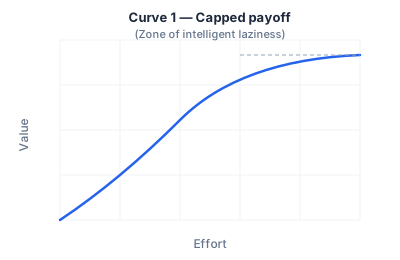
First curve has capped payoffs. This curve goes up and then flattens out once it reaches the zone of diminishing returns. Tasks like formatting slides or internal emails, expense reports, FYI meetings. What happens if you spend additional effort to make the outcome of these tasks pitch perfect? Nothing. There’s no upside here because the value flat lines after a point. Nobody cares if you spend hours choosing better fonts or breathtaking designs in internal slides that are seen for 6 minutes.
This curve shows you your zone of intelligent laziness.
There was a Nobel Prize-winning economist and computer scientist and his name was Herbert A Simon and he came up with a concept called satisficing which pretty much means stop when it’s good enough. Satisfy and suffice. Satisfice.
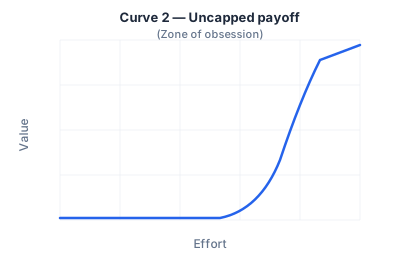
Now our second curve is the exact opposite. It has uncapped payoff. This curve stays flat for a long time but then goes to the moon in a hurry. These are tasks like customer interactions, product design, pricing model, finding a co-founder or a life partner. Being 1% better here does not yield 1% better result. It actually solves the rest of the 99% of your problems. Jony Ive would obsess for many months on even the internal component design of iPhone. But, you know, Steve Jobs never said, “Hey, this is costing us a lot of money.” And who’s going to pry open the iPhone? But Steve knew this was the second curve.
So, if the first curve is your zone of laziness, your second curve is your zone of obsession.
The DRAG Framework
Let’s talk about how AI can help. Effective professionals use AI on zone one — the zone of laziness. The more they outsource zone one to AI, the more they can focus on zone two, the zone of obsession.
So how do I decide what to outsource to AI and when? For that I use a very simple framework called DRAG. Four categories of work you immediately should delegate to AI so you can stay in your zone of obsession.
D = Drafting. This is the blank page problem we all face. It’s hardest to get from zero to one. Sometimes AI can help here tremendously. Give it a prompt using the AIM protocol: “Hey AI, Act in this role. Use this Input and this is your Mission.” And that way you get started very quickly on that email or code or presentation and the first draft from AI will be crappy and atrocious, but that’s fine. Now you have a starting point. You’re not staring at a blank page anymore. Now it’ll trigger something in your brain and you’re off to the races.
R = Research. Most people drown in information. Learning to filter it is a valuable skill. Today, AI can do the heavy lifting — searching, comparing, summarizing — in minutes instead of days. But wisdom still requires judgment. Trust the tool, but always verify the result.
A word of caution: AI can confidently present outdated, biased, or fabricated information. Cross-reference important claims with primary sources, especially for decisions that matter.
Used correctly, it’s like having a skilled researcher working quietly in the background, freeing you to think, decide, and act.
A = Analysis. Let AI take the first pass at analyzing, summarizing, reasoning, especially if it’s all unstructured data because AI is going to find patterns that we humans aren’t going to be able to. So use it for your advantage.
G = Grunt work. Tasks like reformatting, translating, tabulating, cleaning data, and on and on the boring manual work. Just give it to AI.
So what’s the key principle behind DRAG? Apply it only when you are in your zone one. That first curve. If it requires human interaction, judgment, intuition, decision-making, or taste, that’s curve two. That you’ve got to do yourself.
Important caveat: Even in zone one, AI isn’t perfect. Review outputs for errors, biases, or inappropriate content before sharing. Your name is still on the work.
I’ve found that 70-80% of my repetitive tasks tend to be in zone one. You might find that too. So be efficient when you can use DRAG. Be obsessed for everything else.
Step Two: The Intelligent Hill
For 300 years, Isaac Newton convinced us that universe was a clockwork machine, predictable and certain. But in 1927, Heisenberg revealed that certainty is an illusion at the quantum level. What we call reality exists not as fixed facts, but as probabilities — a discovery that reshaped modern science.
You and I have to make a similar shift when we use AI nowadays.
Stop Treating AI Like a Calculator
The first trick is to stop treating AI like a calculator. We like to live in a world with clear rules. You type 2 + 2 into a calculator and you get four always. It’s predictable. But AI is not a calculator. It’s a probability engine.
If you ask the same question to AI again, it’ll give you a completely different answer. It’ll happily make things up for you unless you ask it to verify. AI is brilliant on some days, confused on others, but on any given day, it refuses to admit that it doesn’t know the answer. It loves to make things up.
So, you don’t just ask AI the way you ask a normal human being. You have to architect your questions very carefully.
The Four Camps of the Intelligent Hill
Now, most people use a tactic called zero-shot prompting. For example, they would ask, “Give me the best new business idea.” And of course, AI will dish out a response and tell you why it’s the greatest idea in the world, but you’re literally rolling the dice and looking to win.
To get elite results, though, you must climb the intelligent hill. There are four camps on the way. Each camp will show you a different way to work with AI.
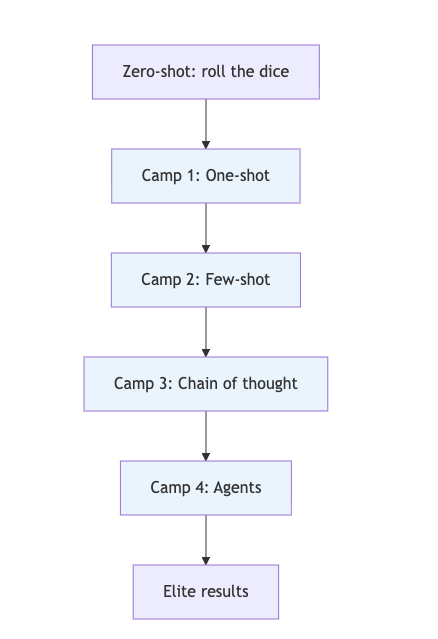
Camp 1: One-Shot Prompting
When you prompt, give one clear example so the model doesn’t guess blindly. The prompt would look like: “Write a LinkedIn post about remote work. Use this specific post as a style guide.” And so give it a post. Give it an example and paste that post in the prompt as a reference. And that simple act is already an upgrade than rolling the dice blindly.
Camp 2: Few-Shot Prompting
Now here you give AI three or more examples so it can find patterns of style and substance and tone that you desire. Attach documents, links, data or your prior work. This is called grounding the model. So basically it stops fantasizing and hallucinating and gets grounded to reality.
Here’s an example of a prompt: “Here are the five of my previous presentations. And now write a new presentation based on my tone of voice on topic XYZ.”
And here’s a pro tip: Ask the AI to explain the pattern back to you first. That way AI is forced to articulate what it’s doing. And more importantly, you’re forced to learn how your brain works. How did it come up with those patterns? Now you’re being smart about being smart.
Camp 3: Chain of Thought Reasoning
Again, fancy name, but the idea is simple. Ask the model to think long and hard before it responds. Your job is to slow AI down and force explicit clarity by asking it to show its work. That’s all there is. This is also a good way to reduce hallucinations, of course.
Let’s say you’re working on some report and so you attach it and write a prompt that could look like this: “Do not refine my research report yet. List the top three most impactful areas of improvement after we analyze it. Tell me why you think so and suggest how we address each. Think step by step. Show me your thinking for each step.”
That last line is the most important one.
Camp 4: Agents
According to Salesforce, AI agents help drive $79.6 billion in global sales during Cyber Week alone. So agents are already here.
The best way to think about agents is to think about who you would hire for a task. So let’s say if you wanted to hire a researcher, an analyst, and a copywriter, you can do that with a single agentic prompt that looks like this:
“Do deep research on trends on topic XYZ. Analyze and cross-reference all the trends to find the three most important ones and draft a one-page memo summarizing the findings.”
What is Actionable?
Try this framework tonight. Open your favorite AI app and take any prompt that you were about to use. Just try to get to the next camp. That’s how you start climbing up the intelligent hill.
When you’re dealing with a drunk genius — make sure you’re the one driving the car.
Step Three: The Intelligent Gym
So now at this point, everything we’ve done has made you fast and efficient. You’re delegating better, you’re prompting smarter, you’re moving up the hill, and there is less friction than before.
And that’s exactly where most people would stop. But here’s the plot twist. The most thoughtful AI users go one step further. They slow things down deliberately.
Why is that important? They know when to shift gears. Because long-term intelligence isn’t built through convenience — it’s built through resistance.
Don’t Use AI as a Crutch for the Mind
It’s tempting to use AI as a crutch for thinking. And if you lean on a crutch when you don’t need one, your mental muscles can weaken over time.
But thoughtful AI users apply a different principle:
For information tasks, use AI to remove friction.
For transformation tasks, use AI to add friction.
When you go to a physical gym, we all know how muscles are built, right? Through resistance. You lift increasingly heavier weights to introduce wear and tear to your muscle fibers. So they break and they grow back stronger. That is called progressive overload.
But when it comes to our minds, we do the exact opposite somehow. We avoid resistance. We use AI to outsource our thinking. “Write my LinkedIn post, fix my resume, summarize this book.” That’s like going to the gym and asking someone else to lift weights on your behalf.
When astronauts spend months in zero gravity, their muscles and bones can atrophy significantly. Over-reliance on AI can have a similar effect on thinking — less friction means less growth.
AI as Your Spotter
The intelligent gym is not about information. It’s about transformation. For things where you need to be smart and capable, you can think of AI as your spotter.
In any gym, a spotter doesn’t lift the weight for you. They stand next to you and help you lift. They also make sure that you don’t get crushed when you’re lifting the weight. So, do the same with AI.
Here’s a concrete example. If you want to learn a concept, study it first yourself, and then go to your spotter, your AI. Paste the concept text and then prompt AI: “I need to master this concept. Quiz me on it.”
And now comes the most important part of your intelligent gym. Ask AI to apply progressive overload. Four levels:
Level 1: Quiz me like I am a high school student.
Level 2: Ask me questions like I am a college student.
Level 3: Now grill me like you’re interviewing me for an executive job.
Level 4: Now challenge me like an irate boss who thinks I’m unprepared.
So that truly strengthens and deepens your understanding on that concept.
Step Four: The Intelligent Fool
So now we have covered three key steps to become smarter by using AI. But there is one internal adjustment that changes everything — and that is our final step.
The Biggest Obstacle
You know the biggest obstacle to intelligence isn’t ignorance, it’s ego. That’s why the smartest people are obsessed with what they don’t know. And this is what I call the fool’s advantage.
Let me give you an example. Microsoft went from $300 billion to $3 trillion in market cap with just one mental cultural shift.
When Satya Nadella became the CEO of Microsoft in 2014, they had missed two huge disruptions: search and mobile. The cloud race was ongoing but it was slipping away from them with Amazon becoming the 800-pound gorilla and the culture inside the company was toxic and political and everyone was terrified to admit that there were gaps in their knowledge.
Satya made one cultural move. He told the entire company: “We’re switching from a culture of know-it-alls to learn-it-alls.”
People were finally given permission to say, “I don’t know,” or “I was wrong,” and to embrace a beginner’s mind.
Of course, Microsoft’s turnaround involved many factors — cloud investments, strategic acquisitions, market timing. But this cultural shift in how people approached learning was a meaningful part of the story.
Neuroplasticity and Learning
And here’s why this matters. Neuroscience tells us that our brain can rewire all the time. It is called neuroplasticity. This rewiring happens only at the edge of your ability. It happens when you are making errors. It happens when you’re frustrated, when you’re feeling that discomfort.
And if you aren’t feeling stupid, you aren’t learning.
And aren’t you glad that AI has just handed you the ultimate training ground to be a student again?
You can bring your beginner’s mind to AI all day long. Ask questions you would never ask your colleagues out of fear of embarrassment. AI doesn’t roll its eyes.
Pick one thing that you don’t understand in your field. Something that everyone else thinks you know, but you know you don’t. And then ask AI the most basic questions about that topic that you can think of. And then ask, “Can you explain it to me in a simpler way? Teach me like I am 10 years old.”
I ask these questions all the time. In fact, I asked three times in a row to simplify again and again. And sure, I guarantee you, you’ll feel ridiculous at first. I do all the time. But that’s the whole point.
Have the courage to play the fool today so you can be the genius tomorrow.
The trick to mastery is going back to simplicity itself. If you examine some of the greatest masters across human history, you’ll see one consistent pattern: Every master is a student for life.
And you can’t be a genuine student if you’re hiding behind a mask of mastery.
Summary: Your AI Partnership
Here’s what it comes down to:
- Be strategically efficient — Use DRAG to delegate low-value tasks so you can focus on what matters.
- Climb the intelligence hill — Move from basic prompting to grounded, thoughtful interactions with AI.
- Build your mental gym — Use AI to challenge yourself, not replace yourself.
- Stay curious — The willingness to say “I don’t know” is the foundation of real growth.
AI is a powerful tool, but it’s still just a tool. Your judgment, creativity, and willingness to learn are what make the difference.
Use AI to think better, not less.