
Day 18 of Australian Rail Series
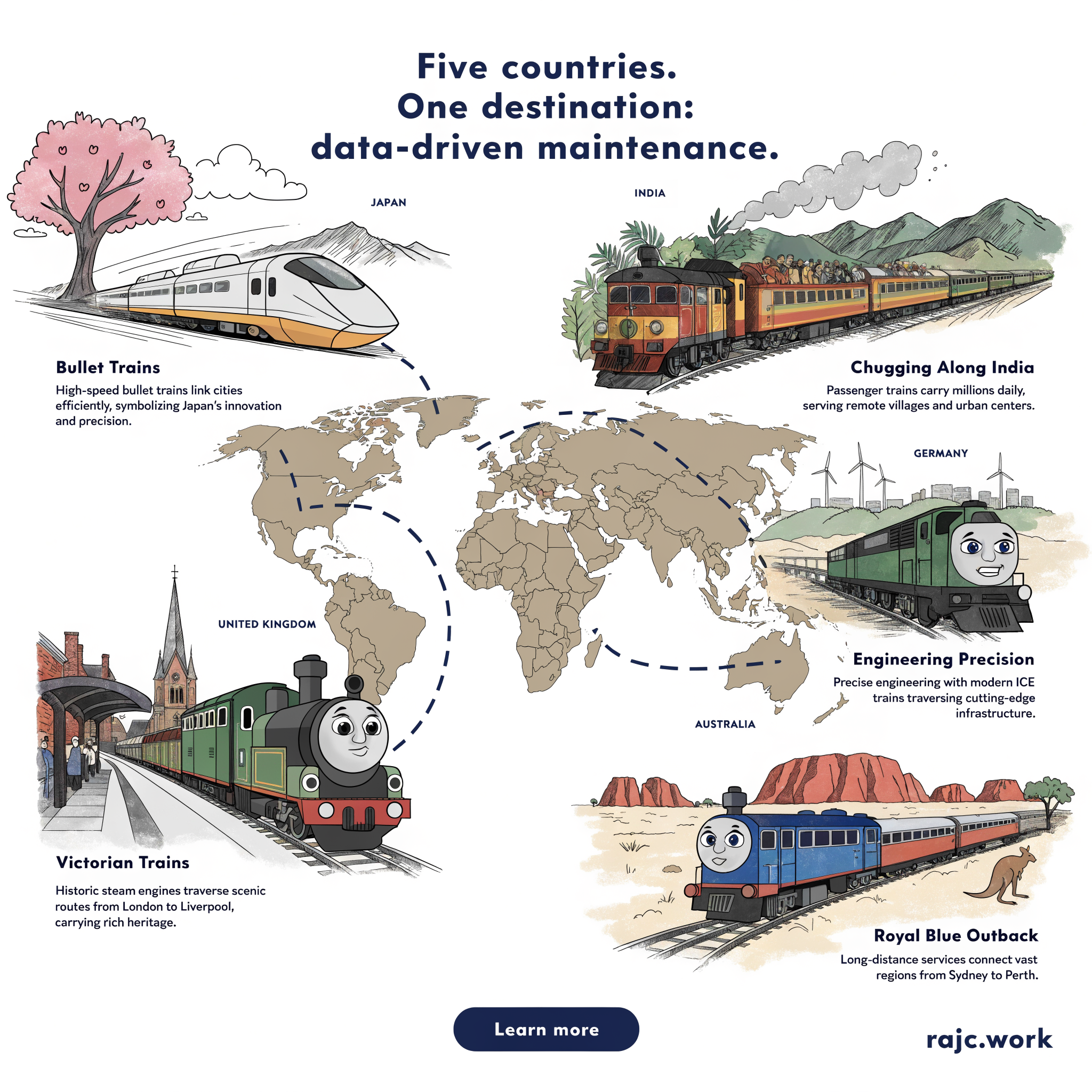
A familiar question — “how does Australia compare internationally?” — leads to an unexpected discovery. Not that one country is best. But that every country has optimised for something different.
The Story
It starts with a familiar question. Someone in a boardroom, a conference panel, or a policy briefing asks: “How does Australia’s rail compare internationally?”
The expected answer involves a ranking. Japan is best. Australia is behind. We should copy Japan. Simple, clear, actionable.
But when you actually compare the systems — not just the punctuality statistics, but the structures, the funding models, the maintenance philosophies, the unique constraints — an unexpected discovery emerges: no single country has it figured out.
Japan’s Shinkansen has 60+ years without a passenger fatality, but its maintenance costs per kilometre are among the highest in the world. The UK privatised and gained investment but lost accountability. India carries 8 billion passengers annually at unimaginable scale but struggles with maintenance backlogs. Germany has invested heavily in digital maintenance but can’t meet its own punctuality targets.
The discovery isn’t that Australia should copy another system. It’s that Australia should borrow principles, not prescriptions — adapting what works elsewhere to conditions that are unlike anywhere else on earth.
Day 18 in pictures
A few visuals for the post.
The Deep Dive — 8 Questions
How does Japan’s obsessive maintenance culture create 60+ years without a passenger fatality?
Japan’s Shinkansen (bullet train) is the global benchmark for punctuality, safety, and customer experience. Key factors:
- Dedicated corridors — no mixed traffic, eliminating freight/passenger conflict. JR Central operates the flagship Tokaido Shinkansen on exclusively dedicated track.
- Obsessive maintenance culture — tracks inspected nightly by “Doctor Yellow” measurement trains running at line speed with on-board diagnostics (JR Central annual report)
- Vertical integration — JR companies own infrastructure and operate trains, aligning incentives — a model codified in the Japanese National Railways Restructuring Act (1986)
- Cultural commitment — precision and punctuality are deeply embedded values, not just KPIs
Average delay: 54 seconds (MLIT Transport Statistics). 60+ years without a single passenger fatality — a record validated by the International Union of Railways (UIC).
Australia’s lesson: Dedicated corridors and relentless maintenance investment create world-class outcomes. But Japan’s approach relies on population density and cultural factors that Australia cannot simply import.
Why did the Hatfield crash expose the accountability gap in the UK’s structural separation model?
The UK privatised British Rail in 1993 under the Railways Act 1993, separating track (Railtrack, later Network Rail) from operations (multiple franchises). Results were mixed:
- Investment increased — private capital flowed into rolling stock and stations
- Complexity exploded — dozens of franchises, multiple interfaces, fragmented accountability
- Safety consequences — the fatal Hatfield rail crash (2000) exposed maintenance failures under private ownership, as documented in the HSE/HMRI investigation. The Office of Rail and Road (ORR) subsequently identified systemic failures in track inspection and gauge corner cracking management.
Australia adopted the above/below rail separation model without the UK’s franchise fragmentation, learning from British mistakes. The McNulty Rail Value for Money Study (2011) later quantified the efficiency costs of fragmentation.
Key lesson: Structural separation works — but only with clear maintenance accountability. Splitting ownership and operation without joined-up maintenance oversight creates dangerous gaps.
How is Indian Railways proving that scale doesn’t prevent digital transformation?
Indian Railways operates at a scale that defies easy comparison (Indian Railways Statistical Publications):
| Metric | India | Australia |
|---|---|---|
| Route kilometres | 68,000+ | 36,000 |
| Employees | 1.3 million | ~100,000 |
| Annual passengers | 8+ billion | ~900 million |
| Revenue model | Freight subsidises passenger | Mixed |
India is now investing massively: semi-high-speed Vande Bharat trains (designed and manufactured by ICF Chennai), the Dedicated Freight Corridor Corporation of India (DFCCIL) building 3,300 km of new freight-only track, and digital transformation across operations. The freight-subsidising-passenger model mirrors some Australian dynamics — a cross-subsidy structure analysed in the Indian Railways Annual Report and Accounts.
Australia’s lesson: Scale doesn’t prevent transformation. If Indian Railways can digitise 68,000 km and 1.3 million employees, Australian operators cannot credibly claim their networks are “too complex” for change.
Why does Deutsche Bahn’s declining punctuality demonstrate that even well-funded systems struggle?
Deutsche Bahn (DB) operates Europe’s largest rail network with an integrated model (infrastructure and operations under one company, regulated by the Eisenbahn-Bundesamt (EBA)). DB has invested heavily in predictive maintenance — their “Digitale Schiene Deutschland” (Digital Rail for Germany) programme uses AI and IoT to reduce disruptions, with DB InfraGO managing infrastructure separately since 2024.
But recent challenges tell a cautionary tale:
- Declining punctuality — falling below 75% on some routes, as tracked in DB’s Integrated Report
- Infrastructure backlog — decades of maintenance deferral catching up, with the Bundesrechnungshof (Federal Audit Office) estimating €90+ billion in required renewal
- Capacity constraints — network at maximum utilisation with little room for disruption
Australia’s lesson: Technology alone doesn’t solve maintenance backlogs. Even well-funded systems struggle when deferred maintenance accumulates over decades. The compound interest of neglect is paid in reliability.
Why does no single model dominate — and what does that mean for Australia?
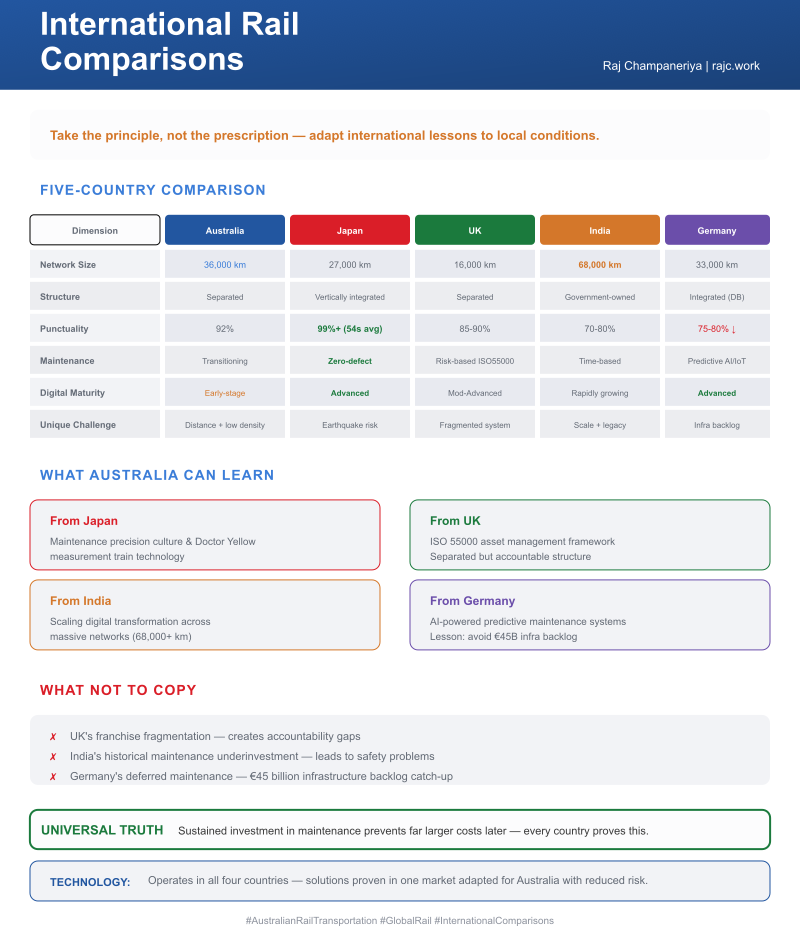
| Dimension | Japan | UK | India | Germany | Australia |
|---|---|---|---|---|---|
| Network size | 27,000 km | 16,000 km | 68,000 km | 33,000 km | 36,000 km |
| Structure | Vertically integrated | Separated + franchises | Government-owned | Integrated + regulated competition | Separated (above/below) |
| Punctuality | 99%+ (MLIT) | 85–90% (ORR) | ~70–80% (IR stats) | 75–80% (DB report) | 92% target (BITRE) |
| Safety record | World-class | Good (post-Hatfield) | Improving | Good | World-class (ONRSR) |
| Digital maturity | Advanced | Moderate | Rapidly growing | Advanced | Early-stage, growing |
| Unique challenge | Earthquake resilience | Fragmented accountability | Scale + legacy | Infrastructure backlog | Distance + low density |
Australia’s challenge is genuinely unique: continental distances, low population density, mixed freight-passenger corridors, and extreme weather. No international model maps directly. The approach must be tailored — borrowing best practices but adapting them to local reality.
What is the universal global trend in maintenance philosophy?
Despite different structures and funding models, every major rail system is converging on the same maintenance trajectory:
- Japan: Prevention-first, zero-defect culture, daily inspections (JR East Technical Review)
- UK: Risk-based maintenance under Network Rail’s asset management framework (ISO 55000 certified, assessed by IAM)
- India: Time-based maintenance transitioning to condition-based under RDSO guidelines
- Germany: Predictive maintenance adoption with digital twin integration via Digitale Schiene Deutschland
- Australia: Transitioning from time-based to condition-based maintenance, with leading operators piloting predictive approaches (Australasian Railway Association benchmarking)
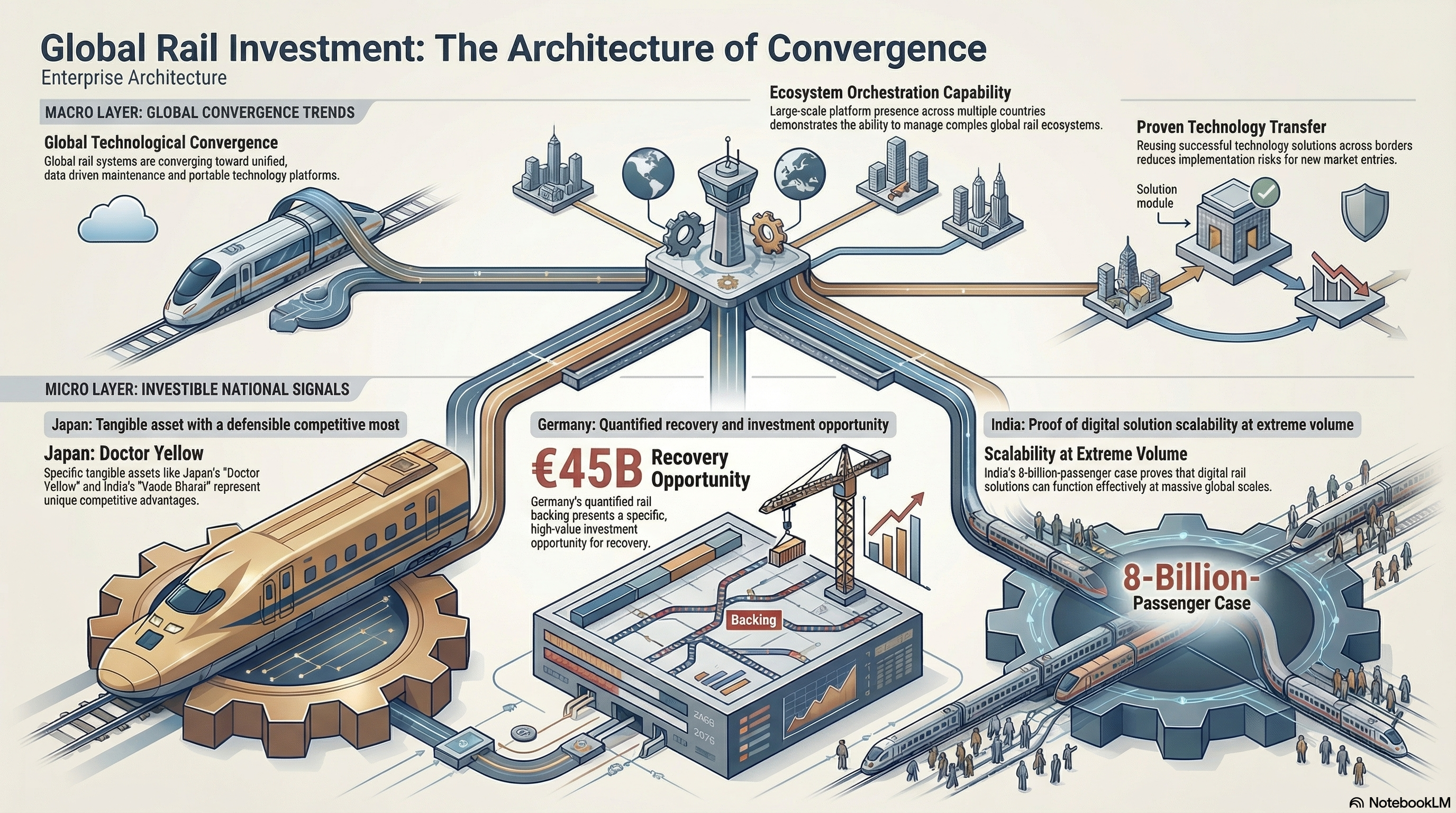
The global trend is universal: toward data-driven, condition-based maintenance. The technology platforms enabling this convergence (AI, IoT, digital twins) are the same everywhere, even if the operational context differs. The UIC Railway Statistics tracks this convergence across 90+ member countries.
How does IBM’s global presence create a knowledge bridge for Australian operators?
Australian rail can adopt proven practices from international systems:
| Source Country | Transferable Practice |
|---|---|
| Japan | Maintenance precision culture, measurement train technology |
| UK | ISO 55000 asset management framework |
| India | Scaling digital transformation across massive networks |
| Germany | AI-powered predictive maintenance systems |
IBM operates in all four countries, creating a knowledge bridge. Solutions proven in one market can be adapted for Australian conditions with reduced implementation risk. A Maximo deployment that worked for Deutsche Bahn doesn’t need to be reinvented for ARTC — it needs to be adapted.
What should Australia avoid when borrowing international lessons?
Pitfalls to avoid:
- UK’s franchise fragmentation — creates accountability gaps that compromise maintenance quality. The McNulty Report (2011) estimated £3.5 billion in annual efficiency losses from structural fragmentation.
- India’s historical underinvestment — decades of maintenance deferral creates safety and reliability problems, as flagged by the Comptroller and Auditor General of India (CAG) in repeated rail safety audits
- Germany’s infrastructure backlog — even generous funding doesn’t fix decades of accumulated neglect. The Bundesrechnungshof (Federal Audit Office) has repeatedly criticised DB InfraGO’s maintenance spending
- Japan’s cost structure — Shinkansen maintenance costs per km are extremely high and may not be economically replicable, as analysed in JR Central’s annual report
The principle: take the lesson, not the prescription. Adapt international insights to local conditions rather than copying structures wholesale. A maintenance philosophy inspired by Japan but calibrated for Australian distances, Australian temperatures, and Australian workforce realities.
Synthesis
The international comparison reveals that Australia’s rail system is neither uniquely challenged nor uniquely advantaged — every major rail nation faces trade-offs between cost, safety, reliability, and modernisation. Australia’s structural separation model provides a solid foundation. The gap is in maintenance maturity and digital adoption, where Japan and Germany offer actionable templates — a finding supported by the Australasian Railway Association’s own benchmarking work.
The connections to earlier themes are direct: the cybersecurity challenges (Day 17) of digitisation apply equally to international systems adopting IoT and cloud analytics. The sustainability imperative (Day 16) is a global driver — every country is decarbonising rail, with the IEA’s “The Future of Rail” report quantifying rail’s role in net-zero transport. And the data and analytics foundation (Day 15) underpins every international maintenance transformation discussed here.
The most transferable lesson across all models: sustained investment in maintenance prevents far larger costs later. This is true in Tokyo, London, Mumbai, Frankfurt, and Sydney. Geography changes. Physics doesn’t.
Vocabulary Spotlight
| Term | Definition |
|---|---|
| Vertical integration | A model where one organisation owns and operates both infrastructure and train services, as in Japan’s JR companies — structured under the JNR Restructuring Act |
| Franchise model | A system where government owns infrastructure and competitively tenders the right to operate services for a fixed period, as in the UK — created by the Railways Act 1993 |
| ISO 55000 | The international standard for asset management, providing a framework for optimising physical asset value across the full lifecycle — adopted by Network Rail and assessed through the Institute of Asset Management (IAM) |
| Shinkansen | Japan’s high-speed rail network, operational since 1964, renowned for its safety record of zero passenger fatalities and average delays under one minute (UIC High Speed Rail Atlas) |
| Condition-based maintenance | A maintenance strategy that monitors actual equipment condition to decide what maintenance needs to be done, replacing fixed-interval schedules — standardised in ISO 17359 |
| Structural separation | Dividing rail infrastructure ownership from train operations, allowing multiple operators to compete on the same tracks — the model Australia adopted, overseen by the ACCC for access regulation |
Micro Signal
Lynch Lens: The key micro-metric is “maintenance cost per track-kilometre” — the single number that reveals whether a country’s rail philosophy is working. Japan’s Shinkansen spends the most per km but achieves zero fatalities and sub-minute delays. India’s railways spend the least but face chronic reliability challenges. The companies that can demonstrate measurable maintenance cost reduction while maintaining or improving safety outcomes — through predictive maintenance, IoT, and digital twins — will win the contracts as every country converges on condition-based maintenance. The Bureau of Infrastructure and Transport Research Economics (BITRE) publishes Australia’s comparative data.
Macro Signal
Druckenmiller Lens: The global macro trend is convergence. Every major rail system is moving toward data-driven, condition-based maintenance regardless of ownership structure or funding model. The technology platforms enabling this convergence are the same everywhere. The macro bet: technology companies that build rail solutions portable across country models will capture global, not just local, value. The IEA’s Future of Rail report and UIC Railway Statistics track this convergence quantitatively.
In the News
Japan’s Ministry of Land, Infrastructure, Transport and Tourism announces a bilateral rail technology cooperation agreement with Australia in February 2026, focused on Shinkansen maintenance knowledge transfer, earthquake early warning integration, and high-speed rail operational safety standards.
Sources
| Type | Source |
|---|---|
| IBM | IBM Institute for Business Value — “The Future of Rail: Global Perspectives on Digital Transformation” (2024) |
| IBM | IBM Japan — “Shinkansen Digital Maintenance Partnership Case Study” |
| IBM | IBM Maximo Application Suite — “Intelligent Asset Management for Rail” |
| Industry | International Union of Railways (UIC) — “Railway Statistics Synopsis 2024” |
| Industry | Network Rail (UK) — “Asset Management Strategy 2024–2029” |
| Industry | Australasian Railway Association (ARA) — “Rail Industry Benchmarking and Best Practice” |
| Industry | Institute of Asset Management (IAM) — “Asset Management — An Anatomy” |
| Government | Indian Railways — “National Rail Plan: Transforming Indian Railways” |
| Government | MLIT Japan — Transport Statistics |
| Government | Bureau of Infrastructure and Transport Research Economics (BITRE) — Australian Rail Performance Data |
| Government | Dedicated Freight Corridor Corporation of India (DFCCIL) — Freight Corridor Project Status |
| Regulator | Office of Rail and Road (ORR) — UK Rail Performance Statistics |
| Regulator | Eisenbahn-Bundesamt (EBA) — German Federal Railway Authority |
| Regulator | Office of the National Rail Safety Regulator (ONRSR) — Australian Rail Safety Data |
| Legislation | Railways Act 1993 (UK) — Structural separation legislation |
| Report | McNulty Rail Value for Money Study (2011) — UK rail efficiency analysis |
| Report | Deutsche Bahn Integrated Report 2023 — Punctuality and infrastructure data |
| Research | Railway Gazette International — “Global Rail Benchmarking Report 2024” |
| Research | IEA — The Future of Rail — Rail’s role in sustainable transport transitions |
| Standards | ISO 55000 — Asset Management — Overview, principles and terminology |
| Standards | ISO 17359 — Condition monitoring and diagnostics of machines |
| Operator | JR Central — Annual Report & IR Materials |
| Operator | Australian Rail Track Corporation (ARTC) — Interstate and Hunter Valley network operator |
| Operator | DB InfraGO — German rail infrastructure manager (est. 2024) |
Next: The Railway That Drives Itself · Everyone knows autonomous trains are coming. But what if they’re already here — and the biggest innovation isn’t the technology, but the business model it enables?