
Day 16 of Australian Rail Series
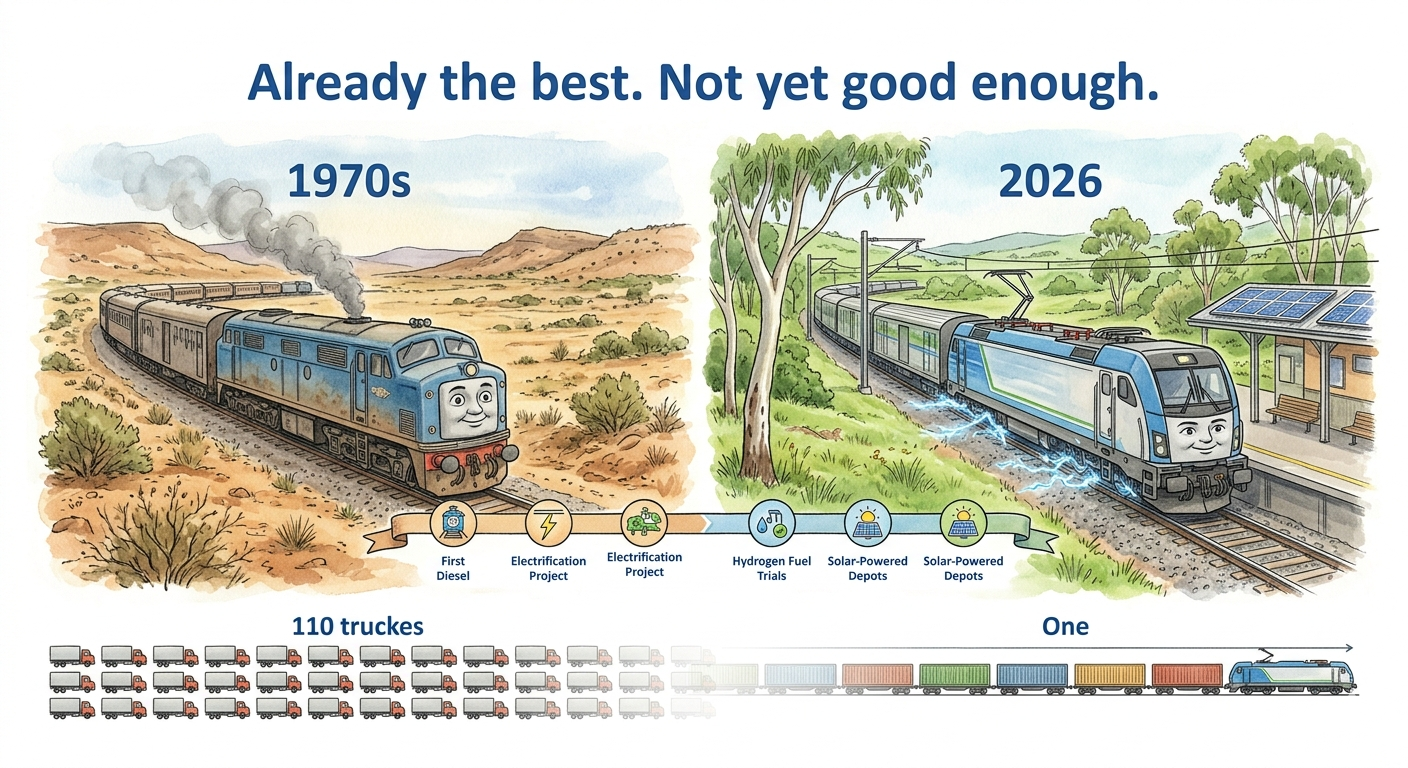
Remember the old photographs of steam trains belching black smoke across the countryside? Everyone thought trains were dirty. The paradox: they were always the cleanest way to move freight — and almost nobody knew.
The Story
There’s a cliché in old westerns and period dramas: the steam locomotive thundering through the landscape, trailing a plume of black smoke across the sky. Coal ash settling on laundry. Soot coating station platforms. The train as symbol of industrial pollution.
That image lives in our cultural memory. And it’s profoundly misleading.
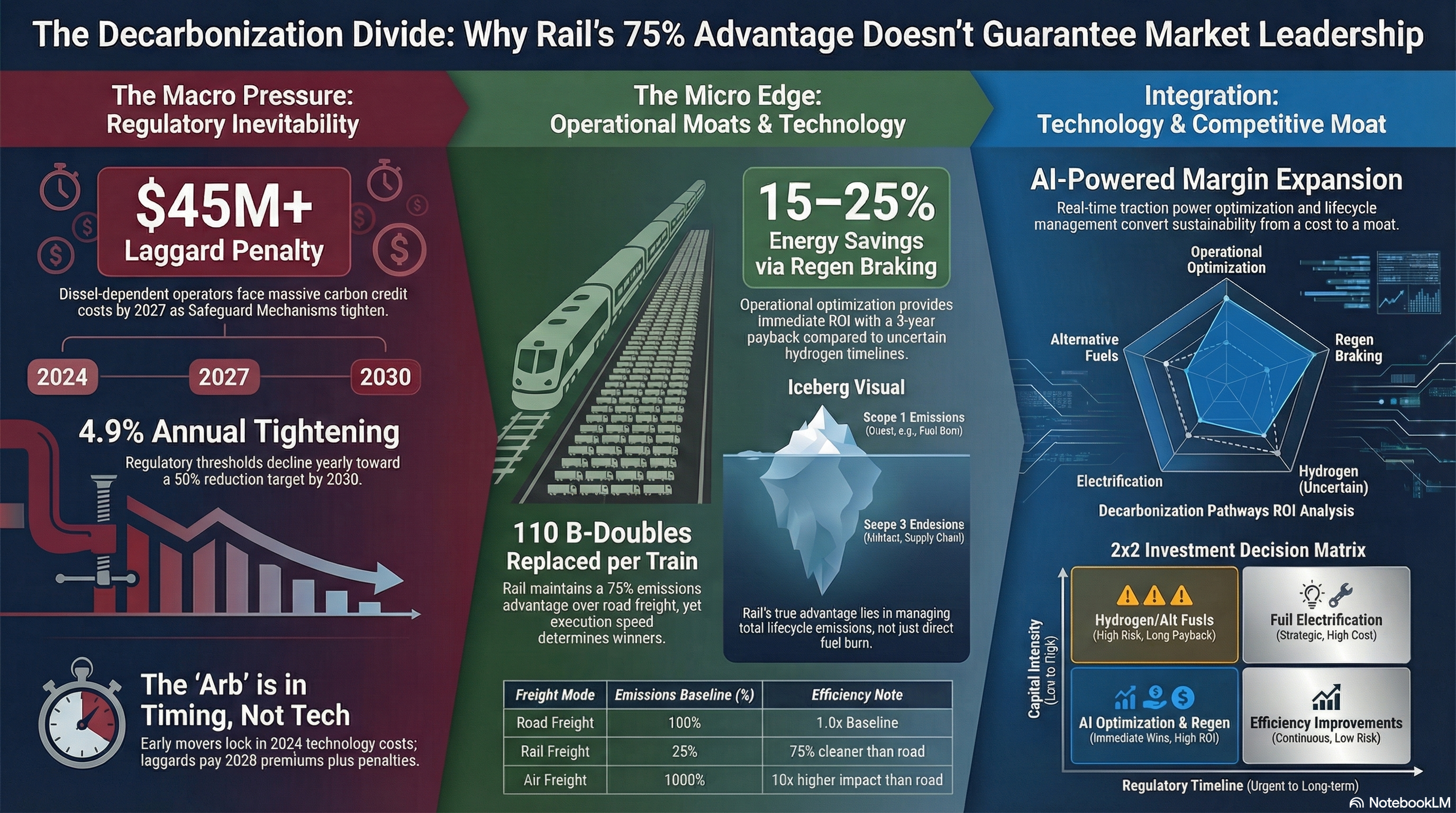
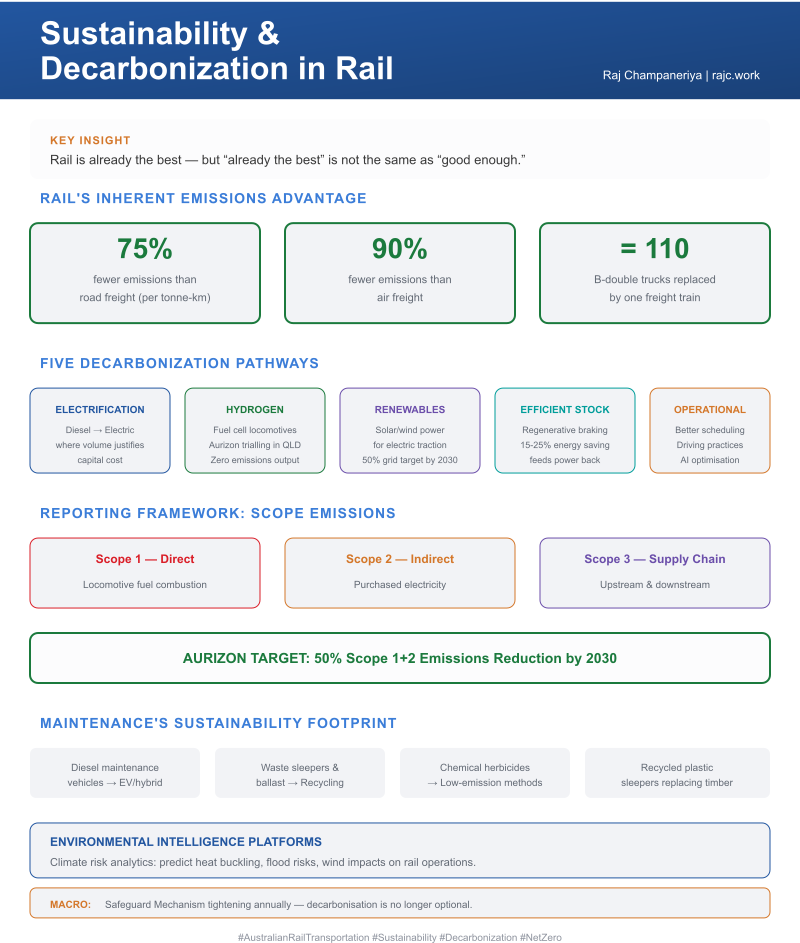
Even in the steam era, rail moved more cargo per unit of energy than any other land transport mode. The black smoke was visible. The efficiency was invisible. And today, when a single fully loaded freight train replaces approximately 110 B-double trucks on Australian highways, the paradox hasn’t changed — it’s only sharpened.
Rail produces 75% fewer emissions per tonne-km than road freight and 90% fewer than air freight. For passengers, electric rail produces 60–80% fewer emissions per passenger-km than private cars. This inherent efficiency makes rail the backbone of any serious national decarbonisation strategy.
The echo from those old photographs carries an ironic lesson: the mode of transport that looked dirty was always the cleanest option. And in an era of climate urgency, that centuries-old efficiency advantage has become rail’s most powerful competitive asset — if governments invest in modal shift to unlock it.
Day 16 in pictures
A few visuals for the post.
The Deep Dive — 8 Questions
Why does rail’s 75% emissions advantage over road only count if governments invest in modal shift?
The numbers are compelling:
- Freight: Rail produces 75% fewer emissions per tonne-km than road (IEA Transport Data)
- Passengers: Electric rail produces 60–80% fewer emissions per passenger-km than cars (IEA Future of Rail)
- Scale: One freight train replaces ~110 B-double trucks (Australasian Railway Association)
But the advantage is structural, not automatic. Moving freight from road to rail requires investment in rail infrastructure (corridors, terminals, rolling stock), policy incentives (road pricing, modal shift subsidies), and connectivity (first/last mile logistics from rail terminal to customer). Without government commitment to modal shift, rail’s inherent efficiency remains an underexploited asset — a point reinforced by the Productivity Commission’s inquiry into National Transport Regulatory Reform.
Which decarbonisation pathway delivers the fastest ROI?
Five pathways are available, each suited to different conditions:
| Pathway | Best For | Investment Level | Timeline |
|---|---|---|---|
| Electrification | High-traffic corridors | High capital, low operating | 5–10 years |
| Hydrogen locomotives | Remote, low-traffic lines | High capital, declining fuel cost | 5–15 years |
| Renewable energy sourcing | Already-electrified networks | Low incremental | 1–3 years |
| Energy-efficient rolling stock | Fleet renewal cycles | Moderate | 3–7 years |
| Operational optimisation | All networks immediately | Low | 0–2 years |
The fastest ROI comes from operational optimisation — reducing fuel consumption through better scheduling, driving practices, and load management. It requires minimal capital and delivers immediate results (UIC Sustainability Report). But the largest long-term impact comes from electrification and hydrogen, which require patient capital (IEA Net Zero Roadmap).
Why must three factors align before hydrogen trains become viable in Australia?
Hydrogen fuel cell trains — like Alstom’s Coradia iLint, operational in Germany since 2022 — offer zero-emission traction for non-electrified lines. Australian trials are underway: Aurizon is evaluating hydrogen for freight in Queensland.
Hydrogen is especially relevant for Australia’s remote freight corridors where electrification costs are prohibitive. But three factors must align simultaneously:
- Hydrogen production costs — green hydrogen (produced from renewable energy) must reach price parity with diesel (CSIRO National Hydrogen Roadmap)
- Refuelling infrastructure — hydrogen storage and dispensing systems must be built along corridors (ARENA Hydrogen Knowledge Sharing)
- Locomotive economics — the cost of hydrogen fuel cell locomotives must justify conversion from proven diesel fleets
Progress is real but uneven. None of these factors is solved in isolation. The Australian Government’s National Hydrogen Strategy provides the policy framework, but commercial viability depends on all three aligning.
How does regenerative braking deliver a 15–25% energy saving?
Electric rail networks draw power from the grid — so their emissions profile mirrors the grid’s energy mix. As Australia’s grid grows greener (50% renewable by 2030 target), electric rail automatically decarbonises without operators doing anything.
Some operators go further:
- On-site solar at stations and depots (Sydney Trains has explored this)
- Regenerative braking captures kinetic energy when trains slow down, feeding it back into the overhead wire or powering adjacent trains
Regenerative braking delivers a 15–25% energy saving on electrified networks. It’s elegant engineering: the act of stopping a train generates energy that helps start the next one.
Why does rail maintenance have its own hidden sustainability footprint?
The trains aren’t the only emission source. Maintenance has its own carbon footprint:
| Source | Impact |
|---|---|
| Diesel maintenance vehicles | On-track machines, hi-rail vehicles, generators |
| Replaced components | Old sleepers (often treated timber), spent ballast, worn rails |
| Chemical use | Herbicides for track vegetation management |
| Embodied carbon | New materials (concrete, steel) carry manufacturing emissions |
Sustainable maintenance practices include recycling steel rails, using recycled plastic sleepers, converting maintenance vehicles to electric/hybrid power, and adopting low-emission ballast cleaning methods. These are smaller numbers than traction energy — but they’re within the operator’s direct control.
How does Aurizon’s 50% Scope 1+2 reduction target compare globally?
Major operators publish annual sustainability reports aligned with frameworks:
| Framework | Purpose |
|---|---|
| GRI (Global Reporting Initiative) | Comprehensive sustainability reporting |
| TCFD (Task Force on Climate-Related Financial Disclosures) | Climate risk and governance |
| UN SDGs | Alignment with global development goals |
Key metrics are categorised by the GHG Protocol:
- Scope 1 — direct emissions (locomotive fuel)
- Scope 2 — indirect emissions (purchased electricity)
- Scope 3 — supply chain emissions
Aurizon’s 2024 sustainability report targets 50% Scope 1+2 emissions reduction by 2030 — ambitious for a diesel-heavy freight operator, and a signal that even the most carbon-intensive rail operations are committing to measurable decarbonisation.
Why does the Inland Rail project’s sustainability rating embed green design from the start?
Key Australian policies shaping rail decarbonisation:
- National Electric Vehicle Strategy — extending electrification thinking to rail traction
- State-level renewable energy targets — greening the electricity grid that powers electric trains (AEMO Integrated System Plan)
- Safeguard Mechanism — requiring large emitters (including freight operators) to reduce emissions
- Infrastructure Australia sustainability criteria — embedding ESG in project assessment
The Inland Rail project includes a 3-star IS (Infrastructure Sustainability) rating requirement — embedding sustainability from design rather than retrofitting it later. This approach treats sustainability as an architectural decision, not an afterthought.
How do IBM’s sustainability tools create an integrated solution for rail?
IBM contributes across the sustainability stack:
| IBM Solution | Rail Application |
|---|---|
| Environmental Intelligence Suite | Climate risk analytics — predicting heat-related track buckling, flood risks, wind impacts |
| Maximo | Lifecycle management — extending asset life to reduce embodied carbon of premature replacements |
| AI-powered energy management | Optimising traction power consumption across the network |
| IBM Consulting | Sustainability strategy, ESG reporting aligned with TCFD, GRI, and government requirements |
| Carbon footprint calculators | Measuring, reporting, and reducing environmental performance |
The integration matters: sustainability in rail isn’t a standalone program. It’s embedded in asset management, operations, procurement, and reporting — and the technology platform must reflect that integration.
Synthesis
Rail’s decarbonisation journey starts from a unique position: already the most efficient land transport mode, but still heavily diesel-dependent outside major urban corridors. The path forward combines infrastructure investment (electrification), technology innovation (hydrogen, batteries), operational optimisation (AI-driven efficiency), and supply chain sustainability (greener materials and processes).
The connections to earlier themes are direct: data and analytics capabilities (Day 15) provide the measurement foundation for tracking emissions reductions. The workforce skills gap (Day 12) is amplified when operators lack sustainability expertise. And the Week 2 synthesis showed that maturity gaps between dimensions create friction — sustainability is the connective thread that increasingly ties funding, regulation, and public perception together.
The green locomotive paradox persists: rail has always been the cleanest option, even when it looked dirty. The task now is to make that invisible advantage visible — through data, reporting, and investment decisions that accelerate what physics has always favoured.
Vocabulary Spotlight
| Term | Definition |
|---|---|
| Modal shift | The transfer of freight or passengers from one transport mode to another (e.g., road to rail), typically to reduce emissions, congestion, or cost |
| Scope 1/2/3 emissions | GHG Protocol categories: Scope 1 (direct from owned assets), Scope 2 (from purchased electricity), Scope 3 (from supply chain and customers) |
| Regenerative braking | Technology recovering kinetic energy during braking and feeding it back to the electrical network or battery storage |
| Green hydrogen | Hydrogen produced via electrolysis powered by renewable energy, producing zero carbon emissions in production |
| Embodied carbon | The total greenhouse gas emissions generated during the manufacture, transport, and installation of materials (e.g., concrete sleepers, steel rails) |
| IS rating | Infrastructure Sustainability rating — an Australian framework for assessing and certifying sustainability performance of infrastructure projects |
Micro Signal
Lynch Lens: The key micro-metric is “modal shift conversion rate” — what percentage of freight that could move by rail is actually moving by rail? For Australia, this number is approximately 50% for bulk commodities but below 10% for intermodal general freight, per BITRE freight statistics. Every percentage point of modal shift from road to rail removes approximately 1.5 million truck-km from Australian highways annually. The operators and logistics companies that build the intermodal terminals, last-mile connectivity, and digital booking systems to capture this shift will own the growth corridor in Australian freight for the next two decades.
Macro Signal
Druckenmiller Lens: The macro trend is regulatory inevitability. The Safeguard Mechanism and state-level emissions targets are tightening annually. Rail operators who delay decarbonisation will face rising compliance costs. Those who invest early will gain both cost advantage and brand differentiation. The macro bet: decarbonisation is no longer optional for any transport mode — the winners are those who move first and own the transition narrative.
In the News
Aurizon commences Australia’s first revenue-service hydrogen fuel cell locomotive trial on the Mount Isa line in Queensland (Aurizon decarbonisation updates), aiming to prove zero-emission freight haulage viability for non-electrified regional corridors by 2028.
Sources
| Type | Source |
|---|---|
| IBM | IBM Environmental Intelligence Suite — “Climate Risk Intelligence for Transportation” |
| IBM | IBM Institute for Business Value — “Sustainability at Speed: The Business Case for Green Transport” (2024) |
| Industry | Australasian Railway Association — “Rail Sustainability Strategy 2024” |
| Industry | Aurizon — “2024 Sustainability Report” |
| Research | Climate Council — “Transport Decarbonisation: Australia’s Pathway” (2024) |
| Industry | Infrastructure Sustainability Council — “IS Rating Scheme for Rail Projects” |
| Government | BITRE — “Australian Freight Statistics Yearbook 2024” |
| Government | Infrastructure Australia — “Sustainability Criteria for Major Projects” |
| Standards | GHG Protocol — “Corporate Standard for Scope 1/2/3 Emissions Accounting” |
| Standards | GRI — “Global Reporting Initiative Standards for Sustainability Disclosure” |
Next: The Hack That Stops a Nation · Everyone knows cybersecurity is important. But what if, in rail, a breach doesn’t just steal data — it stops trains?