
Day 14 of Australian Rail Series
Everyone treats safety, technology, workforce, and supply chain as separate challenges. But what if they’re not separate at all — and what if seeing them as separate is the biggest mistake the industry makes?
The Story
Everyone analyses rail in categories. Safety on Monday. Technology on Tuesday. Workforce on Wednesday. Supply chain on Thursday. Neat, sequential, manageable.
But what if that’s exactly wrong?
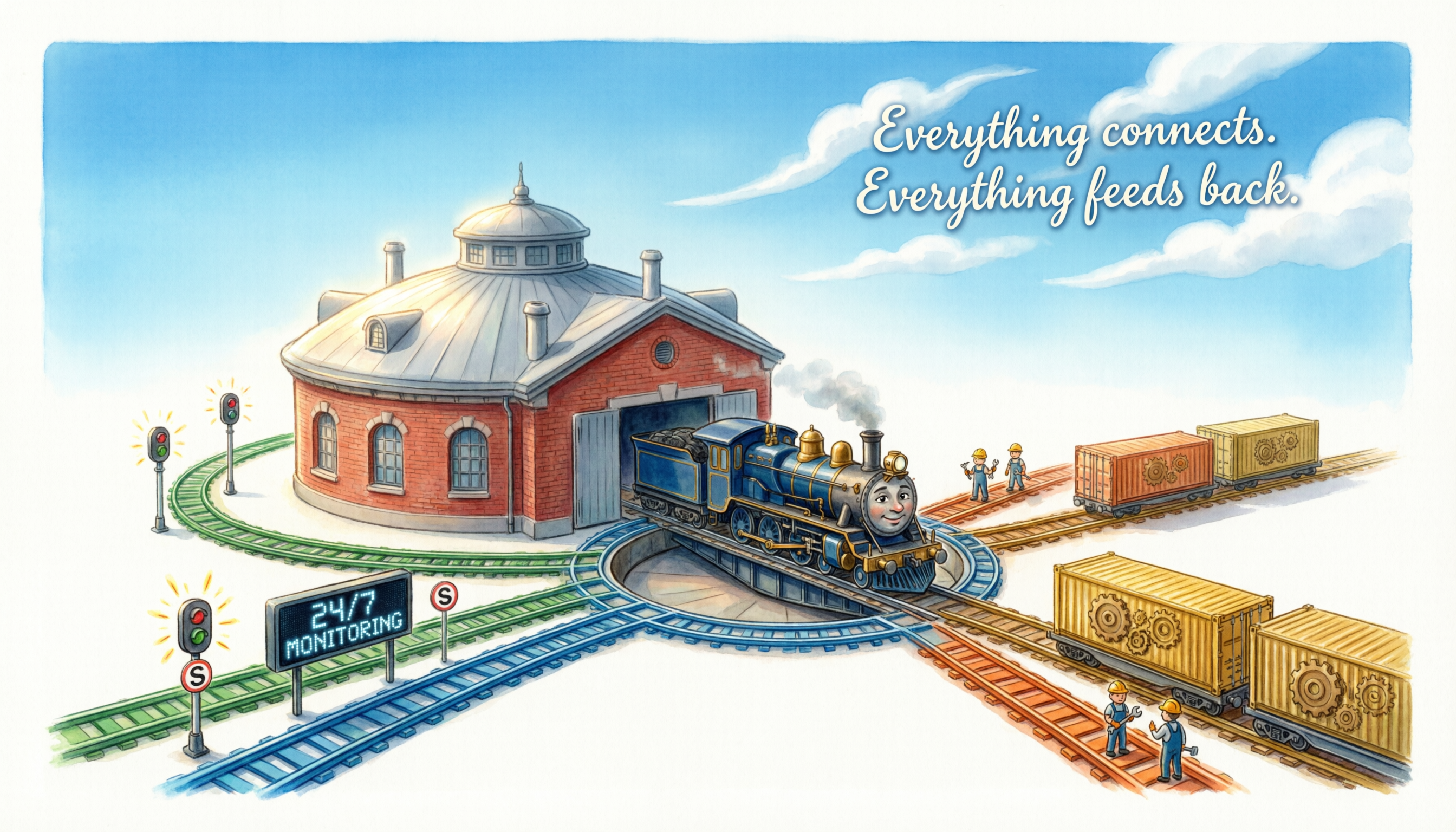
What if safety regulation creates the demand for technology? What if technology exposes the workforce gap? What if workforce shortages accelerate automation? What if automation demands cybersecurity? What if cybersecurity costs compete with maintenance budgets? And what if budgets are shaped by political cycles that respond to public demand for better services?
The reversal isn’t that these topics are connected. Everyone says that. The reversal is that treating them as separate categories actively harms the organisations trying to solve them. A safety initiative that ignores workforce constraints fails. A technology deployment that ignores supply chain lead times fails. An everything-in-isolation approach guarantees nothing-works-together.
This is the midpoint reckoning: the moment we step back and see the system, not just the components.
Day 14 in pictures
A few visuals for the post.
The Deep Dive — 8 Questions
Why does the safety–technology feedback loop create both opportunity and obligation?
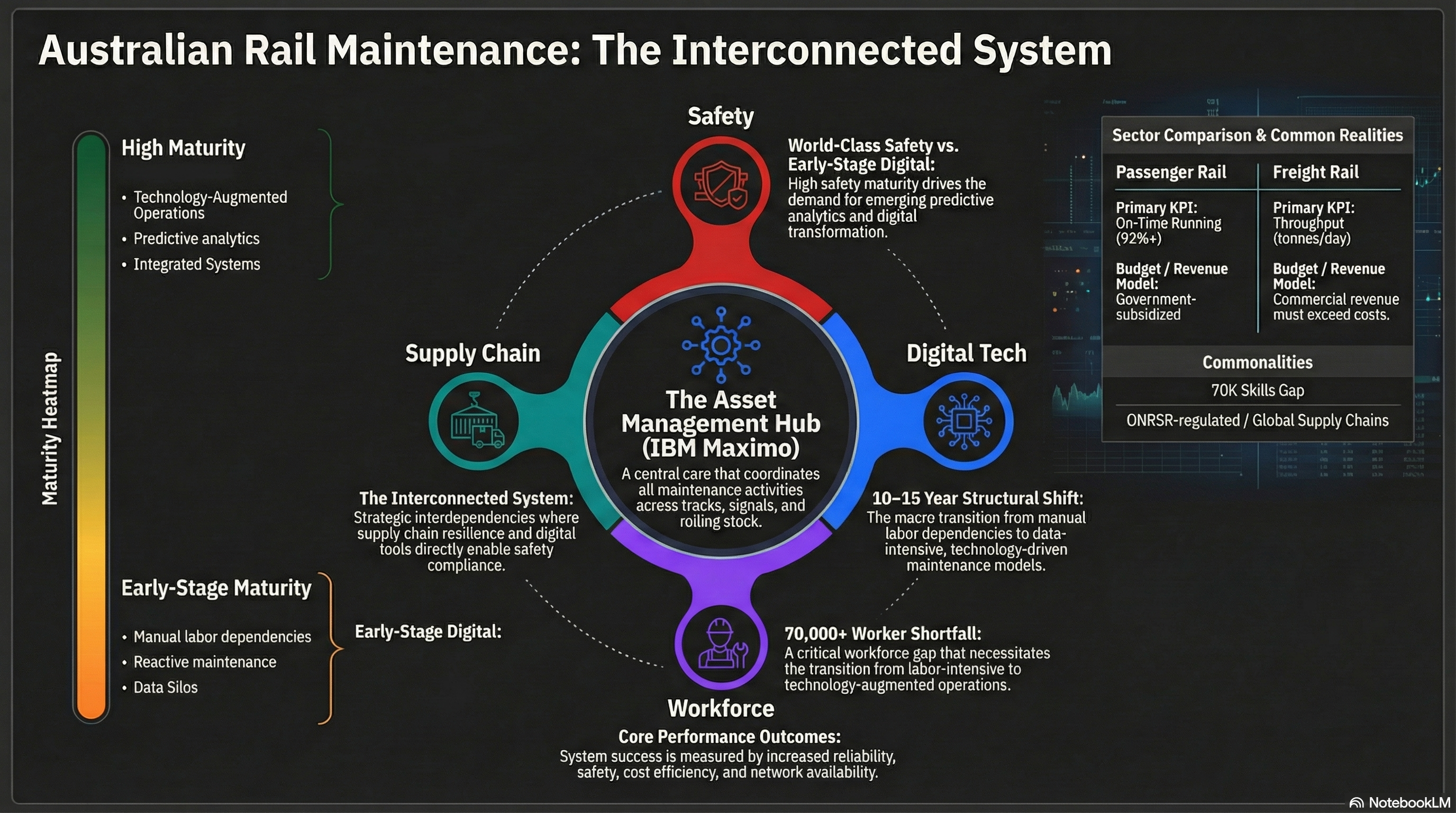
Safety regulation (Day 9) creates the demand for technology (Day 10–11). ONRSR requires risk-based maintenance, which drives adoption of predictive analytics. Maximo doesn’t just manage work orders — it provides the auditable evidence trail that regulators require.
The connection is circular: better technology improves safety → improved safety raises regulatory expectations → higher expectations demand better technology. This isn’t a problem. It’s a virtuous cycle — but only for organisations that recognise it and invest accordingly.
Why does the 70,000+ worker shortfall make digital tool adoption urgent rather than optional?
The skills gap (Day 12) makes technology adoption urgent, not optional. With 70,000+ unfilled positions projected across infrastructure trades (Jobs and Skills Australia, 2025), operators cannot simply hire their way to better maintenance.
Maximo, digital twins, and AI-powered scheduling (Day 10–11) multiply the productivity of existing workers. Simultaneously, these tools require new skills — creating a transition challenge that must be managed, not ignored. The organisations that invest in technology and training will outperform those that choose only one.
How does a missing signalling component create cascading safety risks beyond delayed trains?
Supply chain failures (Day 13) directly impact safety. A missing signalling component doesn’t just delay a train — it creates a safety risk if the maintainer improvises a workaround.
ONRSR’s safety management framework requires organisations to manage supply chain risk as part of their SMS. Conversely, safety requirements (approved products, RISSB-certified suppliers) constrain procurement flexibility, adding cost and lead time. Safety and supply chain are codependent, not independent.
Why do passenger and freight rail demand fundamentally different maintenance strategies?
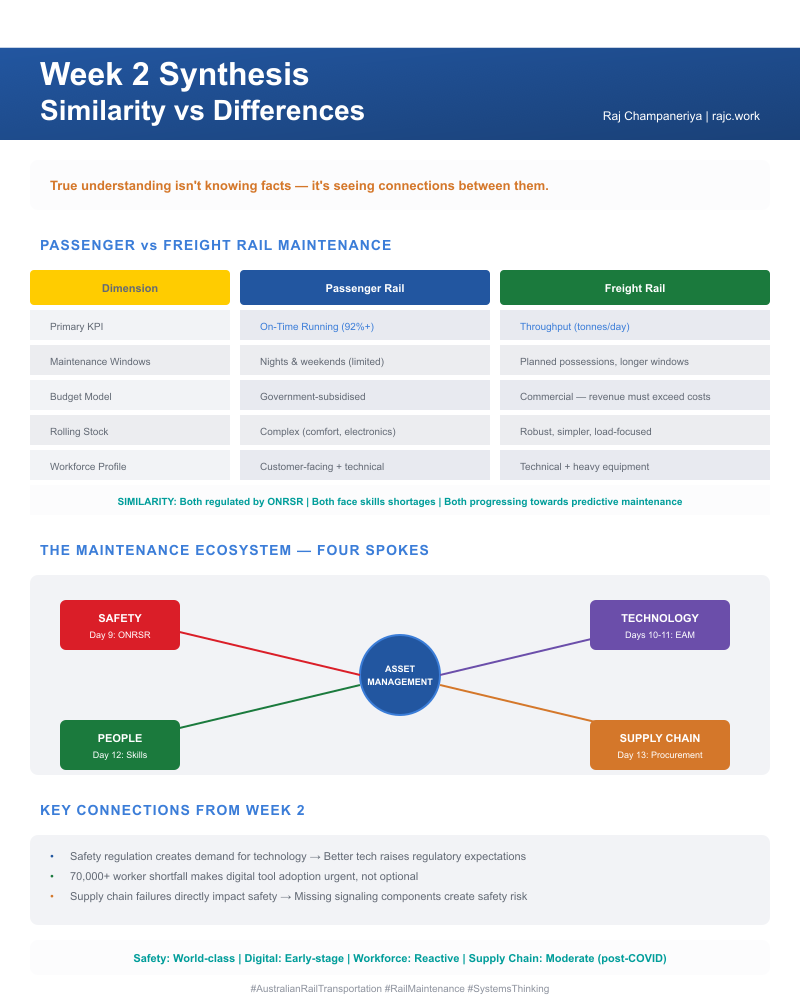
| Dimension | Passenger Rail (Day 7) | Freight Rail (Day 8) |
|---|---|---|
| Primary KPI | On-Time Running (92%+ target) | Throughput (tonnes per corridor per day) |
| Safety focus | Passenger safety, station platforms, doors | Track integrity under heavy loads, derailment risk |
| Maintenance windows | Nights and weekends (limited by timetable) | Planned possessions, sometimes longer windows |
| Technology adoption | High — smart stations, Wi-Fi, CCTV | Moderate — heavy haul efficiency, automation |
| Rolling stock complexity | High — passenger comfort, accessibility | Moderate — robust, built for load capacity |
| Budget model | Government-subsidized operating budgets | Commercial — revenue must exceed costs |
| Workforce profile | Customer-facing + technical | Technical + heavy equipment operations |
| Supply chain criticality | High — failure = service cancellation | High — failure = freight delays, revenue loss |
Both care about safety equally. Both face skills shortages. Both depend on global component suppliers. But the operational priorities and KPIs they optimise differ fundamentally — meaning a “one-size-fits-all” maintenance strategy serves neither well.
Why do annual budget cycles contradict the decades-long benefits of strategic investment?
Budget cycles (Day 3) are the master constraint:
- Safety improvements require investment
- Digital transformation needs capital
- Workforce development costs money
- Supply chain resilience (strategic stockpiling) ties up capital
All compete for limited budgets on annual cycles, while the benefits they deliver accrue over decades. The organisations that succeed plan across budget cycles, not within them — building multi-year investment cases that show how today’s spending prevents tomorrow’s failures.
How does IBM’s breadth mirror the interconnected nature of rail’s challenges?
IBM sits at the intersection of technology, data, and advisory — touching every theme from this week:
| IBM Solution | Rail Challenge Addressed |
|---|---|
| Maximo | Asset management and safety compliance |
| watsonx | Predictive models for maintenance and demand |
| Sterling | Supply chain optimisation |
| QRadar | Cybersecurity for IT and OT environments |
| Consulting | Workforce transformation and change management |
The breadth matters because rail’s challenges are interconnected. A technology partner who only addresses one dimension creates integration problems. A partner who addresses multiple dimensions creates integration solutions.
Why does uneven maturity create the largest opportunity for improvement?
Maturity varies significantly across dimensions:
| Dimension | Maturity Level |
|---|---|
| Safety regulation | World-class (high) |
| Digital transformation | Early-stage (growing) |
| Workforce development | Reactive (catching up) |
| Supply chain resilience | Moderate (post-COVID improvements) |
The unevenness is both the problem and the opportunity. The discipline already demonstrated in safety — rigorous, evidence-based, continuously improving — can be applied to the lower-maturity dimensions. Safety culture is a template, not just a compliance requirement.
Why does the four-spoke wheel model fail if any single spoke is removed?
Think of a wheel with four spokes: Safety, Technology, People, and Supply Chain — all connected to a central hub of Asset Management.
Remove any spoke and the wheel doesn’t roll:
- Without safety → technology investment is misguided
- Without technology → people work harder but not smarter
- Without people → technology sits unused
- Without supply chain → everyone waits for parts
The budget is the road surface — smooth (adequate funding) or rough (constrained budgets) determines how efficiently the wheel moves. But the wheel’s structure is what determines whether movement is possible at all.
Synthesis
Week 2 revealed that Australian rail maintenance is not a collection of isolated disciplines but an interconnected system where safety, technology, workforce, and supply chain are codependent. The key synthesis insight: maturity gaps between these dimensions create friction. World-class safety regulation paired with early-stage digital transformation means operators must meet high standards with unsophisticated tools.
The organisation that closes these maturity gaps — not individually, but as a system — will set the benchmark for the next decade of Australian rail.
Vocabulary Spotlight
| Term | Definition |
|---|---|
| Systems thinking | An analytical approach examining how components within a complex system interact, rather than analysing each in isolation |
| Maturity model | A framework assessing an organisation’s capability level across defined dimensions (beginner to optimised), used to benchmark rail operators |
| Cross-functional integration | Coordination of operations, maintenance, safety, and technology teams to deliver outcomes no single function can achieve alone |
Micro Signal
Lynch Lens: The key insight from Week 2 is "maturity gap." Australian rail has world-class safety regulation but early-stage digital transformation — and that gap is where value leaks. The micro-opportunity: organisations that apply the same evidence-based rigour proven in safety culture to digital adoption and workforce development will close the gap faster. The Australasian Railway Association estimates that operators with integrated maturity improvement plans see 20–30% better asset performance over five years.
Macro Signal
Druckenmiller Lens: The macro pattern across Week 2: every theme points to a single structural shift — Australian rail is transitioning from a labour-intensive, experience-driven industry to a data-intensive, technology-augmented one. This transition will take 10–15 years and create enormous demand for professionals who can operate across the old and new paradigms simultaneously.
In the News
Infrastructure Australia releases its 2026 Infrastructure Priority List, elevating Inland Rail to “High Priority — In Delivery” and adding three new rail projects: Brisbane–Gold Coast faster rail, Perth METRONET Stage 2, and Melbourne Airport Rail Link.
Sources
| Type | Source |
|---|---|
| IBM | IBM Institute for Business Value — “Connected Rail: Technology Convergence in Transportation” (2024) |
| IBM | IBM Consulting — “Enterprise Asset Management Maturity Model” |
| Industry | Australasian Railway Association — Annual Report 2024 |
| Government | ONRSR — “Rail Safety Report 2023–24” |
| Government | Infrastructure Australia — “Infrastructure Priority List 2024” |
| Government | BITRE — Bureau of Infrastructure and Transport Research Economics, statistical reports on rail freight and passenger volumes |
| Government | Jobs and Skills Australia — “Skills Priority List 2025” (source for 70,000+ infrastructure trade shortfall) |
| Government | Transport for NSW — Train performance and on-time running data |
| Standards | RISSB — Rail Industry Safety and Standards Board, Australian rail standards and product certification |
| Infrastructure | Infrastructure Australia — “2024 Australian Infrastructure Plan” (10–15 year transition outlook) |
Next: The Data Goldmine Under the Tracks · Everyone knows rail generates data. But what if most operators are sitting on petabytes of insight they’ve never once analysed?