
Day 13 of Australian Rail Series
Everyone knows rail is about trains and tracks. But what if the most critical part of the whole operation is the supply chain you never see — and it’s more fragile than anyone wants to admit?
The Story
Everyone knows rail is about trains running on tracks. It’s obvious. You can see the trains. You can see the tracks. You can see the stations.
But what if the most critical part of the entire operation is invisible?
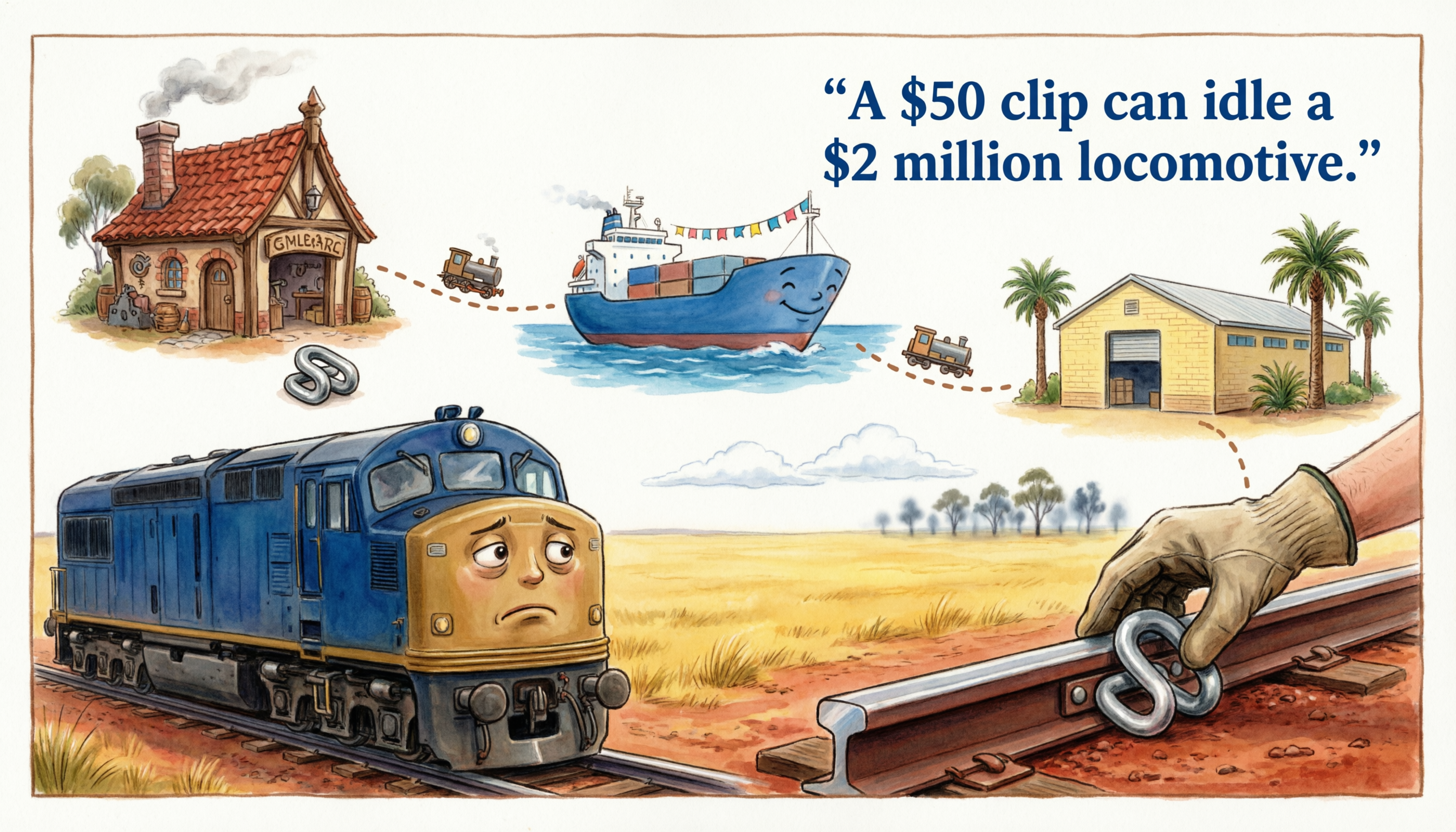
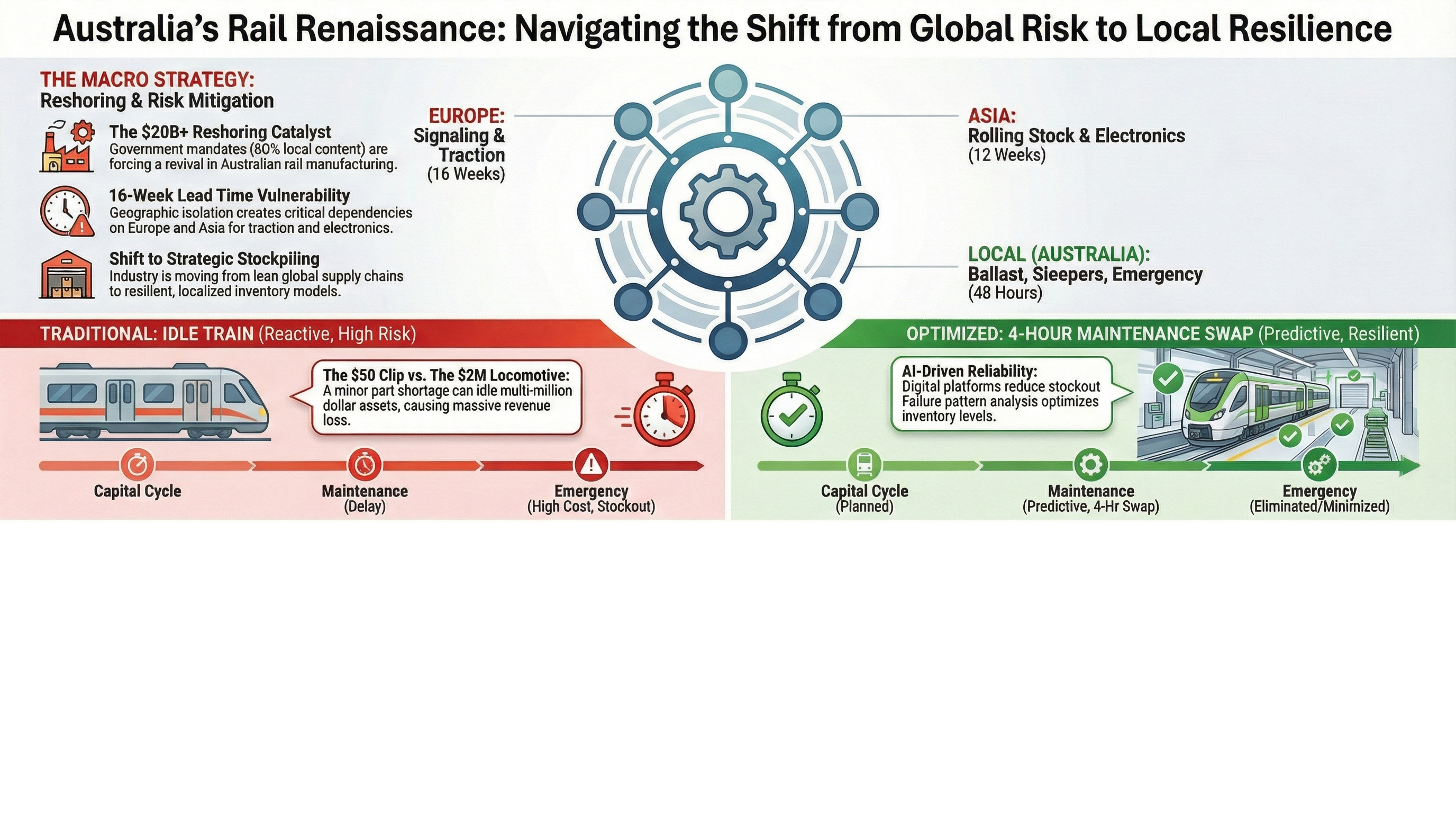
Behind every on-time departure is a supply chain stretching from European signal manufacturers to Asian rolling stock factories to Australian quarries — hundreds of suppliers across multiple tiers, multiple currencies, and multiple time zones. When a critical signalling relay fails in regional New South Wales, the replacement part is manufactured in Germany, shipped through Singapore, cleared through Australian customs, and trucked to a depot 600 kilometres from the nearest major city. The total elapsed time: 16 weeks — a lead time gap the Australasian Railway Association identifies as a systemic industry risk. The maintenance planner needs it in 48 hours.
This is the supply chain you never see. And when it breaks — as COVID proved with devastating clarity (McKinsey, 2020) — the visible network stops.
Day 13 in pictures
A few visuals for post.
The Deep Dive — 8 Questions
Why does Australia’s dependence on European and Asian imports create structural vulnerability?
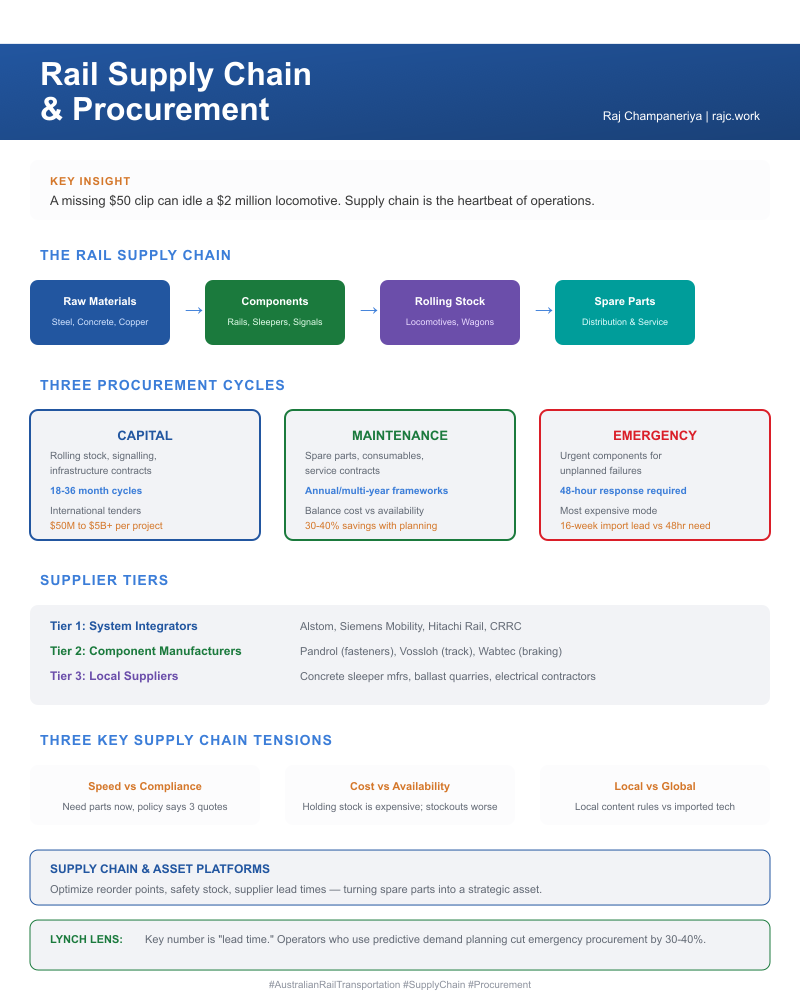
The rail supply chain spans five tiers:
| Tier | Examples |
|---|---|
| Raw materials | Steel, concrete, copper, ballast |
| Component manufacturing | Rails, sleepers, fasteners, signalling equipment |
| Rolling stock assembly | Locomotives, passenger cars, freight wagons |
| Spare parts distribution | Warehousing, inventory management, logistics |
| End-of-life recycling | Steel reclamation, sleeper disposal, asbestos management |
Australia imports most signalling and rolling stock technology from Europe and Asia, while locally sourcing heavy materials like ballast and sleepers. This creates a structural vulnerability: technology-intensive components have long lead times and single-source dependencies. A factory fire in a European signalling plant can ripple through Australian maintenance schedules months later — a pattern documented in BITRE’s Australian Infrastructure and Transport Statistics Yearbook 2023.
How do three distinct procurement cycles create competing demands?
Rail procurement follows three cycles with different rhythms:
- Capital procurement — major rolling stock, signalling systems, and infrastructure contracts. 18–36 month cycles, often requiring international tenders, government approval, and probity review under the Commonwealth Procurement Rules
- Maintenance procurement — spare parts, consumables, and service contracts. Annual or multi-year framework agreements with pre-qualified suppliers
- Emergency procurement — urgent components for unplanned failures. 48-hour response requirements that bypass normal approval processes
Each cycle has distinct compliance requirements, approval authorities, and supplier engagement models. The tension: capital procurement is slow and rigorous because it must be. Emergency procurement is fast and exception-based because it has to be. And maintenance procurement sits uncomfortably between the two — a challenge the APICS Supply Chain Council frameworks address through demand-driven MRP.
Why are alliance contracting models replacing traditional design-build in Australian rail mega-projects?
Major rail contracts use several models:
| Model | Risk Sharing | Used For |
|---|---|---|
| Design-Build (DB) | Contractor assumes design and construction risk | Standard projects |
| Design-Build-Maintain (DBM) | Extends contractor responsibility through operations | PPP-style projects |
| Public-Private Partnership (PPP) | Shared long-term risk and reward | Major infrastructure |
| Alliance contracting | Client, contractor, and designer share risk and reward jointly | Complex, uncertain scope |
Alliance models are increasingly popular in Australian rail — Sydney Metro and Cross River Rail use alliance contracting for major packages. The rationale: for projects with uncertain scope and high complexity, shared risk produces better outcomes than fixed-price contracts that incentivise claims and variations. Contract values range from $50M to $5B+ for mega-projects, as catalogued in Infrastructure Australia’s Market Capacity Report 2023.
How do local content requirements reshape competitive dynamics?
Key suppliers span multiple tiers:
- Tier 1 system integrators — Alstom, Siemens Mobility, Hitachi Rail, CRRC (rolling stock and signalling)
- Tier 2 component manufacturers — Pandrol (fasteners), Vossloh (track components), Wabtec (braking systems)
- Tier 3 local suppliers — concrete sleeper manufacturers, ballast quarries, electrical contractors
Local content requirements in government contracts mandate that a minimum percentage of materials, labour, or manufacturing is sourced from Australian suppliers. This reshapes competitive dynamics: global integrators must partner with local manufacturers, creating joint ventures and technology transfer. The Victorian Government’s 60% local content requirement for Suburban Rail Loop rolling stock is driving manufacturing investment across the sector.
What lessons from COVID permanently changed Australia’s approach to supply chain resilience?
COVID exposed critical vulnerabilities:
- Container shipping disruptions delayed European component deliveries by months — UNCTAD’s 2021 Review of Maritime Transport documented port congestion and freight rate spikes of 300–500%
- Factory shutdowns in Asia halted rolling stock assembly
- Border restrictions prevented international engineers from commissioning new systems
- Just-in-time inventory strategies left operators without critical spare parts
The permanent changes: strategic stockpiling of critical spares, dual-sourcing policies for essential components, increased local manufacturing investment, and stronger supplier relationship management. The lesson was expensive but decisive: resilience costs money, but fragility costs more.
How does Maximo transform spare parts from a cost centre into a strategic asset?
Maintenance spare parts management balances availability against cost:
- Critical spares (signalling components, traction motors) are stocked locally despite high holding costs — because a stockout means network failure
- Non-critical items use just-in-time delivery to minimise inventory costs
- Rotable items (components that are repaired and re-used) require tracking through repair cycles
IBM Maximo’s inventory management module optimises reorder points, safety stock levels, and supplier lead times. It transforms spare parts from a cost centre — “we spend $X million on warehouse” — into a managed strategic asset aligned with ISO 55000 asset management principles — “our inventory investment prevents $Y million in unplanned downtime.”
Why does rail’s emissions advantage make green procurement a natural competitive differentiator?
Sustainability is increasingly a procurement criterion:
- Recycled steel for rails
- Concrete sleepers using supplementary cementitious materials
- Energy-efficient rolling stock specifications
- Lifecycle cost assessments that factor in environmental impact
The Australian Government’s Climate Active procurement policy encourages low-carbon supply chains. Rail’s inherent environmental advantage — lower emissions per tonne-km than road, as quantified by the IEA’s Future of Rail report — makes green procurement a natural fit. Operators who build sustainability into procurement criteria aren’t just meeting compliance requirements; they’re strengthening their competitive position for government tenders where ESG scores now carry weight.
How do AI-driven demand planning and blockchain traceability eliminate guesswork from safety-critical procurement?
Digital procurement platforms enable:
- E-tendering for transparency and audit trails
- Supplier performance dashboards correlating delivery times, quality, and cost across the supply base — a practice advocated by CIPS procurement standards
- Real-time inventory visibility across multiple depots
- Predictive demand planning using AI to forecast consumption patterns
- Blockchain-based traceability for critical safety components — ensuring every brake pad, signalling relay, and rail segment can be traced to its manufacturer, batch, and material traceability
IBM Sterling Supply Chain Intelligence Suite helps operators optimise procurement timing, quantities, and supplier selection using data-driven insights rather than historical purchasing habits.
Synthesis
Rail supply chain management operates at the intersection of global manufacturing and local operational reality. Three key tensions define rail procurement:
- Speed vs compliance — maintenance needs parts yesterday, but procurement policy requires three quotes
- Cost vs availability — holding spare parts is expensive, but stockouts are catastrophically expensive (the total cost of ownership equation)
- Local vs global sourcing — local content requirements support manufacturing investment, but some technologies are only available internationally
The operators who manage these tensions best will be those who invest in visibility — knowing what they have, where it is, and when they’ll need more. That’s a data problem. And data problems have solutions.
Vocabulary Spotlight
| Term | Definition |
|---|---|
| Alliance contracting | A procurement model where client, contractor, and designer share risk and reward jointly, commonly used in complex Australian rail mega-projects per the National Alliance Contracting Guidelines |
| Local content requirements | Government contract clauses mandating a minimum percentage of materials, labour, or manufacturing be sourced domestically |
| Rotable item | A component that is removed from service, repaired or overhauled, and returned to inventory for reuse — common for high-value rail parts like traction motors |
Micro Signal
Lynch Lens: The key number in rail supply chains is "lead time." When a critical signalling relay fails, the maintainer needs a replacement within 48 hours — but the manufacturer in Germany quotes 16 weeks. The micro-opportunity is in predictive demand planning: analysing failure patterns and consumption data to order parts before they’re needed. Operators who get this right cut emergency procurement costs by 30–40% (Deloitte, 2023).
In the News
The Victorian Government mandates 60% local content for the $34.5B Suburban Rail Loop rolling stock procurement in late 2025, triggering a manufacturing investment wave as Alstom, Downer, and UGL expand Australian rail vehicle production capacity.
Sources
| Type | Source |
|---|---|
| IBM | IBM Sterling Supply Chain Intelligence Suite — “Intelligent Supply Chain Management” |
| IBM | IBM Institute for Business Value — “Building Resilient Supply Chains in Transportation” (2024) |
| Industry | Australasian Railway Association — “Rail Supplier Development Strategy” |
| Government | Infrastructure Australia — “Australian Infrastructure Plan: Supply Chain Capacity” (2024) |
| Research | Deloitte — “Rail Industry Procurement Trends: Global Insights for Local Operators” (2023) |
Next: The Midpoint Reckoning — Week 2 Synthesis · Halfway through. Time to step back and ask: do these threads connect — or are they just topics?