
Day 12 of Australian Rail Series
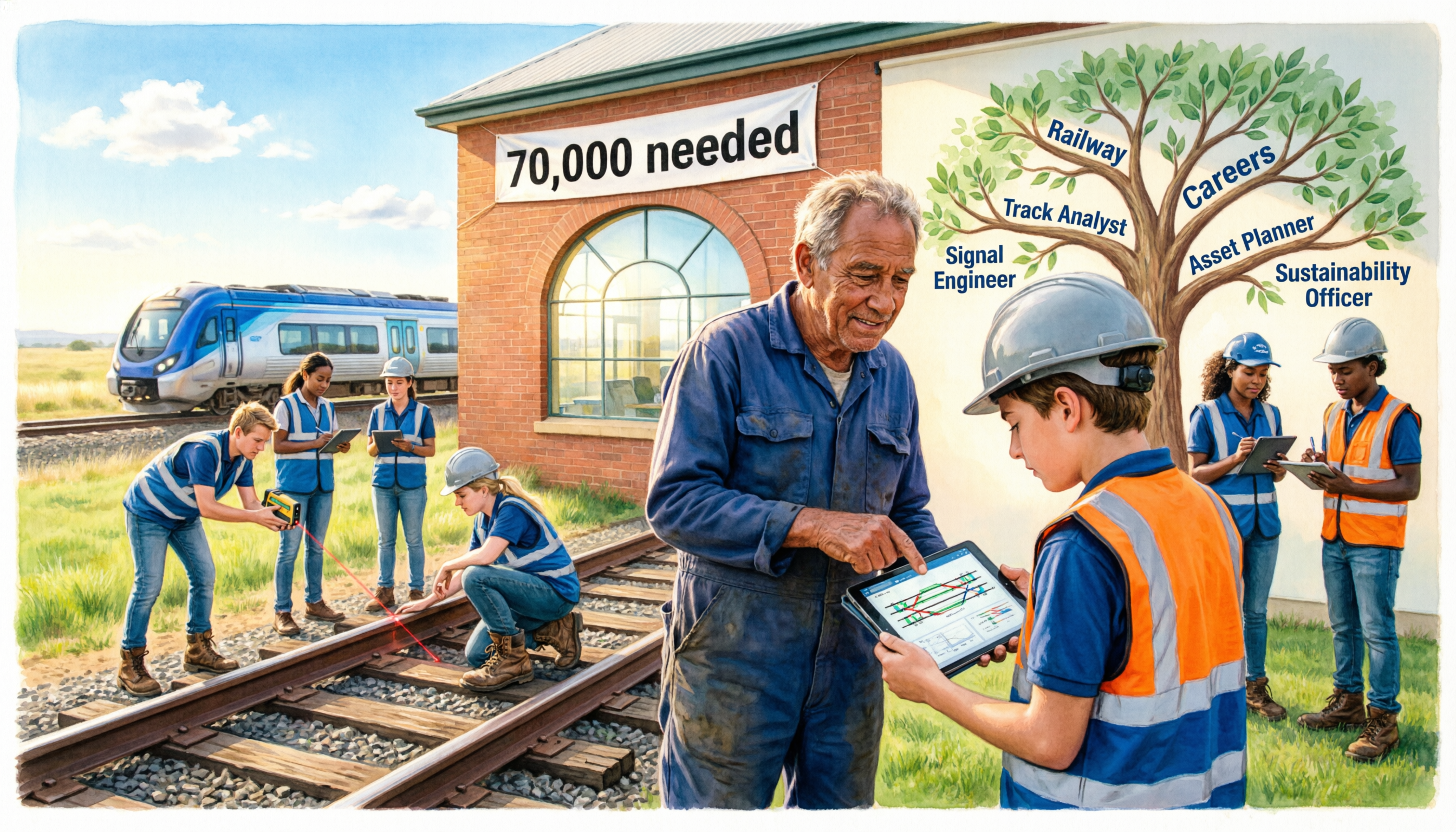
Remember when rail was the career your grandfather’s generation built a life around? Somewhere between then and now, rail lost its workforce narrative. And now it needs 70,000 people who never heard the call.
The Story
There’s a photograph in an Australian Railway Historical Society archive — a group of track workers in the 1960s, leaning on their shovels, squinting into the sun. They look tired and proud. Their sons would follow them onto the track. Their grandsons would not.
Somewhere between that photograph and today, the rail industry stopped being a career destination. Mining paid more. Construction was more visible. Technology was more exciting. Rail became the industry that everyone used but nobody aspired to join.
And now, with $100 billion in transport infrastructure committed over the next decade, Australia needs 70,000+ rail workers who grew up never once hearing an adult say, “You should consider a career in rail.”
The echo from that 1960s photograph is faint but unmistakable: the industry that built the nation’s backbone is struggling to build its own workforce. The tools have changed — from shovels to sensors, from paper to platforms — but the fundamental challenge remains the same: convincing talented people that rail is worth their career.
Day 12 in pictures
A few visuals for post.
The Deep Dive — 8 Questions
Why does a projected shortfall of 70,000+ workers represent Australian rail’s top non-safety risk?
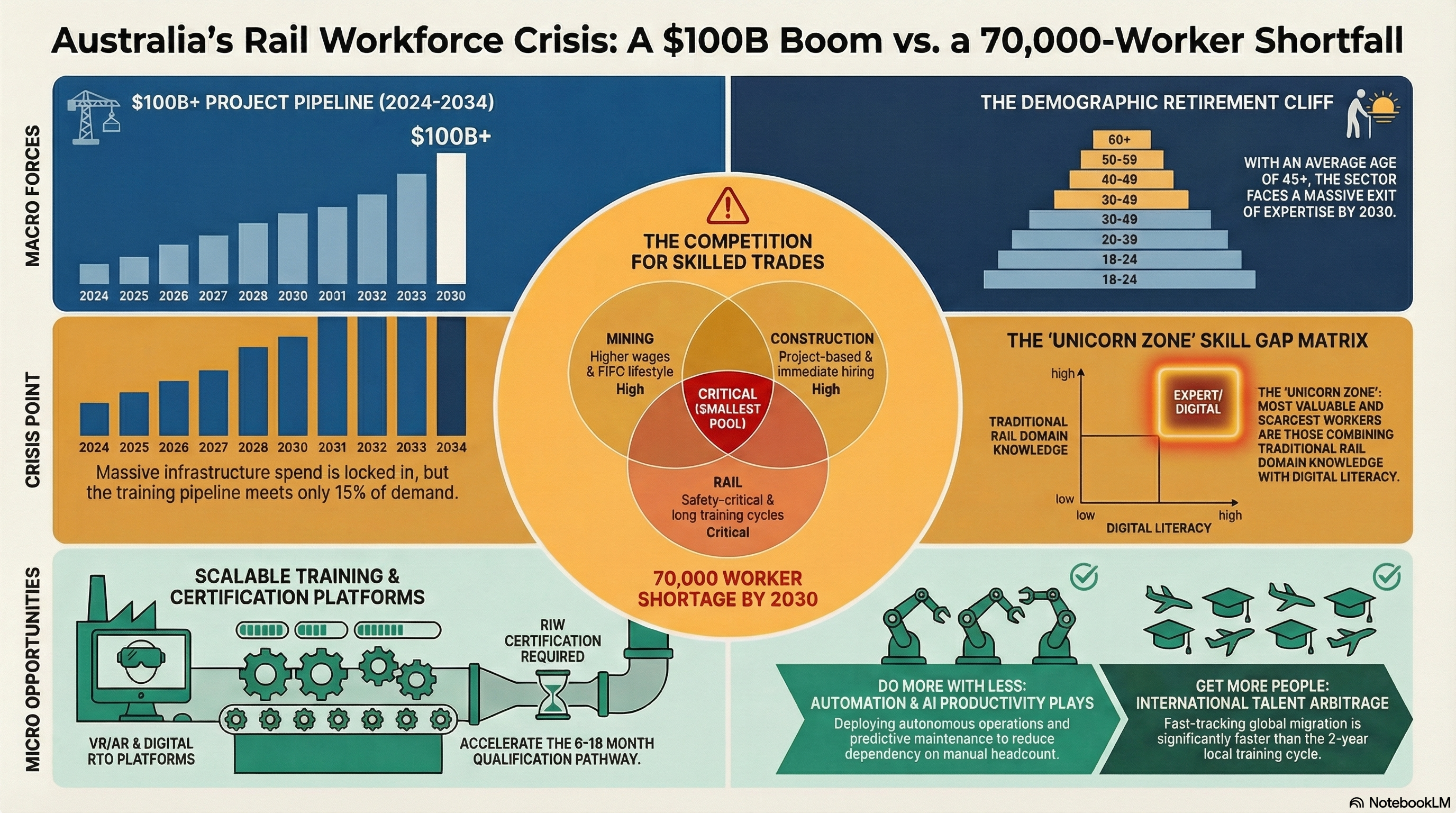
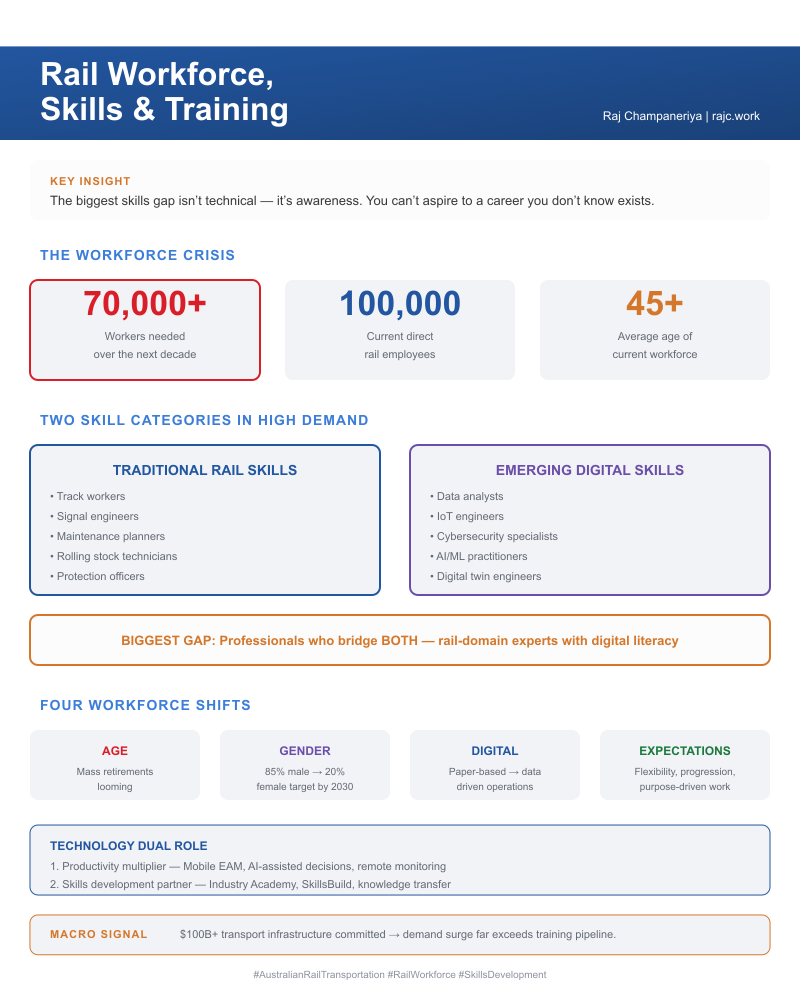
The rail industry employs approximately 100,000 people directly across operations, maintenance, engineering, and administration. The projected shortfall of 70,000+ workers over the next decade is driven by three converging forces:
- Mass retirements — average workforce age is 45+, with a generation of experienced rail professionals approaching exit
- Infrastructure expansion — Inland Rail, Sydney Metro, Cross River Rail, Melbourne Metro Tunnel, and Perth METRONET are all demanding workers simultaneously
- Competition — mining and construction compete aggressively for the same skilled trades
The ARA’s Workforce Development Strategy identifies this as the industry’s top non-safety risk. You can build the infrastructure. You can buy the technology. But without the people to operate and maintain it, the investment fails.
Why is the professional who bridges rail domain expertise and digital literacy the most scarce and valuable?
High-demand skills span two categories:
| Traditional Rail Skills | Emerging Digital Skills |
|---|---|
| Track workers | Data analysts |
| Signal engineers | IoT engineers |
| Maintenance planners | Cybersecurity specialists |
| Rolling stock technicians | AI/ML practitioners |
| Protection officers | Digital twin engineers |
The biggest gap is professionals who bridge both — rail-domain experts with digital literacy, or technologists with rail operational knowledge. The World Economic Forum’s Future of Jobs Report identifies this hybrid skills gap as a top workforce challenge across infrastructure industries. A data scientist who doesn’t understand rail operations builds models that look impressive on a laptop and fail on the track. A track engineer who can’t interpret data outputs misses the insights that would improve their decisions.
How well does the TAFE-to-RIW certification pathway prepare workers for a digitally-driven rail environment?
Training pathways include:
- TAFE-delivered apprenticeships and certificates (Certificate III/IV in Rail Infrastructure)
- University engineering degrees with rail specialisations
- Registered Training Organisation (RTO) programs
- Employer-delivered competency training
Rail Industry Worker (RIW) certification is mandatory for track access. The ARA coordinates national skills standards through the Rail Industry Reference Committee.
The gap: these pathways are excellent at producing traditionally competent rail workers. They are not yet producing digitally fluent ones. A track worker who graduates in 2026 will spend their career working alongside AI-powered inspection systems, digital twins, and predictive maintenance platforms. Are we training them for that world?
Which workforce shift — ageing demographics, gender diversity, or digital literacy — will most reshape rail?
The workforce is shifting along four simultaneous axes:
- Age — average age 45+, mass retirements looming across all skill categories
- Gender — historically male-dominated (85%), active programs like ARA’s Women in Rail aim for 20% female representation by 2030
- Digital literacy — moving from manual/paper-based operations to data-driven decisions
- Career expectations — younger workers expect flexible work, career progression, and purpose-driven employment
Each shift reinforces the others. An ageing workforce means lost institutional knowledge. Gender diversity means rethinking workplace culture. Digital literacy means retraining at scale. Changed career expectations mean rail must compete as an employer brand, not just a job provider.
Why do international rail professionals bring perspectives that domestic training cannot replicate?
Skilled migration is critical for niche roles — signal engineers, rail design specialists, and technology professionals often come from the UK, India, and Europe where rail industries are larger and more diverse.
International workers bring valuable perspectives from different rail systems:
- A signal engineer from the UK understands ETCS implementation from first-hand deployment
- An Indian Railways veteran knows how to operate at continental scale
- A German rail professional brings predictive maintenance experience from Deutsche Bahn
The friction: work visa processing times, qualification equivalency assessment, and cultural adaptation. Solving these bottlenecks isn’t just an HR problem — it’s a strategic capability gap.
Why will automation transform rail jobs rather than eliminate them?
Autonomous train operation is already proven in the Pilbara — Rio Tinto’s AutoHaul is the world’s first fully autonomous heavy-haul rail network. Predictive maintenance reduces manual inspection tasks. AI-powered scheduling replaces routine planning.
But the net effect is transformation, not elimination:
| Manual Role | Transformed Role |
|---|---|
| Train driver | Remote operations controller |
| Track walker | Sensor data analyst |
| Maintenance planner | AI-augmented decision-maker |
| Paper-based inspector | Mobile device-equipped assessor |
Every automated task creates a higher-skilled monitoring, analysis, or exception-handling role. The workforce doesn’t shrink — it upskills. The organisations that manage this transition deliberately will retain their best people. Those that don’t will lose them to industries that invest in career development.
Why does the skills gap continue to widen despite multiple government and industry programs?
Current initiatives include:
- ARA’s Women in Rail program
- National Rail Skills Hub
- State-funded training subsidies (fee-free TAFE for rail trades in some states)
- Cadetship and graduate programs at operators like ARTC and Aurizon
- National Rail Action Plan workforce pillar
Despite these efforts, the gap widens because demand is growing faster than supply. Every new rail project creates hundreds of positions. Every retiree takes decades of institutional knowledge. Every competing industry (mining, construction, defence) runs its own talent attraction campaigns.
The solution isn’t any single program — it’s a systemic approach that treats rail workforce development as critical national infrastructure, not a corporate HR initiative. Infrastructure Australia’s Market Capacity Report corroborates this, warning that workforce supply is the binding constraint on the national infrastructure pipeline.
How can IBM serve as both productivity multiplier and skills development partner?
Technology partners have a dual role:
- Productivity multiplication — Maximo Mobile, AI-assisted decision-making, and remote monitoring enable fewer workers to manage more assets effectively
- Skills development — IBM Training and SkillsBuild platform could serve as rail digital skills resources, creating certification pathways that bridge technology and domain expertise
The most powerful impact: technology that makes existing workers more productive and helps them develop new skills simultaneously. A maintenance planner who uses Maximo daily doesn’t just work more efficiently — they develop data literacy through daily practice.
Synthesis
Australia’s rail workforce challenge is structural, not cyclical. An ageing workforce, unprecedented infrastructure investment, and digital transformation are converging to create a skills crisis that outpaces current training capacity. The industry needs both more workers and differently-skilled workers.
For rail maintainers, two things are true: experienced professionals who can bridge traditional rail knowledge with digital tools are exceptionally valuable, and the industry must actively attract talent from adjacent sectors through clear career pathways and compelling narratives about rail’s societal importance.
Vocabulary Spotlight
| Term | Definition |
|---|---|
| Registered Training Organisation (RTO) | An institution accredited by the Australian government to deliver nationally recognised vocational qualifications |
| Skills gap | The difference between the competencies an industry requires and those the available workforce possesses |
| Rail Industry Worker (RIW) card | A national competency card confirming completion of mandatory safety inductions and medical assessments for rail site access |
Macro Signal
Druckenmiller Lens: The macro force shaping rail workforce economics is infrastructure spending. Australia has committed over $100 billion in transport infrastructure across federal and state budgets for the next decade. This creates a demand surge for rail-skilled workers that far exceeds training pipeline capacity. The macro bet: companies that solve the skills gap — through automation, training, or international recruitment — will capture disproportionate value from the infrastructure boom.
In the News
The ARA’s 2026 Workforce Development Report warns Australia’s rail industry faces a 70,000-worker shortfall by 2030, prompting a $200M federal Skills and Training Package targeting women, Indigenous Australians, and career changers for rail-specific vocational pathways.
Sources
| Type | Source |
|---|---|
| IBM | IBM SkillsBuild — “Building Digital Skills for Industry” |
| IBM | IBM Institute for Business Value — “The Enterprise Guide to Closing the Skills Gap” (2024) |
| Industry | Australasian Railway Association — “National Rail Workforce Development Strategy 2024–2034” |
| Government | Infrastructure Australia — “Infrastructure Market Capacity Report” (2024) |
| Government | Jobs and Skills Australia — “Skills Priority List: Transport & Logistics” (2024) |
Next: The Supply Chain You Never See · Everyone knows rail is about trains and tracks. But what if the hidden supply chain — the one you never see — determines whether the visible network runs at all?