
Day 11 of Australian Rail Series
Everyone knows digital twins are a buzzword. But what if they’re not a buzzword at all — what if they’re the most quietly practical technology in rail today?
The Story
Everyone knows digital twins are a buzzword. Consultants love them. Conference slides feature them. Vendor brochures promise them. And most people assume they’re another technology concept that sounds brilliant in a boardroom and fails in a rail yard.
But what if the opposite is true?
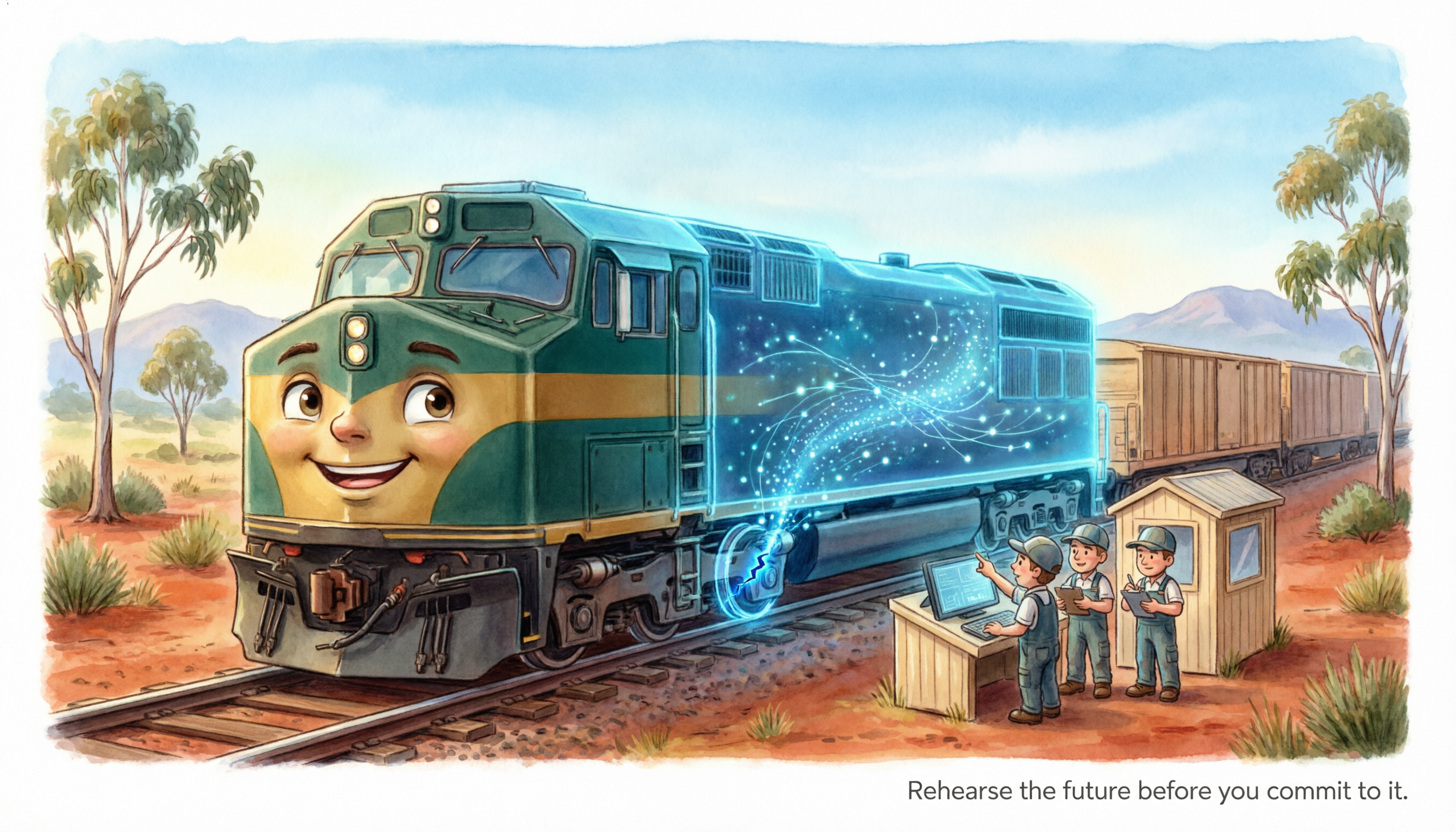
What if digital twins — virtual replicas of physical infrastructure, continuously updated with real-time sensor data — are actually the least controversial, most practical technology investment a rail maintainer can make? Not because they’re flashy, but because they answer a brutally simple question: What is the actual condition of this asset right now, and when will it need attention?
The irony of the digital twin “buzzword” is that the concept is ancient — NASA used physical twin systems during the Apollo programme, and the modern digital twin was formalised by Dr. Michael Grieves at the University of Michigan in 2002 (retrospective account published via MDPI). Rail engineers have always kept mental models of their track — the soft spot near the bridge abutment, the curve that wears faster in summer, the culvert that floods in heavy rain. A digital twin doesn’t replace that knowledge. It scales it. It makes the tribal knowledge of a retiring track inspector available to every planner, manager, and engineer on the network.
The real story isn’t whether digital twins work. It’s whether the organisations deploying them can change their decision-making culture fast enough to use what the twins are telling them.
Day 11 in pictures
A few visuals for post.
The Deep Dive — 8 Questions
How does a digital twin merge sensor data, engineering models, and inspection records to mirror a rail asset’s real condition?
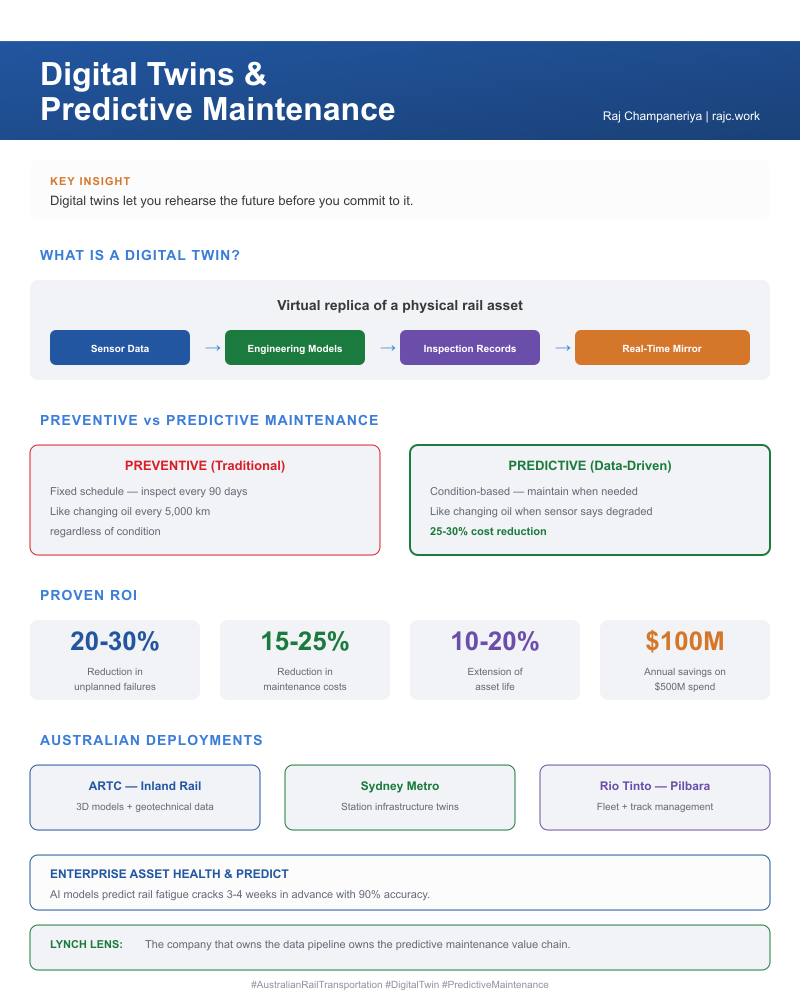
A digital twin is a virtual replica of a physical rail asset — a stretch of track, a bridge, a signalling system, or an entire network corridor. It combines three data streams:
- Real-time sensor data — vibration, temperature, strain, geometry measurements from trackside IoT devices
- Engineering models — structural capacity, load-bearing calculations, degradation curves based on material science
- Inspection records — historical condition assessments, defect logs, repair histories
Changes in the physical asset (wear, damage, increased loading) are reflected in the digital twin, enabling remote monitoring and simulation. A planner sitting in an office in Sydney can assess the condition of a rail segment in regional Queensland — not based on the last inspection six weeks ago, but based on sensor readings from this morning.
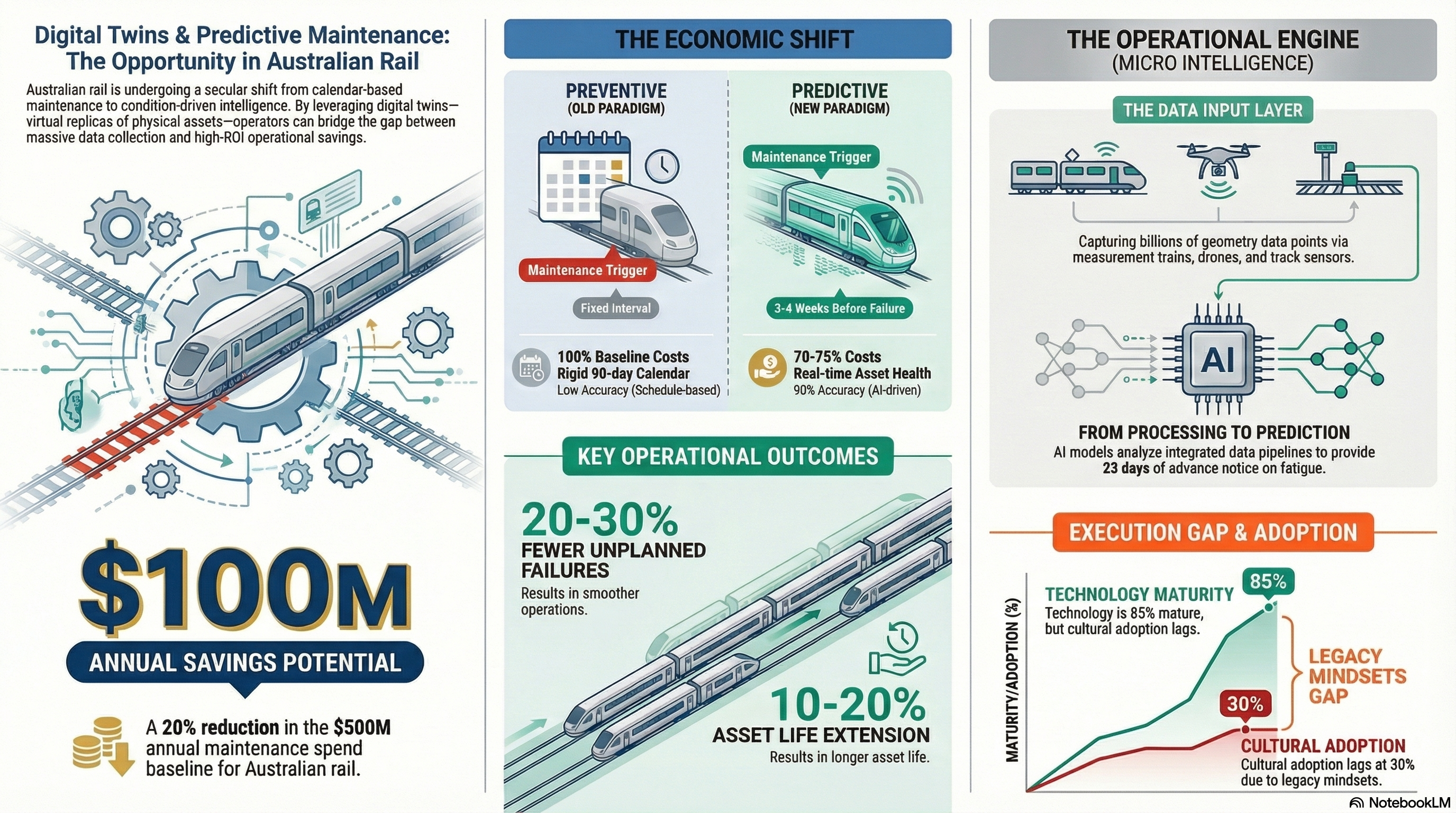
Why can predictive maintenance reduce costs by 25–30% compared to fixed-schedule preventive approaches?
Preventive maintenance follows fixed schedules: inspect every 90 days regardless of condition. It’s the equivalent of changing your car oil every 5,000 kilometres whether the oil is degraded or not.
Predictive maintenance uses data — vibration sensors, rail wear measurements, temperature profiles, loading histories — to determine when an asset actually needs attention. The intervention happens at the optimal moment: not too early (wasting money on unnecessary work) and not too late (risking failure).
The result is a 25–30% cost reduction (IBM Institute for Business Value) because:
- Assets with remaining useful life aren’t replaced prematurely
- Assets degrading faster than expected are caught before catastrophic failure
- Maintenance crews are deployed to the highest-priority work rather than routine inspections that reveal no defects
A McKinsey study on predictive maintenance corroborates this range, finding condition-based strategies reduce maintenance costs by 10–40% depending on asset class.
How do billions of data points from measurement trains, IoT sensors, and drones create actionable intelligence?
Data sources include:
| Source | What It Measures |
|---|---|
| IoT sensors on track | Strain, acceleration, vibration, temperature |
| Measurement trains | Track geometry at speed — gauge, alignment, cross-level |
| Drone inspections | Visual condition of bridges, cuttings, embankments |
| Weather stations | Temperature, rainfall, wind — correlated with track behaviour |
| Train GPS and loading data | Actual traffic volumes and axle loads |
| SCADA systems | Signalling and power system status |
| Manual inspection records | Human observations, defect classifications |
Australian operators like ARTC run measurement trains that collect billions of data points per corridor traversal. The challenge isn’t collection — it’s integration. A single measurement is noise. Billions of measurements, integrated and analysed, become intelligence.
Why can AI models predict rail fatigue cracks 3–4 weeks before human inspectors detect them?
AI models — particularly machine learning algorithms — identify patterns in asset degradation that humans cannot perceive. Research published in the International Journal of Fatigue and by MxV Rail (formerly TTCI) confirms that an AI model can learn that a specific combination of traffic loading + temperature cycles + track age predicts rail fatigue cracks with 90% accuracy, 3–4 weeks in advance.
Human inspectors are excellent at identifying visible defects. They are poor at predicting invisible ones. The AI doesn’t replace the inspector — it directs them to the right location at the right time.
IBM Maximo Health and Predict provides pre-built AI models for common asset types and allows custom model training on operator-specific data — bridging the gap between data science capability and rail domain expertise.
Where do ARTC, Sydney Metro, and Rio Tinto stand in their digital twin deployments?
Three Australian examples at different maturity levels:
- ARTC has invested in digital twin capabilities for the Inland Rail corridor — using 3D models combined with geotechnical and track condition data. Early-stage but architecturally ambitious.
- Sydney Metro uses digital twins for station infrastructure management — integrating building information models (BIM) with operational data for predictive facilities maintenance.
- Rio Tinto’s autonomous rail operation in the Pilbara — AutoHaul, the world’s first fully autonomous heavy-haul rail network — uses digital twin concepts for fleet and track management. It is the most operationally advanced deployment in Australian rail.
All three are early-stage relative to their potential. The technology works. The organisational adaptation is where the real effort lies.
How does a 20% efficiency gain yield $100M annual savings for an operator spending $500M/year on maintenance?
Industry benchmarks from IBM’s Institute for Business Value, McKinsey, and Deloitte’s digital twin and smart factory analysis estimate:
| Metric | Improvement Range |
|---|---|
| Reduction in unplanned failures | 20–30% |
| Reduction in maintenance costs | 15–25% |
| Extension of asset life | 10–20% |
| Improvement in network availability | 5–10% |
For an operator spending $500M per year on maintenance, a 20% efficiency gain yields $100M in annual savings. Over a decade, that’s a billion dollars — from a technology investment that costs a fraction of that amount. The business case isn’t theoretical; it’s arithmetic.
Why is “we’ve always done it this way” harder to overcome than any technology challenge?
The barriers to digital twin adoption in rail are only partly technical:
- Data quality — legacy systems don’t talk to each other; decades of inspection records exist in incompatible formats (a challenge ISO 55000 asset management standards directly address)
- Skills gaps — rail engineers need data literacy, data scientists need rail domain knowledge, and professionals who bridge both are rare (World Economic Forum identifies this as a top workforce gap)
- Upfront investment — sensor deployment, platform licensing, system integration
- Cybersecurity — connecting operational technology (OT) to networks creates new attack surfaces that must be managed with frameworks like NIST CSF
- Cultural resistance — “we’ve always done it this way” is the hardest barrier
Technology problems have technology solutions. Culture problems require leadership, patience, and demonstrated wins that convert sceptics into advocates.
What will distinguish rail operators who achieve the ARA’s “connected, intelligent railway” vision by 2030?
The ARA’s Digital Rail Roadmap envisions a “connected, intelligent railway” by 2030 — a vision that Gartner predicts will make digital twins a standard capability across infrastructure-heavy industries. Digital twins and predictive maintenance are foundational capabilities in that vision.
The operators who reach this goal will be those that:
- Started with data integration — connecting siloed systems before attempting AI
- Invested in people alongside technology — building hybrid teams of rail engineers and data scientists
- Proved value on small pilots before scaling — a single depot, a single asset class, a single corridor
- Treated digital transformation as an operational programme, not an IT project
Synthesis
Digital twins and predictive maintenance represent the next frontier for Australian rail — moving from reactive and calendar-based approaches to proactive, condition-driven strategies. The technology stack is mature: sensors, AI, cloud platforms like IBM Maximo Health and Predict. Early Australian deployments demonstrate viability.
The real challenge is organisational: integrating data from disparate sources, building teams that combine rail engineering with data science, and shifting cultural mindsets toward data-driven decision-making. The operators who move now will spend less, fail less, and know their assets better than those who wait.
Vocabulary Spotlight
| Term | Definition |
|---|---|
| Digital twin | A virtual replica of a physical asset or system continuously updated with real-time data to simulate behaviour and predict outcomes |
| Leading indicator | A metric predicting future performance or failure (e.g., vibration trend), contrasting with lagging indicators that record past events |
| Edge computing | Processing data at or near its source (e.g., on-board sensors) rather than centrally, enabling real-time analysis for moving assets |
Micro Signal
Lynch Lens: The key number for predictive maintenance adoption is “data readiness.” Most Australian rail maintainers have 10–20 years of inspection records in spreadsheets, PDFs, and legacy systems. The micro-opportunity is in data migration and integration — before AI can predict anything, it needs clean, connected data. The company that owns the data pipeline owns the predictive maintenance value chain.
In the News
Sydney Trains launches a digital twin pilot for the T1 Western Line in early 2026, creating a real-time virtual model of 127 km of track, 28 stations, and 900+ signalling assets to predict failures 48 hours before they impact services. (Transport for NSW · Sydney Trains)
Sources
| Type | Source |
|---|---|
| IBM | IBM Maximo Health and Predict — “AI-Powered Asset Management” |
| IBM | IBM Institute for Business Value — “Digital Twins: Unlocking Value in Rail Infrastructure” (2023) |
| Industry | Australasian Railway Association — “Digital Rail Transformation Roadmap” |
| Industry | ARTC — “Inland Rail Digital Engineering Strategy” |
| Research | McKinsey & Company — “Predictive Maintenance: Reducing Costs and Improving Outcomes in Transport” (2024) |
| Research | Deloitte — “Digital Twin Technology in Smart Factory and Predictive Maintenance” |
| Standards | ISO 55000 — “Asset Management — Overview, Principles and Terminology” |
| Framework | NIST Cybersecurity Framework — “Framework for Improving Critical Infrastructure Cybersecurity” |
| Research | Gartner — “What Is a Digital Twin?” |
| Academic | Dr. Michael Grieves — “Digital Twin: Manufacturing Excellence through Virtual Factory Replication” (2002; retrospective via MDPI, 2017) |
Next: The Workforce That Time Forgot · Remember when rail was the career your grandfather’s generation aspired to? What happened — and why is it suddenly the career your generation needs to rediscover?