
Day 10 of Australian Rail Series
Everyone knows enterprise software makes things efficient. But what if the real breakthrough isn’t efficiency at all — it’s giving a maintenance worker the ability to see three weeks into the future?
The Story
Everyone knows enterprise software is about efficiency. Streamlined workflows, paperless processes, digital work orders. It’s obvious. It’s logical. And it’s only half the story.
What if the most valuable thing a maintenance platform can do isn’t make existing work faster — but tell you which work to do before the need is visible?
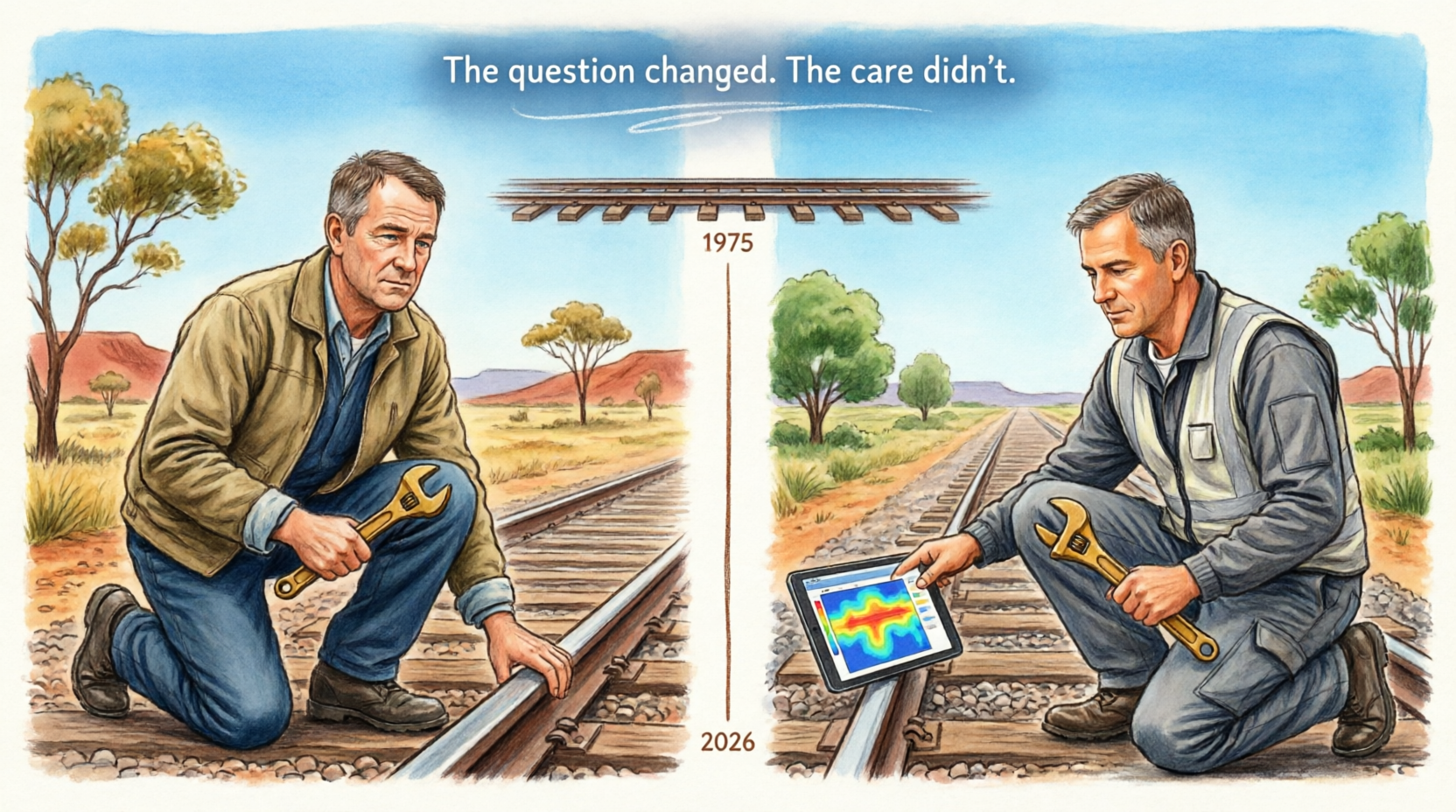
A rail maintainer replacing a sleeper today is doing the same physical job their predecessor did fifty years ago. The timber is heavier or lighter, the tools slightly improved, the safety gear more visible. But the decision of which sleeper to replace — when, where, and why — has been completely transformed by data.
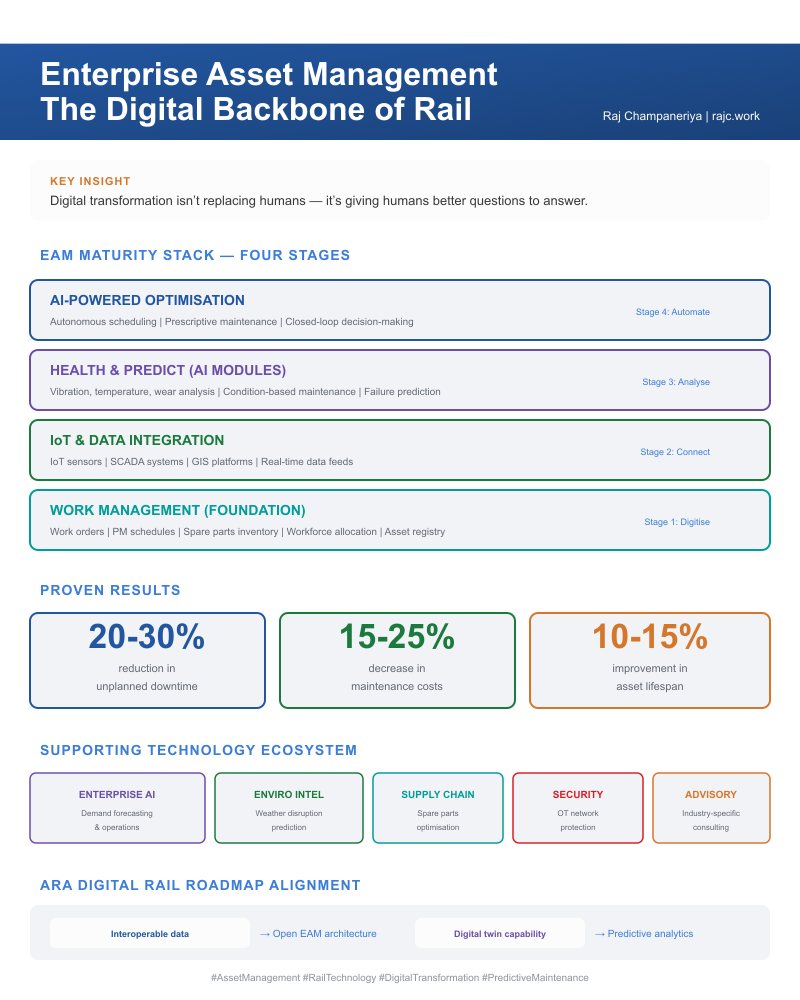
The truth is that digital transformation in rail maintenance isn’t about replacing humans with machines. It’s about giving humans better questions to answer. And the platform that enables those questions is where IBM meets the iron road.
Day 10 in pictures
A few visuals for post.
The Deep Dive — 8 Questions
Why has Maximo become the standard EAM platform for rail operators across 100+ countries?
IBM Maximo is used by rail operators in over 100 countries because it solves a specific, universal problem: managing the lifecycle of physical assets — from procurement through operation, maintenance, and disposal — across geographically distributed networks.
Rail operators need a single system that tracks every asset (track segments, signals, bridges, rolling stock), schedules every maintenance activity (inspections, repairs, replacements), manages every spare part (inventory, procurement, logistics), and provides every performance metric (MTBF, cost-per-km, availability).
Maximo does all of this on a single platform. The alternative — spreadsheets, legacy systems, paper-based processes — creates information silos that make integrated decision-making impossible. Gartner’s Magic Quadrant for EAM has consistently positioned IBM as a Leader in this space.
How does Maximo’s integrated work-order-to-inventory pipeline eliminate paper-based decision-making blind spots?
In a paper-based system, the maintenance planner creates a work order. A separate team checks whether the required spare parts are in stock. A third team arranges logistics to get parts to the worksite. If any step fails — wrong part, out-of-stock, delivery delay — the entire maintenance task is delayed.
Maximo integrates this pipeline: the work order automatically checks inventory management, triggers procurement if stock is below threshold, and schedules delivery to coincide with the possession window. The planner sees one view — “this task is ready to execute” or “this task is blocked by parts availability” — rather than chasing three separate systems.
The elimination of blind spots isn’t a productivity gain. It’s a risk reduction. A blind spot in rail maintenance can mean a missed inspection, a deferred repair, and ultimately a safety incident. The Australian Transport Safety Bureau data shows that deferred maintenance is a contributing factor in a significant proportion of rail safety events.
Why does Maximo Health and Predict’s shift from calendar-based to condition-based maintenance reduce costs by 25-30%?
Calendar-based maintenance says: inspect every 90 days, replace every 5 years, grind every X million gross tonnes. It treats every asset identically regardless of actual condition.
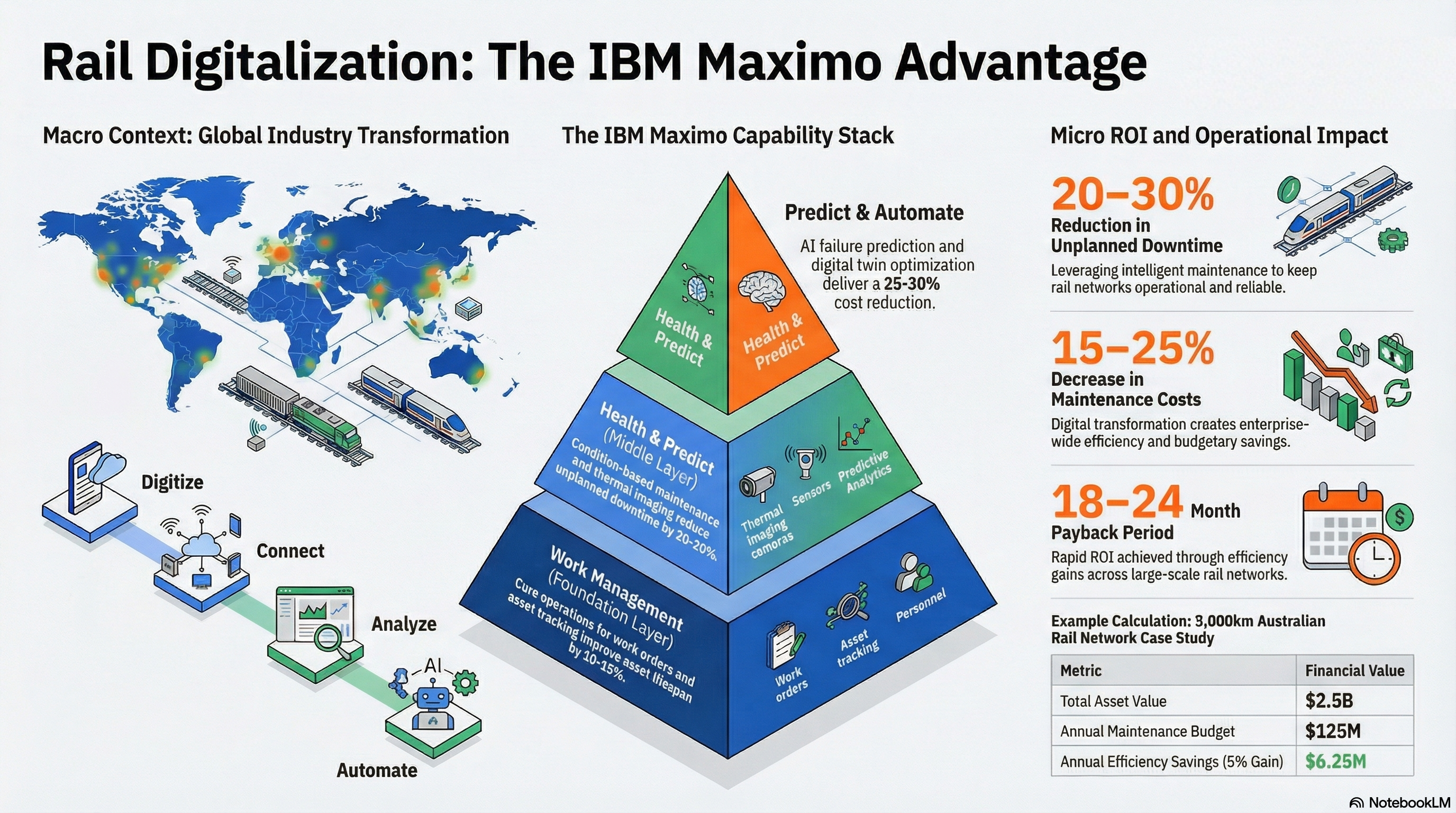
Maximo Health and Predict ingests real-time data — vibration sensors, temperature readings, rail profile measurements, weather conditions — and calculates a health score for each individual asset. Maintenance is triggered when the health score crosses a threshold, not when the calendar says so.
The result: 25–30% cost reduction (IBM Institute for Business Value) because interventions happen at the optimal moment. Assets with remaining useful life aren’t replaced prematurely. Assets degrading faster than expected are caught before failure. A McKinsey study on predictive maintenance corroborates this range, finding condition-based strategies reduce maintenance costs by 10–40% depending on asset class.
How do IBM’s five solution pillars cover rail’s full digital transformation needs?
| Solution | Rail Application |
|---|---|
| Maximo | Enterprise asset management — lifecycle management of track, signals, rolling stock |
| watsonx | AI platform — demand forecasting, computer vision defect detection, NLP for maintenance reports |
| Sterling | Supply chain intelligence — spare parts optimisation, supplier management, procurement analytics |
| Security (QRadar) | Threat detection for IT and OT environments — protecting signalling, SCADA, and enterprise networks |
| Consulting | Implementation and strategy — digital transformation roadmaps, change management, system integration |
The value of breadth: rail’s challenges aren’t isolated. A maintenance problem is also a supply chain problem (do we have the parts?), a data problem (what does the sensor data say?), a security problem (is the sensor data trustworthy?), and a people problem (do we have the skilled team?). IBM’s portfolio addresses these interdependencies — a principle the IBM Institute for Business Value calls “connected asset management.”
Why does IBM’s four-stage maturity model prevent rail clients from skipping critical steps?
IBM’s rail digital transformation maturity model:
- Digitise — Move from paper to digital: electronic work orders, digital asset registers, mobile inspection tools
- Connect — Integrate systems: link EAM to IoT sensor data, connect inventory to procurement, unify disparate databases
- Analyse — Apply analytics: descriptive dashboards, trend analysis, performance benchmarking
- Automate — Deploy AI: predictive maintenance, prescriptive recommendations, autonomous decision-making
Most rail operators are at Stage 1 or early Stage 2. The temptation is to jump to Stage 4 — “give us AI.” But AI built on incomplete, disconnected, or poor-quality data generates confident-sounding nonsense. Gartner research confirms that over 60% of AI projects in asset-intensive industries stall due to data readiness gaps. The maturity model prevents this: each stage builds the foundation for the next.
How does a 5% efficiency gain from Maximo translate to tens of millions in savings for a large rail maintainer?
An operator spending $500 million annually on maintenance: a 5% efficiency gain is $25 million per year. Over a 10-year Maximo deployment, that’s $250 million in cumulative savings — from a platform investment that costs a fraction of that. For context, ARTC’s annual reports show infrastructure maintenance spending in the hundreds of millions for the interstate network alone.
The efficiency gains come from three sources: reduced unplanned downtime (fewer emergency repairs), extended asset life (replacing at optimal condition rather than calendar date), and better resource allocation (deploying crews to highest-priority work rather than routine inspections that reveal no defects). The IBM Total Economic Impact study commissioned from Forrester found that Maximo deployments typically deliver a 3-year ROI exceeding 200%.
The compounding effect is significant: saved maintenance dollars can fund further technology investment, creating a virtuous cycle of improvement.
What patterns emerge from IBM’s rail engagements across European, Asian, and North American operators?
Three patterns appear in every geography:
Pattern 1: Data is the barrier, not technology. The AI algorithms are ready. The sensor technology is proven. The missing piece is clean, integrated data. Every rail engagement starts with data quality and integration. Harvard Business Review reports that 80% of the effort in successful AI deployments is data preparation, not model building.
Pattern 2: Change management is harder than system implementation. Installing Maximo takes months. Changing a workforce’s daily habits takes years. The organisations that invest in change management alongside technology outperform those that don’t. Prosci’s benchmarking data shows projects with excellent change management are six times more likely to meet objectives.
Pattern 3: Start small, prove value, scale. Successful rail deployments begin with a single depot, a single asset class, or a single corridor. Prove the ROI. Then expand. “Big bang” implementations in rail have a poor track record — a lesson reinforced by Standish Group’s CHAOS reports showing large IT projects fail at significantly higher rates than incremental ones.
Why does the ARA’s Digital Rail Roadmap naturally align with Maximo’s open-architecture approach?
The ARA’s Digital Rail Transformation Roadmap calls for interoperable, open-standard platforms that enable data sharing across operators, regulators, and technology partners. This aligns with Maximo’s architecture: RESTful APIs, standards-based data models, cloud-native deployment, and integration with third-party systems.
A closed, proprietary platform locks operators into a single vendor’s ecosystem. An open platform enables best-of-breed integration — connecting Maximo’s asset management with specialist rail analytics, sensor platforms, and enterprise systems. The ARA’s roadmap and IBM’s architecture philosophy converge on the same principle: openness enables innovation. ISO 55000 (the international standard for asset management) reinforces this, mandating that asset management systems support integration across organisational boundaries.
Synthesis
IBM’s relevance to Australian rail centres on solving a fundamental challenge: managing ageing, geographically dispersed infrastructure with limited maintenance windows and growing demand. Maximo provides a single platform for asset lifecycle management — from work order creation to AI-powered predictive maintenance. The broader portfolio addresses adjacent challenges in supply chain, cybersecurity, and sustainability.
For rail maintainers, the practical value is simple: better data leads to better decisions about where to deploy limited crews and budgets. The organisations investing in this capability now will spend less, fail less, and know their assets better than those who wait.
Vocabulary Spotlight
| Term | Definition |
|---|---|
| Enterprise Asset Management (EAM) | A software platform managing the full lifecycle of physical assets from procurement through maintenance to disposal |
| Condition-based maintenance (CBM) | Maintenance triggered by actual asset condition data rather than fixed time schedules |
| Work order | A formal instruction to perform a specific maintenance task on a defined asset, tracked in the EAM system |
Macro Signal
Druckenmiller Macro: The key number is “20–30% reduction in unplanned downtime” — for a rail maintainer, unplanned downtime means emergency track closures, delayed freight, and safety risk. Reducing that by a fifth changes the economics of an entire maintenance operation. Maximo is IBM’s fastest-growing asset management platform, with rail as a top-3 industry vertical.
In the News
Queensland Rail announces a major IBM Maximo Application Suite deployment across its 6,600km network in Q1 2026, consolidating legacy maintenance systems into a single enterprise platform — one of Australia’s largest rail EAM transformations.
Sources
| Type | Source |
|---|---|
| IBM | IBM Maximo Application Suite — Product Documentation |
| IBM | IBM Institute for Business Value — “The Value of AI in Asset Management” (2024) |
| IBM | IBM Consulting — Transportation Industry Solutions Overview |
| Industry | Australasian Railway Association — “Digital Rail Transformation Roadmap” |
| Research | Gartner — “Magic Quadrant for Enterprise Asset Management Software” (2024) — IBM positioned as a Leader |
Next: The Digital Ghost of Every Rail Asset · Everyone knows digital twins are a buzzword. But what if, in rail maintenance, they’re the most practical technology nobody’s arguing about?