
Day 9 of Australian Rail Series
Everyone knows rail is safe. But what if that safety record is hiding one of the most complex regulatory frameworks in any industry — and what if the framework itself is the reason it works?
The Story
Everyone knows rail is one of the safest ways to travel. It’s obvious. It’s in every comparison chart. Fewer fatalities per passenger-kilometre than road, than aviation, than cycling — BITRE’s transport safety statistics confirm this consistently. The statistics are clear, the conclusion comfortable.
It’s also wrong — or at least, deeply incomplete.
What if rail’s safety record isn’t the result of inherent safety, but the outcome of an extraordinarily complex regulatory framework that most people — including many executives — have never examined? What if the system works because it’s relentlessly regulated, obsessively documented, and culturally committed to learning from every near-miss?
The truth is that rail safety isn’t natural. It’s engineered. And the engineering is as impressive as any bridge or tunnel in the network.
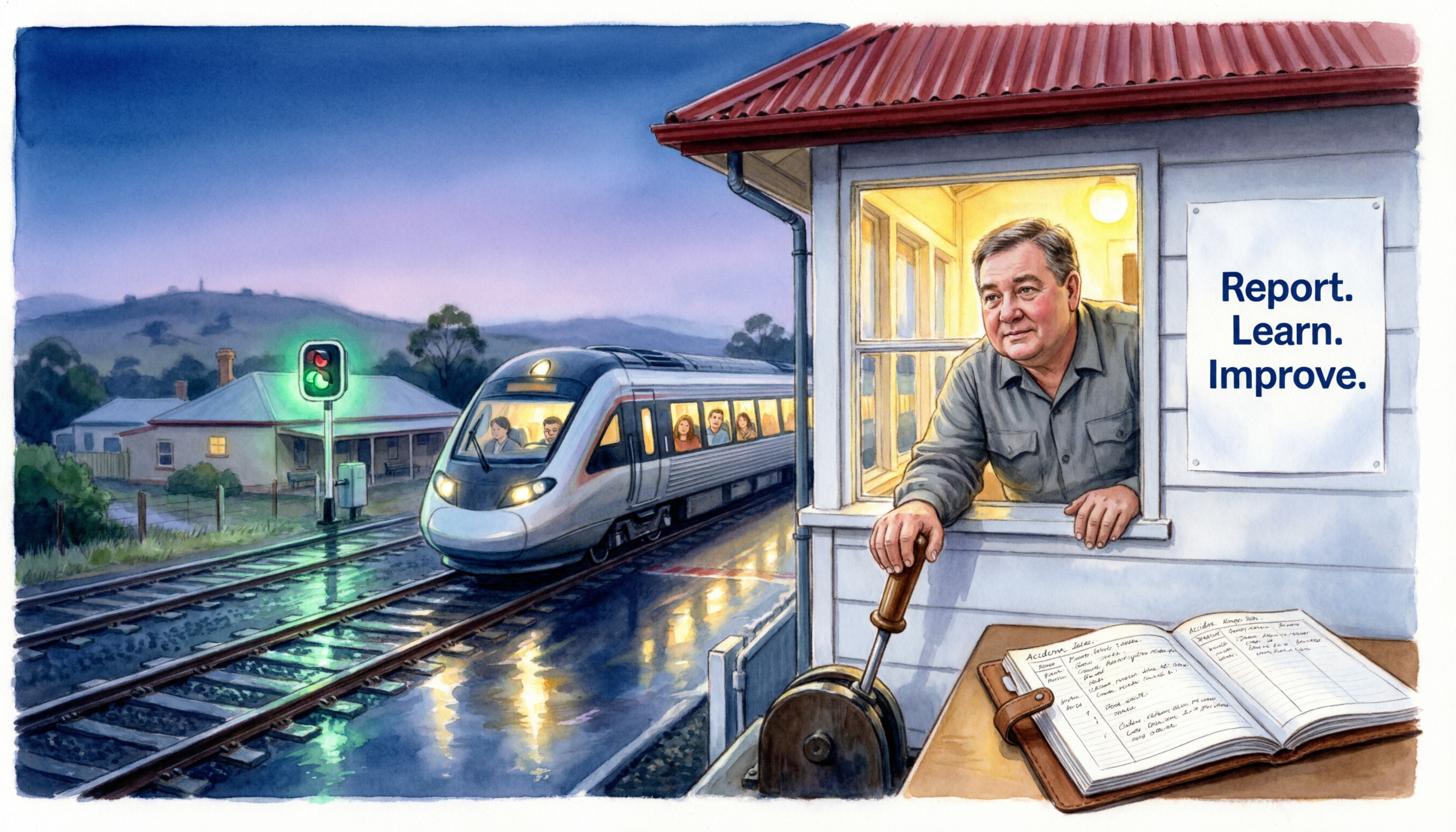
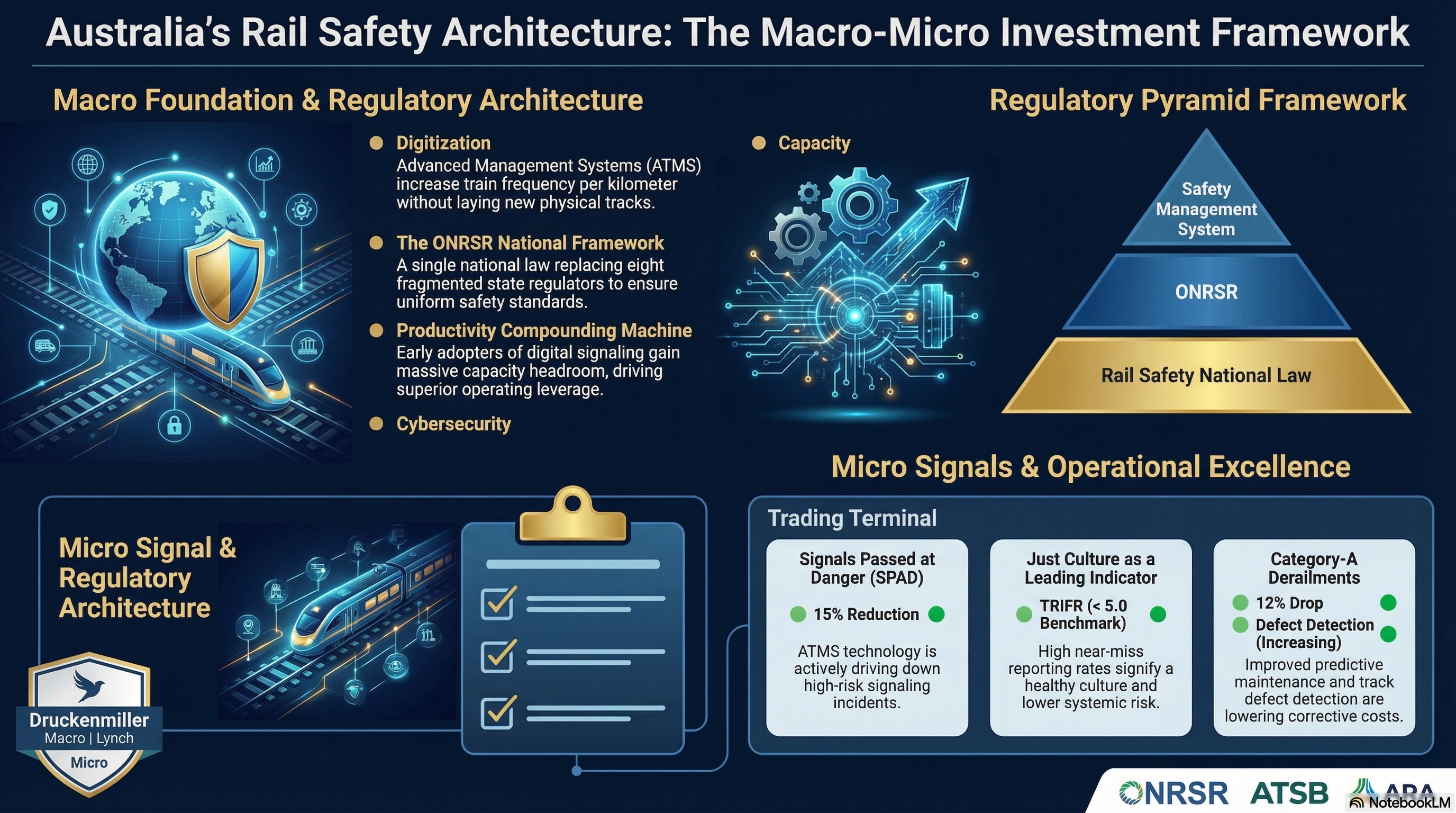
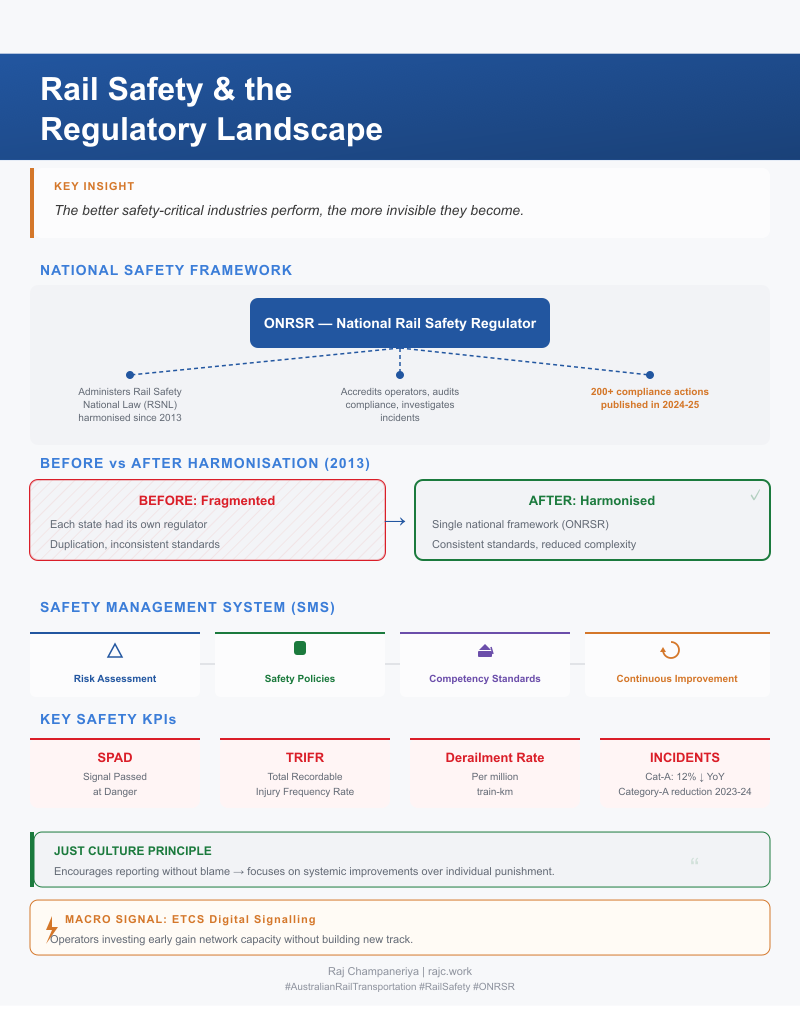
Day 9 in pictures
A few visuals for post.
The Deep Dive — 8 Questions
How did ONRSR’s 2013 harmonisation fix Australia’s fragmented state-by-state safety approach?
Before 2013, every Australian state had its own rail safety regulator, its own legislation, and its own compliance requirements. An operator working across state borders faced multiple sets of rules, multiple regulators, and multiple reporting obligations — none of which were coordinated.
The Office of the National Rail Safety Regulator (ONRSR), established in 2013 under the Rail Safety National Law, harmonised this patchwork into a single national framework. One regulator, one law, one set of obligations — regardless of whether you’re operating in Queensland, Victoria, or Western Australia.
The impact was immediate: reduced regulatory burden for multi-state operators, consistent safety standards across the network, and a single national dataset enabling trend analysis that was previously impossible.
Why do ONRSR’s 200+ compliance actions in 2024-25 signal an increasingly assertive regulatory stance?
A compliance action isn’t a penalty — it’s a regulatory intervention. ONRSR issues improvement notices, prohibition notices, and enforceable undertakings when it identifies safety risks that operators haven’t adequately addressed.
Over 200 compliance actions in a single year signals two things: ONRSR is becoming more assertive in identifying and acting on safety risks, and the industry still has gaps between safety policy and safety practice. The most common triggers are maintenance documentation deficiencies, workforce competency gaps, and inadequate risk assessments for non-routine work.
For operators, this means safety compliance is not a box-ticking exercise — it’s an active, evolving obligation enforced by a regulator willing to use its powers.
Why is the SMS the backbone that separates compliant operators from exposure-prone ones?
Every rail operator in Australia is required by law to maintain a Safety Management System (SMS) — a documented, systematic framework for identifying, assessing, and managing safety risks.
An effective SMS isn’t a filing cabinet full of procedures. It’s a living system: risk registers updated with operational experience, procedures revised when incidents reveal gaps, competency frameworks ensuring workers have the skills to perform safely, and audit programs verifying that practice matches documentation.
The operators with mature SMS frameworks treat safety as an operating system — embedded in every decision, every possession plan, every maintenance task. The operators with immature frameworks have documents but not systems. The difference shows up in incident rates, regulatory interactions, and — ultimately — in careers.
How does Australia’s “just culture” investigation principle create better safety outcomes than punitive models?
When a maintenance worker makes an honest error that causes a near-miss, two responses are possible. The punitive response: discipline the worker, create fear, drive reporting underground. The “just culture” response: investigate the system conditions that made the error likely, learn from it, fix the system, and share the lesson across the industry.
Australia’s rail safety framework operates on just culture principles — a concept rooted in James Reason’s error management model — distinguishing between genuine errors (systemic learning), at-risk behaviour (coaching and system redesign), and reckless behaviour (disciplinary action).
The outcome is measurable: higher near-miss reporting rates, richer safety data, and earlier identification of emerging risks. A system that learns from every near-miss catches the patterns that predict serious incidents — before they happen.
Which safety KPI — SPAD, TRIFR, or derailment rate — best predicts systemic network risk?
Each KPI measures a different dimension of safety:
| KPI | What It Measures | Predictive Value |
|---|---|---|
| SPAD (Signal Passed at Danger) | Driver error or signal system failure | High — SPADs are precursors to collisions |
| TRIFR (Total Recordable Injury Frequency Rate) | Workforce injury rate per million hours worked | Medium — indicates safety culture health |
| Derailment rate | Track or rolling stock failure causing loss of rail | High — indicates infrastructure condition |
No single KPI is sufficient. SPADs predict human-factor and signalling risks. TRIFR predicts workforce safety culture issues. Derailment rates predict infrastructure maintenance quality. Together, they form a triangle: people, systems, infrastructure. A spike in any one demands investigation.
Why does safety regulation simultaneously drive up maintenance costs and improve maintenance quality?
This is the paradox at the heart of rail safety economics.
ONRSR requires documented inspection regimes, competent workers (holding current RIW cards and role-specific certifications), and risk-assessed maintenance procedures. Each requirement adds cost: more inspection hours, more training, more documentation, more oversight.
But the same requirements drive quality. Documented inspections create traceable records. Competent workers make fewer errors. Risk-assessed procedures catch problems before they escalate. The maintenance costs more — and the outcomes are measurably better.
The operators who understand this don’t view safety regulation as an overhead to minimise. They view it as a quality framework that, when properly implemented, reduces the far greater costs of incidents, investigations, and remediation.
What specific design choices make Australia’s rail safety framework outperform the US system?
The comparison is instructive:
| Feature | Australia | United States |
|---|---|---|
| Regulator | Single national (ONRSR) | Federal (FRA) + 50 state agencies |
| Safety approach | Risk-based, outcome-focused | Prescriptive, rule-based |
| Investigation culture | Just culture, learning-oriented | More punitive, litigation-driven |
| Safety reporting | High near-miss reporting rates | Lower reporting due to liability fears |
| Derailment rate | Declining trend | Persistent (e.g., East Palestine 2023, FRA Accident Data) |
Australia’s risk-based approach allows operators flexibility in how they achieve safety outcomes, while the US prescriptive approach specifies what actions must be taken. The Australian model incentivises innovation and continuous improvement; the US model creates compliance-driven minimum standards.
Which emerging safety challenge — cybersecurity, automation, or climate — poses the greatest risk to rail’s safety record?
Cybersecurity: As rail systems connect to networks (ETCS signalling, IoT sensors, remote monitoring), the attack surface expands. US federal cybersecurity directives for rail — including FRA cybersecurity safety alerts — underscore the urgency. A compromise of signalling systems is a physical safety threat, not just a data breach.
Automation: Driverless operations remove human error but introduce software failure modes and new risk profiles that existing safety frameworks weren’t designed for.
Climate: Extreme weather — bushfires, floods, heatwaves — is increasing in frequency and severity. Track buckling in 50°C heat, ballast washout in floods, and visibility reduction in smoke all challenge existing safety systems. The National Transport Research Organisation (NTRO) is actively researching climate adaptation strategies for rail infrastructure.
All three are serious. But cybersecurity may be the most urgent because the threat is growing fastest while the industry’s capability to respond is still maturing. Day 17 is dedicated to this topic.
Synthesis
Australia’s rail safety framework, anchored by ONRSR and the Rail Safety National Law, represents one of the most effective harmonised regulatory systems globally. The shift from fragmented state-based regulation to a single national framework has reduced complexity and improved safety outcomes.
For rail maintainers, safety isn’t a compliance checkbox — it is embedded in every possession plan, every track inspection, and every work procedure. The framework’s strength lies in its “just culture” principle: learning from incidents rather than assigning blame, driving continuous improvement across the industry.
Vocabulary Spotlight
| Term | Definition |
|---|---|
| Signal Passed at Danger (SPAD) | An incident where a train passes a stop signal without authority; a critical safety metric tracked nationally |
| Safety Management System (SMS) | A documented, systematic framework for managing safety risks, required by law for all Australian rail operators |
| ONRSR | The Office of the National Rail Safety Regulator — Australia’s single national rail safety regulator established in 2013 |
Macro Signal
Druckenmiller Macro: The macro trend shaping rail safety is the digitisation of signalling — ETCS is being deployed across Australian corridors. This shift from physical signals to in-cab digital systems introduces both cybersecurity risk and operational efficiency gains. Operators who invest in ETCS early will gain network capacity without building new track.
In the News
ONRSR’s 2025 Rail Safety Report records a 15% reduction in national SPAD incidents year-on-year, crediting the rollout of Advanced Train Management System (ATMS) technology on ARTC’s interstate network.
Sources
| Type | Source |
|---|---|
| IBM | IBM Security — “Securing Operational Technology in Transportation” (IBM IBV, 2024) |
| Regulator | ONRSR — “Annual Safety Report 2023-24” |
| Industry | Australasian Railway Association — “Rail Safety in Australia: A National Framework” |
| Government | ATSB — Rail Safety Investigation Reports |
| Government | BITRE — Bureau of Infrastructure and Transport Research Economics — Transport Safety Statistics |
| Government (US) | FRA Safety Data — Federal Railroad Administration Accident/Incident Query |
| Government (US) | FRA Cybersecurity — Federal Railroad Administration — Rail Safety & Cybersecurity Advisories |
| Research | NTRO — National Transport Research Organisation (formerly ACRI) — Climate Adaptation & Rail Innovation Research |
| Infrastructure | ARTC — Australian Rail Track Corporation — Network & ATMS Program |
| Safety Science | SKYbrary — Just Culture — Eurocontrol/ICAO Just Culture Framework (James Reason model) |
| Workforce | Safe Work Australia — Work-Related Injury Statistics (TRIFR methodology) |
Next: The Machine That Sees the Future · Everyone knows enterprise software is about efficiency. But what if, in rail, it’s about predicting which asset will fail before the failure happens?