
Day 6 of Australian Rail Series
You’ve seen the headlines about Australian high-speed rail your entire life. But have you ever noticed the same promise being recycled for 40 years — and what might actually be different this time?
The Story
You’ve seen the artist’s impression a hundred times. A sleek white train, blurred at the edges to suggest impossible speed, slicing through green Australian countryside with the Sydney skyline receding in the background. “High-speed rail connecting Australia’s east coast” — the headline reads, promising a future that’s always three decades away.
But have you ever noticed that the artist’s impression hasn’t changed much since the 1980s?
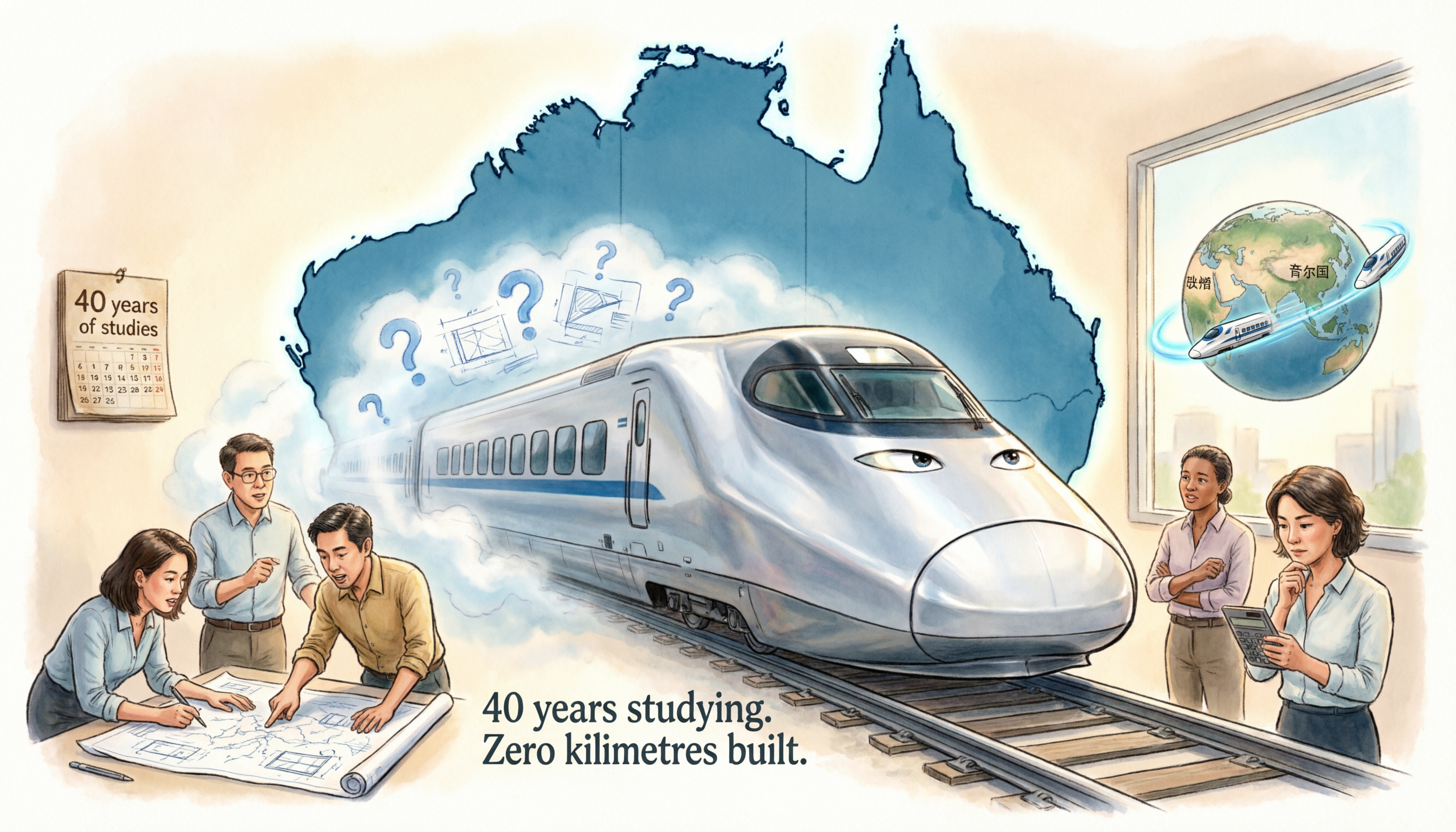
The first serious Australian HSR feasibility study was commissioned in 1984. Then again in 2001. Then again in 2013. Each time, the conclusion was broadly the same: technically feasible, economically marginal, politically difficult. Each time, the study was shelved. Each time, a new government commissioned a new study.
Here’s what’s actually happening in 2026: the High-Speed Rail Authority (HSRA) — established in 2023 — is not commissioning another study. It’s preserving corridors, issuing land acquisition orders, and developing detailed business cases. For the first time in 40 years, the machinery of government is doing something other than studying.
Whether that machinery delivers a bullet train or another filing cabinet is the question that defines this generation of Australian infrastructure ambition.
Day 6 in pictures
A few visuals for post.
The Deep Dive — 8 Questions
Why has establishing the HSRA in 2023 been Australia’s most concrete HSR step despite 40 years of studies?
Because an authority is an institution, and institutions persist beyond political cycles.
Previous HSR proposals lived inside government departments — subject to ministerial priorities, budget reallocations, and election-cycle attention spans. The HSRA is a standalone statutory authority with its own budget, staff, and legislative mandate. It can plan across decades, not just parliamentary terms.
This institutional permanence doesn’t guarantee delivery. But it does guarantee continuity — the HSRA will exist regardless of who wins the next election, which is more than any previous HSR proposal could claim.
Why does connecting Brisbane-Sydney-Canberra-Melbourne serve 80% of Australia’s population?
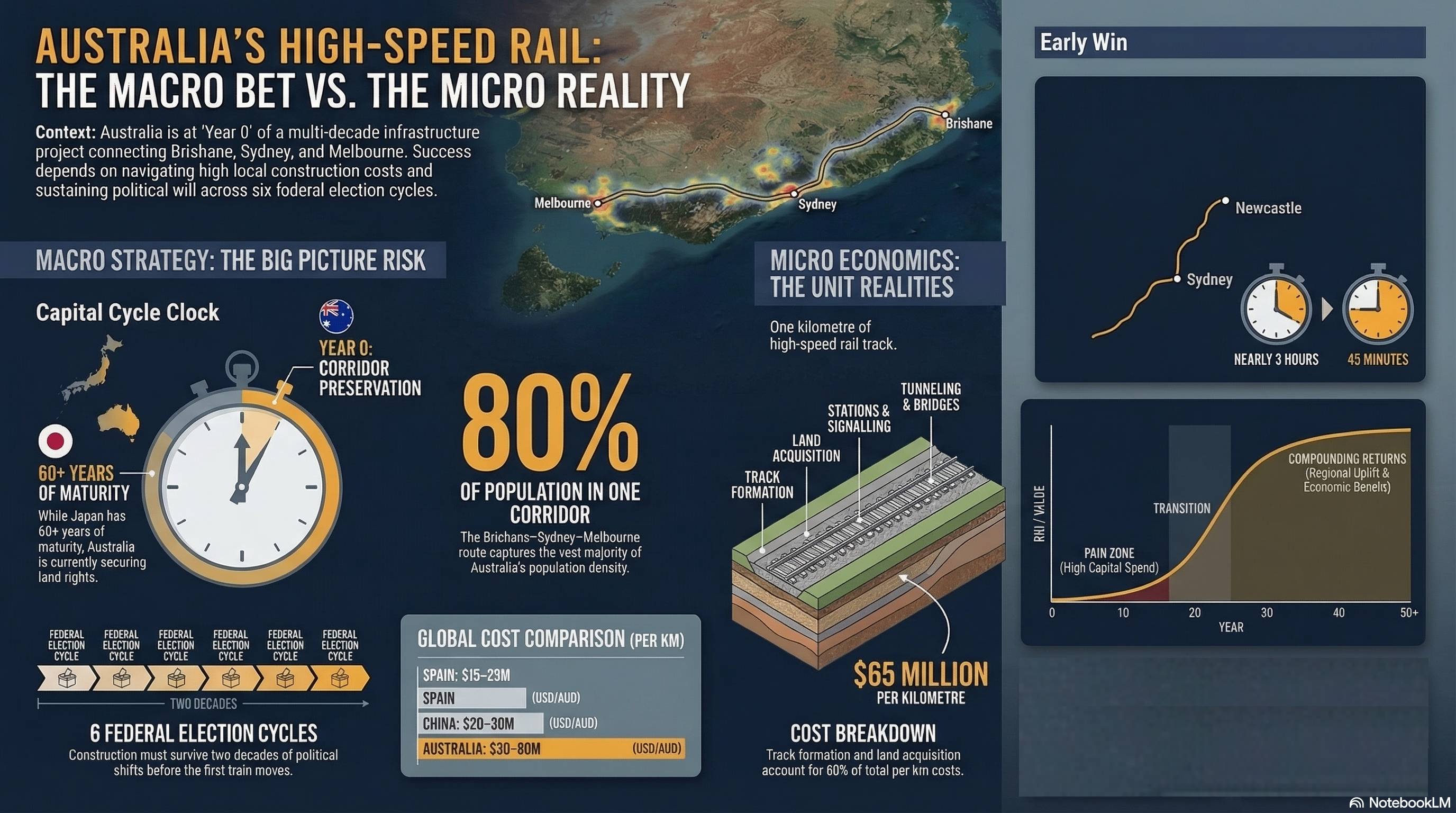
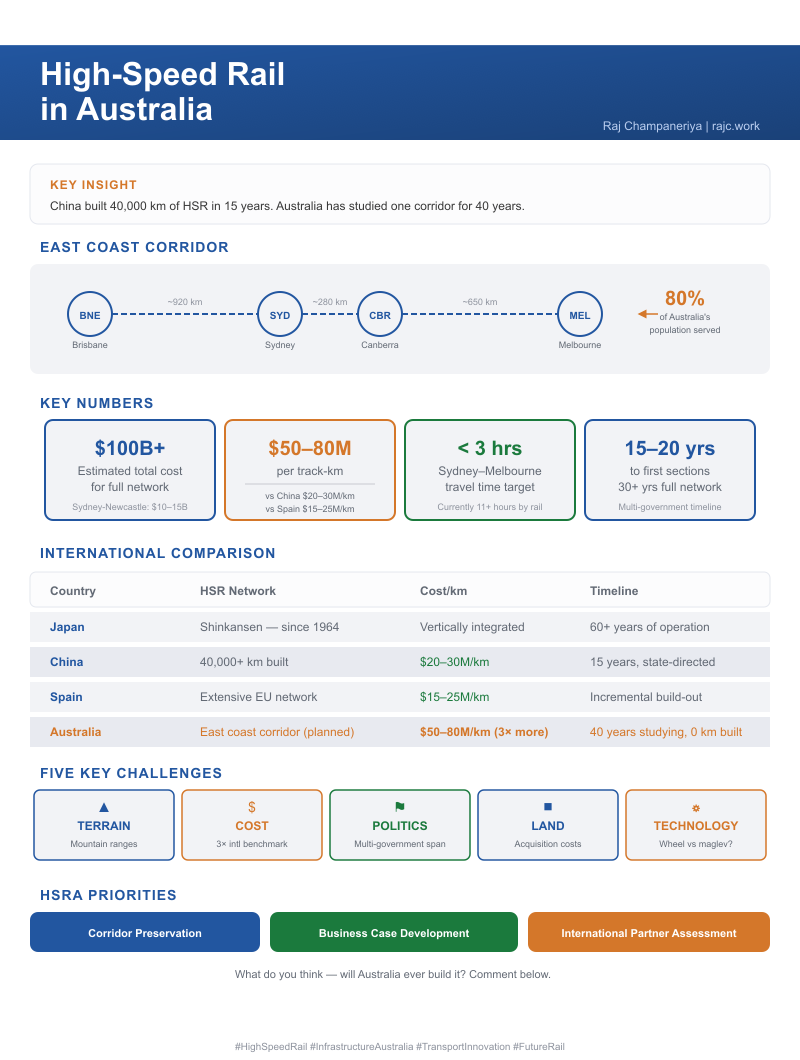
Australia’s population is coastal and concentrated. Over 80% of Australians live in the eastern seaboard corridor between Brisbane and Melbourne, with Sydney and Canberra in between. An HSR corridor connecting these cities would serve the vast majority of the population within a single linear infrastructure investment.
Contrast this with continental European HSR, which must serve multiple population centres in every direction, or Japan’s Shinkansen, which follows a dense urban corridor. Australia’s geography is both advantage and challenge: one corridor covers the majority, but the distances between cities (roughly 900 km Sydney–Melbourne, 900 km Sydney–Brisbane) push HSR to its economic limits.
Why does Australia’s $50-80M/km construction cost make HSR 3x more expensive than China’s model?
The per-kilometre cost of HSR construction varies enormously by country:
| Country | Cost per track-km | Primary drivers |
|---|---|---|
| China | $20–30M | State-directed land acquisition, lower labour costs, standardised design |
| Spain | $15–25M | Experienced delivery organisations, favorable terrain |
| UK (HS2) | $100M+ | Planning complexity, urban tunnelling, compensation costs |
| Australia (est.) | $50–80M | High labour costs, environmental compliance, land acquisition, terrain |
Australia’s cost premium reflects its economic reality: high construction wages, complex environmental and planning approval processes, land acquisition in developed areas, and difficult terrain (the Great Dividing Range between Sydney and Canberra requires significant tunnelling).
The World Bank’s analysis of China’s HSR program explains why direct cost comparisons mislead — any business case that benchmarks Australian HSR costs against Chinese construction costs is building on sand.
What lessons from Japan’s Shinkansen and China’s 40,000km network apply — and don’t apply — to Australia?
Japan’s lessons that apply: Obsessive maintenance culture, vertical integration reducing interface risk, public willingness to pay premium fares for reliable high-speed service.
Japan’s lessons that don’t apply: Population density along the Tokaido corridor (10x Australia’s east coast), established rail culture where train travel is default mode, government ability to compulsorily acquire land without decades of legal challenge.
China’s lessons that apply: Standardised train design reducing procurement costs, building HSR as a system (not individual projects), using HSR to drive regional economic development.
China’s lessons that don’t apply: State-directed investment without parliamentary scrutiny, construction costs achievable through wage levels impossible in Australia, land acquisition without democratic process.
The transferable principle: build HSR as a system, not a collection of independent projects. The non-transferable element: the political and economic conditions that enabled rapid delivery elsewhere.
Which challenge — terrain, cost, or political continuity — is the true barrier to Australian HSR?
Terrain is solvable. Engineers have tunnelled through the Alps (Gotthard Base Tunnel), under the English Channel, and beneath Tokyo Bay. The Great Dividing Range is challenging but not unprecedented.
Cost is significant but manageable over a multi-decade timeframe — if spread across federal and state budgets, value capture mechanisms, and private sector participation.
Political continuity is the true barrier. A 15–20 year project requires sustained commitment across 4–5 federal elections. A single hostile government can defund, delay, or redefine the project mid-delivery. The HSRA’s institutional permanence mitigates this — but doesn’t eliminate it.
The history of Australian infrastructure megaprojects — as Infrastructure Australia’s priority list repeatedly demonstrates — suggests that bipartisan commitment is the critical success factor, not engineering or budget.
Does the HSR business case work on transport economics alone, or does it require regional development benefits?
On narrow transport economics — comparing HSR ticket revenue against construction and operating costs — the Australian business case is marginal. Load factors must remain high, fares must be competitive with aviation, and operating costs must be tightly controlled.
But narrow transport economics ignores the wider benefits: regional city growth around HSR stations, reduced road congestion, avoided aviation emissions, and land value uplift. When these “wider economic benefits” are included, the business case strengthens considerably.
The debate is ultimately about what counts. If you count only ticket revenue, HSR is questionable. If you count the economic transformation of cities like Wagga Wagga, Toowoomba, and Shepparton gaining 60-minute HSR access to major capitals — as the Grattan Institute has argued — the case changes entirely.
Why is corridor preservation now more urgent than construction for Australia’s HSR future?
You can build a railway later. You cannot un-build a housing estate.
Corridor preservation — legally protecting the land needed for a future HSR route from development — is the single most time-sensitive HSR decision. Every year of delay means more development encroaching on potential corridors, higher land acquisition costs, and more politically difficult resumptions.
The HSRA’s current priority is corridor preservation, not construction. This is strategically wise: it buys optionality. A preserved corridor can wait for the right funding moment, the right technology moment, or the right political moment. A corridor lost to development is lost forever.
How will HSR create a generational career opportunity for current rail professionals?
If HSR proceeds, it will require a workforce with capabilities that barely exist in Australia today: high-speed track maintenance, ETCS Level 3 signalling expertise, 300+ km/h rolling stock engineering, and passenger service design for a premium travel experience.
The professionals who build these skills now — through international secondments, specialist training, and early involvement in HSRA planning — will be positioned for careers that span decades. HSR projects employ thousands of engineers, planners, and operators for 20+ years from construction through steady-state operations.
Synthesis
High-speed rail in Australia sits at the intersection of engineering ambition and political reality. The HSRA’s establishment represents the most concrete step yet, but the $100+ billion price tag and 15–20+ year timeline mean this project will span multiple governments, budget cycles, and economic conditions.
International comparisons are illuminating but imperfect: Japan succeeded through vertical integration and density; China through state direction and scale. Australia’s unique challenge is low population density combined with high construction costs — the business case works if regional development benefits are included, but struggles on narrow transport economics alone.
For rail professionals, HSR represents both a generational career opportunity and a test case for whether Australia can execute transformative infrastructure at national scale.
Vocabulary Spotlight
| Term | Definition |
|---|---|
| Corridor preservation | Legally protecting land along a planned rail route from development to ensure future construction remains feasible |
| Grade of Automation (GoA) | International classification (GoA 0–4) for train automation levels, from manual driving to fully automated unattended operation |
| Track-km cost | The unit cost of constructing one kilometre of railway, used internationally for benchmarking |
Micro Signal
Lynch Lens: The key number for Australian HSR is "$50–80 million per track-km" — the estimated construction cost. Compare this to China’s $20–30M/km and Spain’s $15–25M/km. Australia’s high construction costs (labour, land acquisition, environmental compliance) make the per-km economics roughly 3x more expensive than international benchmarks. Any HSR business case that doesn’t account for this cost premium is building on sand.
In the News
The HSRA confirms Sydney–Newcastle as the priority first stage of Australia’s east coast high-speed rail network in early 2026, with detailed business case development commencing and corridor preservation orders issued for key land parcels along the proposed route.
Sources
| Type | Source |
|---|---|
| Government | High-Speed Rail Authority (HSRA) — “Strategic Plan and Corridor Preservation” |
| Government | Infrastructure Australia — “Assessment of High-Speed Rail: Priority List 2024” |
| Research | Grattan Institute — “Fast Train Fever: Evaluating High-Speed Rail in Australia” |
| Research | World Bank — “China’s High-Speed Rail Development” |
| Research | World Bank — “Japan’s Shinkansen: The First High-Speed Rail” |
| Government | EU Agency for Railways — “European Train Control System (ETCS)” |
Next: Eight Hundred Million Journeys · The memory of your first solo train ride connects to a system carrying 800+ million passengers a year.