Day 5 of Australian Rail Series
You’ve heard “points failure” announced over the PA at your train station a hundred times. But have you ever noticed what it actually means — and why a vocabulary choice made in the 1850s still costs Australia billions today?
The Story
You’ve heard the phrase “points failure causing delays” a hundred times. On the PA system at Central Station, in the app notification on your phone, in the resigned sigh of the commuter next to you.
But have you ever noticed what “points” actually are?
Not a score. Not an argument. A physical piece of track infrastructure — tapered rails that slide laterally to divert a train from one route to another. When they fail, the train can’t switch tracks. When the train can’t switch tracks, nothing behind it can move. A single set of points, in the wrong location at the wrong time, can paralyse an entire suburban network.
Here’s the deeper discovery: rail vocabulary isn’t trivia. It’s a lens. Each term encodes a decision, a constraint, a whole engineering philosophy. Master eight terms and you unlock the logic of an entire industry.
And one of those terms — gauge — reveals a 170-year-old mistake that Australia is still paying for.
Day 5 in pictures
A few visuals for post.
The Deep Dive — 8 Questions
Why does a poorly planned possession waste more money than the maintenance work itself?
A possession is a scheduled period when a section of track is taken out of service for maintenance. It sounds simple. It isn’t.
A typical urban possession involves: shutting down power to overhead wiring, establishing safe work zones, briefing crews, transporting equipment in, performing the actual maintenance, testing, clearing equipment out, restoring power, and returning the corridor to revenue service. The setup and teardown can consume 40–60% of the possession window, leaving barely half the time for productive work.
A poorly planned possession — wrong equipment, weather delays, coordination failures between contractors — can waste the entire window. The track gets closed, passengers get bussed, revenue is lost, and the maintenance work doesn’t get done. The possession must then be rescheduled, wasting another window later. The cost of the failed possession often exceeds the cost of the work it was meant to accomplish.
How does the diversity of rolling stock shape maintenance strategy?
Rolling stock is every vehicle that runs on railway tracks: locomotives, passenger carriages, freight wagons, and maintenance vehicles. The diversity is staggering.
In the Pilbara, Rio Tinto operates 28,000-tonne ore trains with 240+ wagons behind GE locomotives. In Sydney, double-deck Waratah electric multiple units (EMUs) carry commuters in climate-controlled comfort. In regional Australia, diesel railcars serve communities hundreds of kilometres apart.
Each type has different maintenance demands: EMUs need electrical system maintenance (traction motors, pantographs, power electronics); freight wagons need structural inspections (couplers, bogies, wagons bodies under extreme axle loads); diesel locomotives need engine overhauls on defined hour cycles.
A maintenance organisation serving mixed rolling stock must operate what is essentially multiple parallel maintenance systems — different skills, different spare parts, different inspection protocols.
Why does ballast condition determine both ride quality and track safety simultaneously?
Ballast — the crushed stone bed beneath railway sleepers — looks like a pile of rocks. It is precisely engineered infrastructure.
Ballast performs three critical functions: draining water away from the track formation (wet ballast causes track instability), distributing train loads evenly across the formation (uneven load causes settlement), and enabling geometric adjustment (tamping machines compact ballast to correct track alignment).
When ballast degrades — through fouling (fine material filling the voids), mechanical breakdown, or vegetation growth — all three functions fail simultaneously. Drainage fails, causing soft spots. Load distribution fails, causing uneven settlement. Geometry adjustment becomes impossible without ballast cleaning or replacement.
The result: a rough ride for passengers, speed restrictions for safety, and eventually a track closure for ballast rehabilitation. A $30-per-tonne material quite literally holds the entire network together.
How does Australia’s multi-gauge legacy from the 1850s still cost the industry billions today?
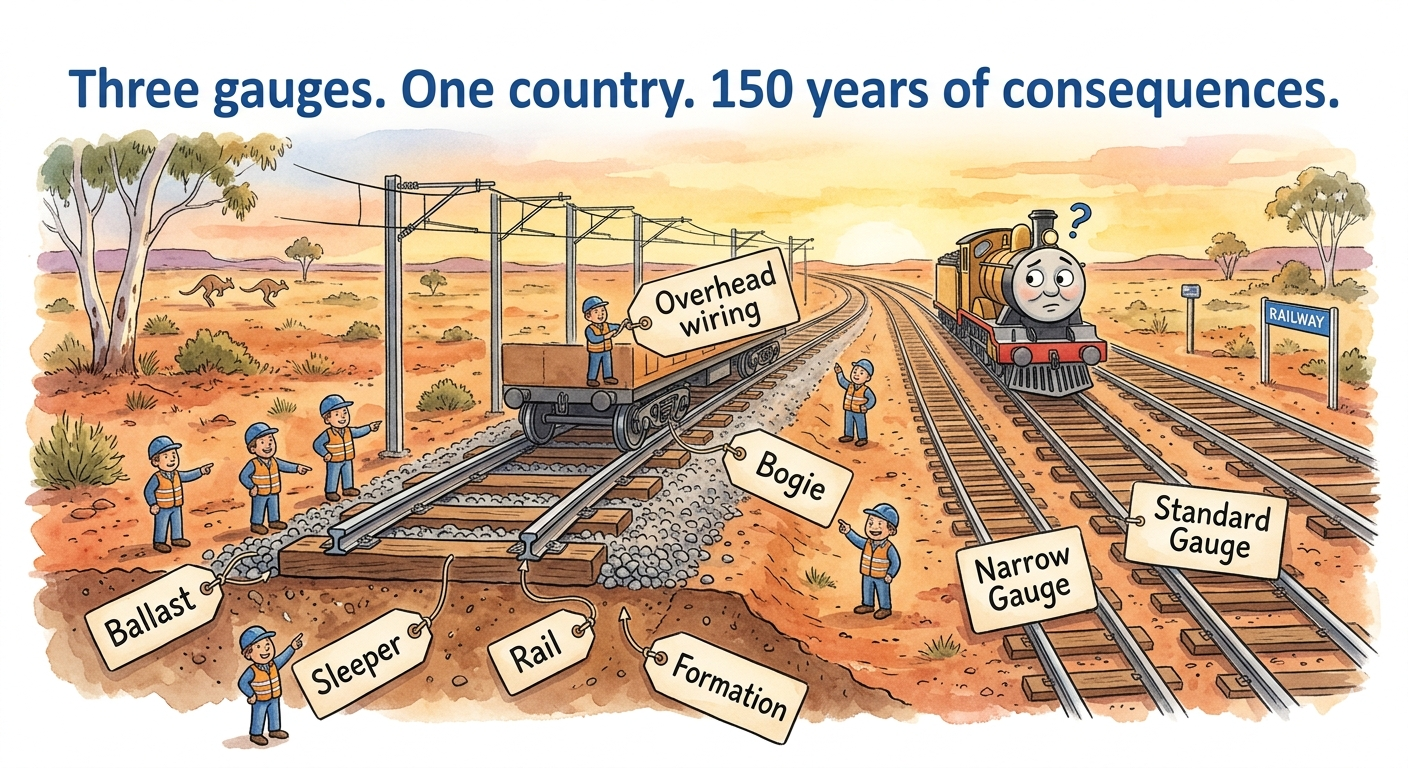
Gauge — the distance between the inner faces of the two running rails — seems like a simple specification. Choose a number and stick with it.
Australia chose three numbers.
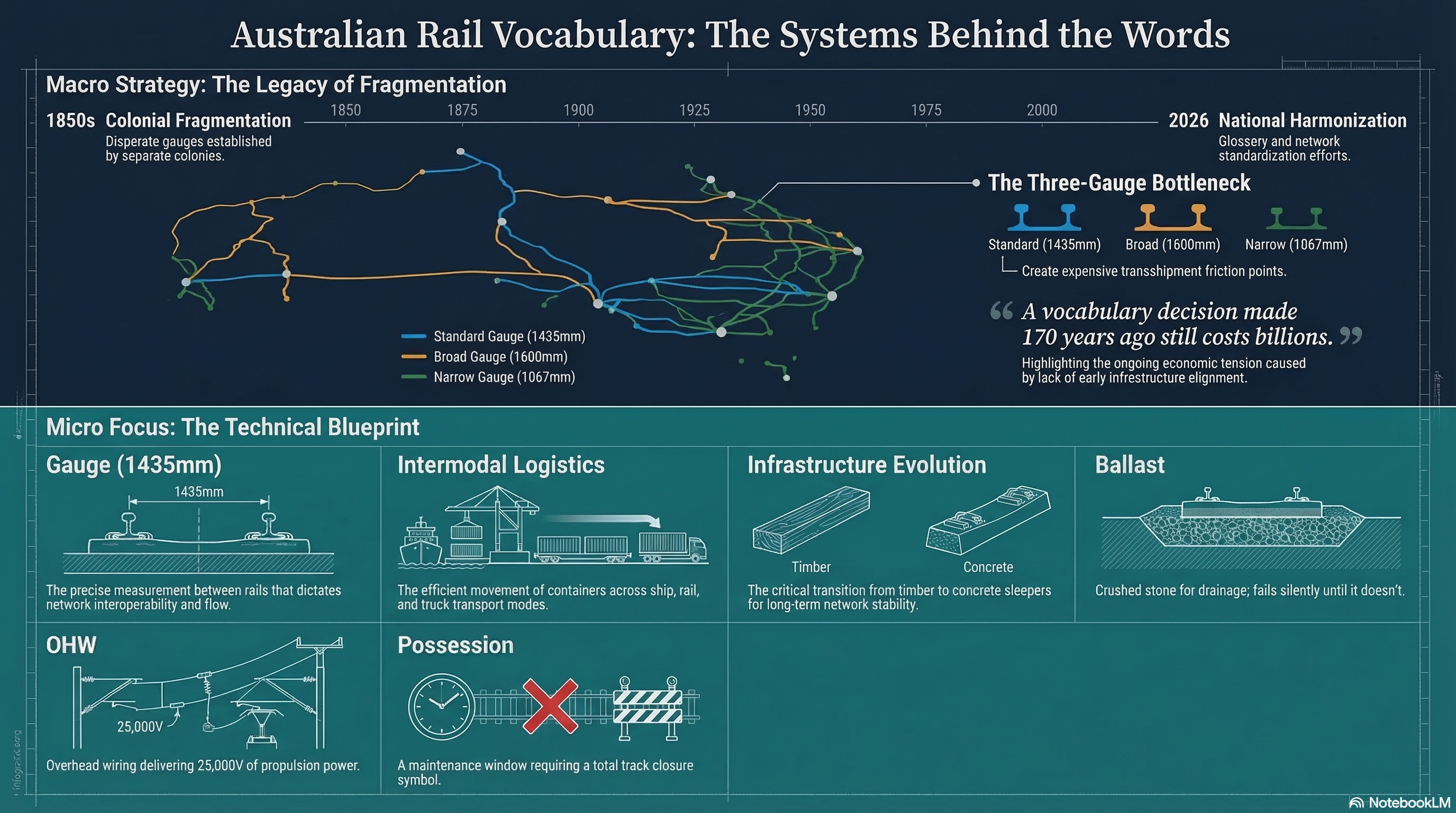
In the 1850s, each colony independently selected its gauge: New South Wales chose standard gauge (1,435mm), Victoria and South Australia chose broad gauge (1,600mm), and Queensland chose narrow gauge (1,067mm). They didn’t coordinate because they were separate colonies with no obligation to do so.
The result, 170 years later, is a network where freight trains crossing state borders sometimes need to be unloaded, transferred to differently-gauged wagons, and reloaded — a process called transshipment. The interstate standard gauge network (managed by ARTC) has resolved the worst of this for long-haul freight, but significant portions of state networks still operate on legacy gauges.
The cost: billions in reduced efficiency, duplicated infrastructure, and lost interoperability. A vocabulary choice made before the telephone was invented is still shaping infrastructure investment today.
Why is the material transition from timber to concrete sleepers a multi-decade infrastructure shift?
Sleepers (called “ties” in North America) are the transverse supports beneath the rails that maintain gauge, distribute loads, and hold the track in position.
Australia is in the middle of a generational transition from timber sleepers to concrete. Timber sleepers are lighter, absorb vibration well, and are easy to work with — but they rot, are attacked by termites in northern climates, and have a lifespan of 15–25 years. Concrete sleepers are heavier, more durable (50+ year lifespan), and better suited to heavy axle loads — but they’re more expensive, harder to handle, and transmit more vibration to ballast.
The transition isn’t a one-year project. Australia has hundreds of millions of sleepers in service. Replacing them at natural lifecycle exchange rates means the transition will take 30–40 years. Every year, billions of dollars flow into sleeper replacement programs that most of the public will never see.
Why do millimetre-tolerance OHW failures cause disproportionate network disruption?
Overhead wiring (OHW), also called catenary, provides electrical power to trains via a pantograph mounted on the roof. The contact wire must maintain precise height and alignment — within millimetres — so the pantograph can collect current smoothly at speed.
When OHW fails — a dewirement, a catenary break, a pantograph snag — the consequences are immediate and severe. The affected section loses power. Every electric train on that section stops. Unlike a track defect (which can sometimes be passed at reduced speed), an OHW failure is absolute: no power, no movement.
Repairing OHW requires specialist high-voltage crews, elevated work platforms, and isolation of the power supply — a process that typically takes 2–6 hours. During that time, the entire affected corridor is shut down. One span of contact wire, one loose fitting, and thousands of commuters are stranded.
How does intermodal freight combine rail efficiency with road flexibility for last-mile delivery?
Intermodal freight uses standardised containers that transfer between road and rail without the goods inside being touched. A container is loaded at a warehouse, trucked to an intermodal terminal, lifted onto a rail wagon, moved 800 km by train, lifted off at the destination terminal, and trucked to the customer.
The economics are elegant: rail provides the cheap, efficient line-haul over long distances; road provides the flexible first-mile and last-mile delivery. The break-even distance — where intermodal rail becomes cheaper than road-only — is typically 500–800 km in Australia, depending on commodity and volume.
Inland Rail is designed to be an intermodal game-changer: double-stacked container trains running the Melbourne–Brisbane corridor in under 24 hours, shifting millions of truck movements off the Hume and Pacific Highways.
How do strategically placed sidings multiply the capacity of single-track corridors?
A siding (or passing loop) is a section of track parallel to the main line where a train can wait while another passes. On single-track corridors — which represent most of regional Australia — sidings are the only capacity mechanism available.
Without sidings, a single-track corridor can run only one train at a time: the second train must wait at the origin until the first reaches the destination. With strategically placed sidings, two trains can pass midway, effectively doubling capacity.
The spacing, length, and location of sidings on a corridor determine its theoretical maximum throughput. ARTC’s capacity modelling for Inland Rail depends critically on siding placement — each additional siding on the corridor adds measurable freight paths per day.
Synthesis
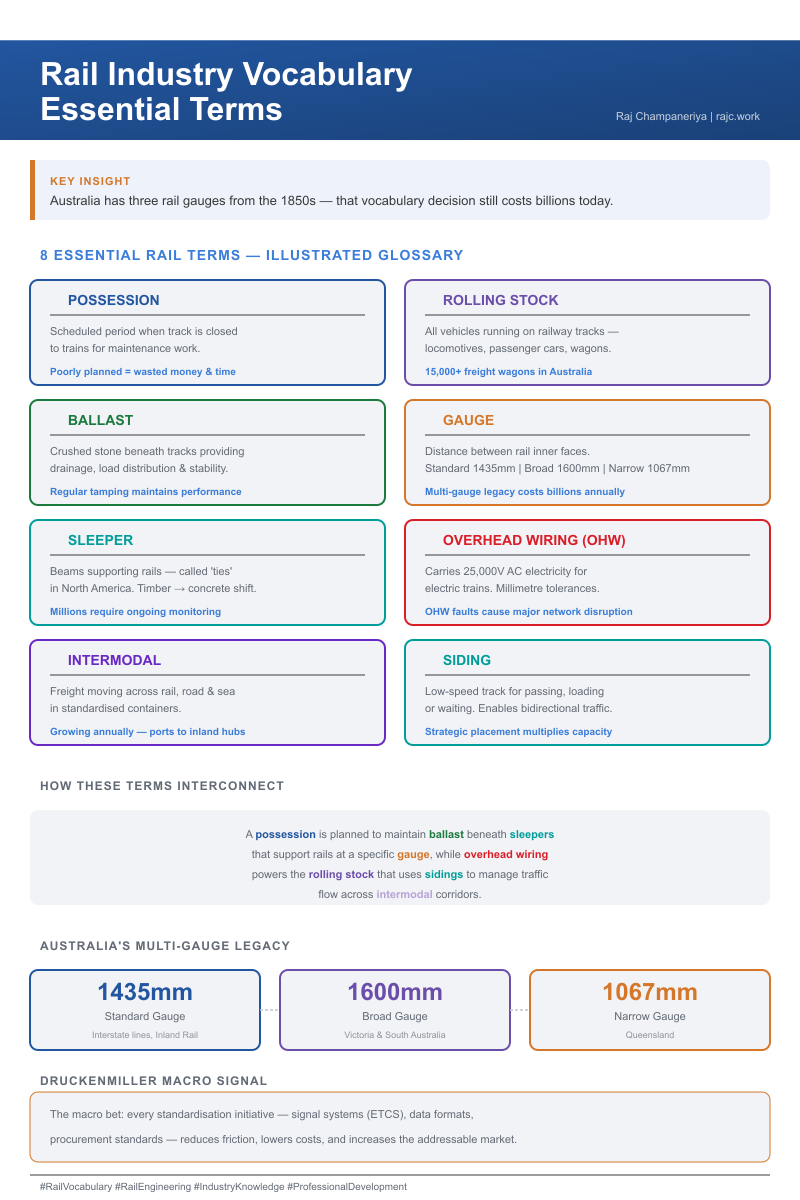
Rail vocabulary isn’t passive knowledge — it’s a systems-thinking tool. These eight terms — possession, rolling stock, ballast, gauge, sleeper, overhead wiring, intermodal, and siding — are interconnected components of a single operating system.
A possession is planned to maintain ballast beneath sleepers that support rails at a specific gauge, while overhead wiring powers the rolling stock that uses sidings to manage traffic flow across intermodal corridors. Understand how these terms connect, and vocabulary transforms from trivia into operational insight.
Australia’s multi-gauge legacy is the most powerful illustration: a seemingly simple vocabulary choice made 170 years ago still shapes infrastructure investment, operational efficiency, and national freight strategy today.
Vocabulary Spotlight
| Term | Definition |
|---|---|
| Possession | A scheduled period when track is closed to trains for maintenance work |
| Rolling stock | All vehicles running on railway tracks: locomotives, passenger carriages, freight wagons, and maintenance vehicles |
| Gauge | The distance between rail inner faces; Australia operates Standard (1,435mm), Broad (1,600mm), and Narrow (1,067mm) gauges |
Macro Signal
Druckenmiller Macro: The macro trend embedded in rail vocabulary is standardisation. Australia’s multi-gauge legacy was a failure of coordination; today, the push for national standards (RISSB Codes of Practice, ONRSR harmonisation, standard gauge Inland Rail) represents a generational correction. Every standardisation initiative — from signal systems to data formats to procurement standards — reduces friction, lowers costs, and increases the addressable market for technology solutions.
In the News
The Australasian Railway Association (ARA) releases an updated National Rail Glossary in February 2026, standardising 450+ industry terms across jurisdictions — a critical step toward harmonising technical language fragmented since the colonial era.
Sources
| Type | Source |
|---|---|
| IBM | IBM Maximo — “Asset Taxonomy and Standardisation for Rail” |
| Industry | Australasian Railway Association — “National Rail Glossary & Standards Guide” |
| Standards | RISSB — “Rail Industry Codes of Practice” |
| Government | BITRE — “History of Rail Gauge in Australia” |
Tomorrow: The Bullet Train Mirage · You’ve seen the headlines about Australian high-speed rail your entire life — but have you ever noticed the same promise being recycled for 40 years?