Day 2 of Australian Rail Series
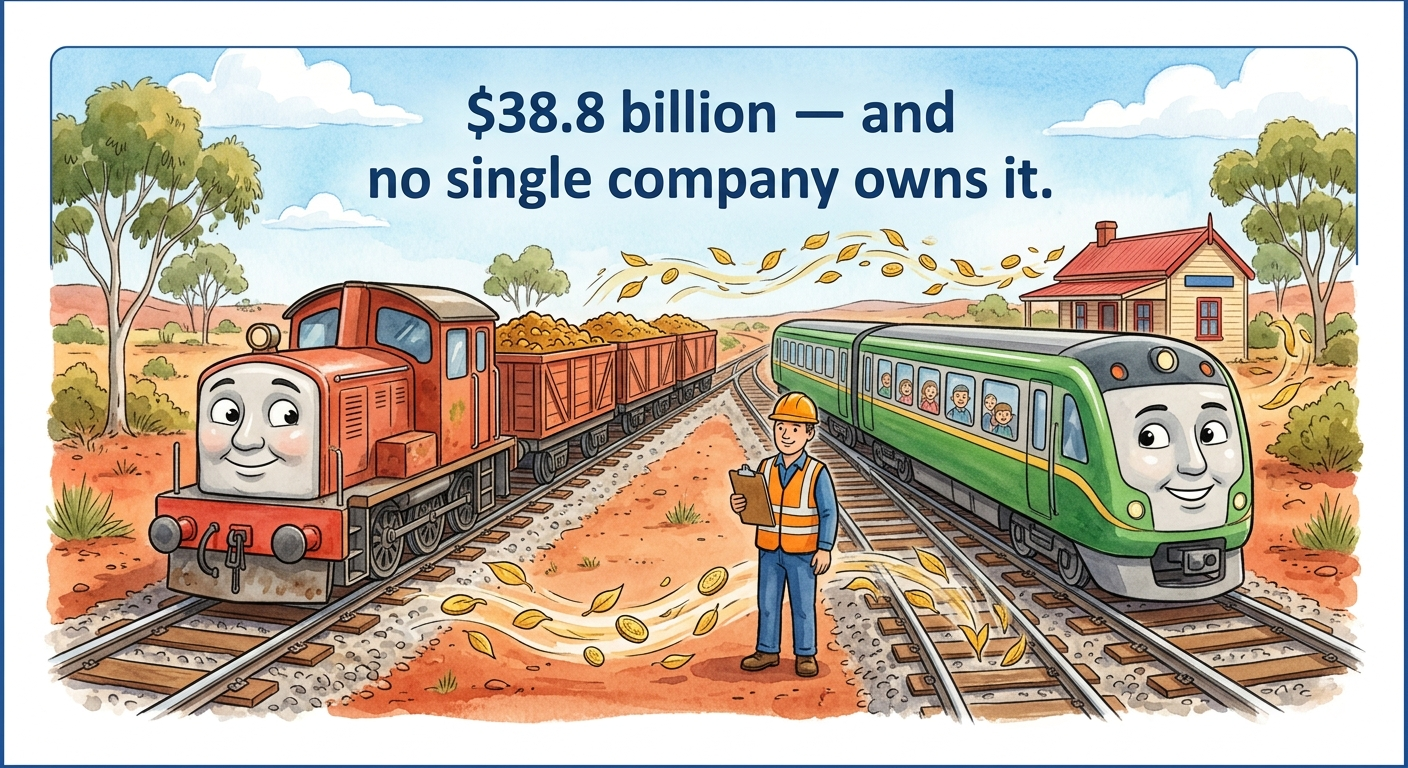
A memory of trains rumbling through the night becomes the key to understanding how a $38.8 billion industry actually makes its money — and why the structural decision to separate tracks from trains changed everything.
The Story
When I was eight, I remember lying awake in bed and hearing a freight train in the distance. Not the sharp horn — the lower sound. The deep, rhythmic drumming of wheels on rail joints, each thud marking another wagon loaded with something heavy being pulled somewhere important. It was hypnotic. I’d try to count the wagons by the thuds. I always lost track past thirty.
That was decades ago. Today, those trains are part of an industry that contributes $38.8 billion to the Australian economy and supports almost 200,000 jobs, and underpins Australia’s entire export economy.
But here’s what hasn’t changed: the sound. The rhythm. The physics of steel wheels on steel rail, pulling Australia’s wealth from inland mines to coastal ports, night after night after night.
What has changed is the economics behind that sound. And that’s where the story gets interesting.
Day 2 in pictures
A few visuals for post.
The Deep Dive — 8 Questions
How do five distinct revenue streams sustain a $38.8B rail industry?
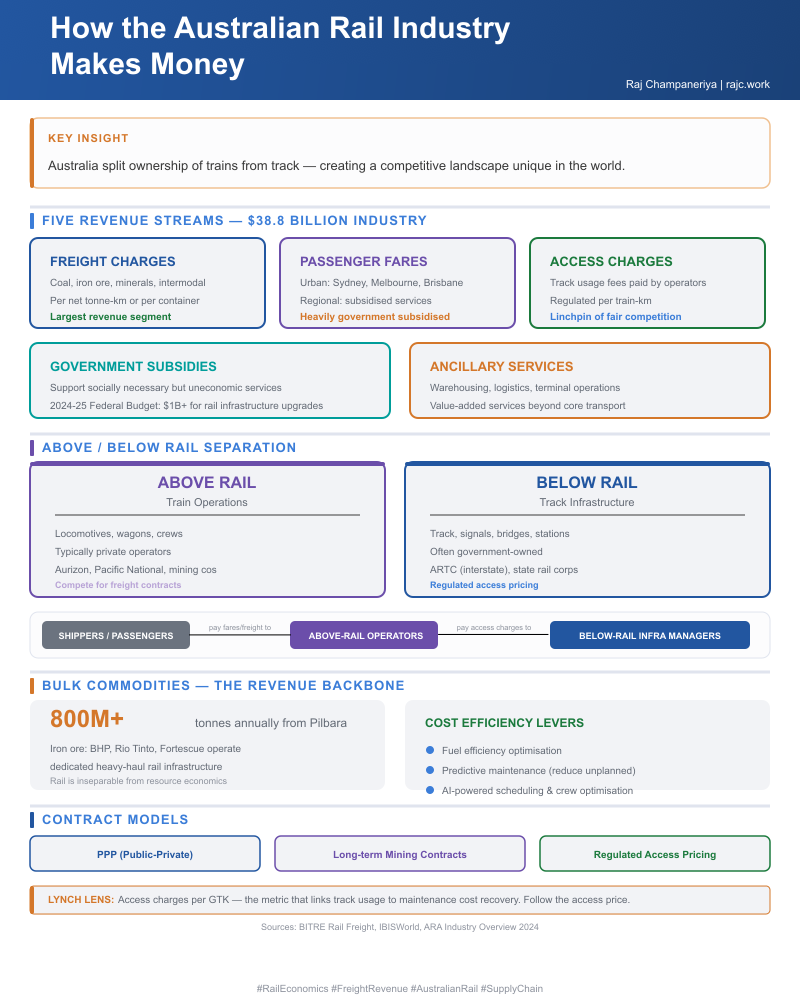
Australian rail doesn’t have one business model — it has five, layered on top of each other like geological strata.
| Revenue Stream | How It Works | Scale |
|---|---|---|
| Freight haulage | Operators charge per tonne or per tonne-kilometre for moving commodities | ~60% of industry revenue |
| Passenger fares | Ticketed travel on urban and regional networks | ~20% (heavily subsidised) |
| Access charges | Track owners charge train operators for using the network | ~10% |
| Government subsidies | Federal and state payments to sustain passenger services | ~8% |
| Ancillary services | Property, retail, advertising, maintenance contracts | ~2% |
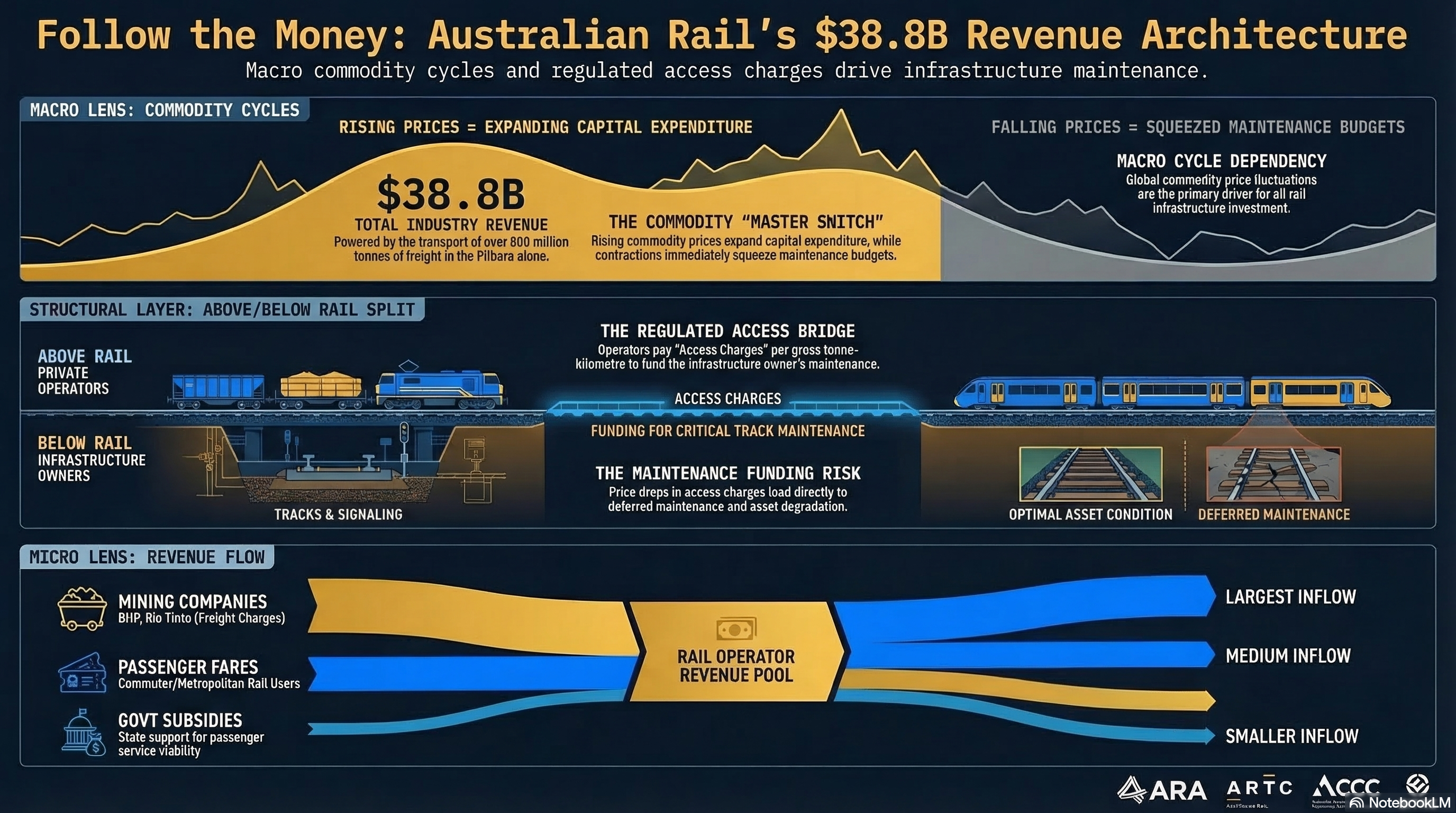
The dominance of freight haulage means Australian rail’s financial health rises and falls with global commodity prices. When iron ore is at $120/tonne, Pilbara railways are among the most profitable transport operations on Earth. When coal demand softens, Hunter Valley economics tighten overnight.
Why do long-term mining contracts stabilise rail revenue more than spot market freight?
Mining companies don’t ship iron ore on a whim. They sign 10–20 year take-or-pay contracts with rail operators — agreements where the miner pays for capacity whether they use it or not. These contracts are the bedrock of freight rail economics. They provide revenue certainty for operators, justify capital investment in rolling stock and track, and create a planning horizon long enough to amortise asset costs.
Contrast this with intermodal freight, where volumes fluctuate with consumer demand, competition from road is fierce, and contracts are typically 1–3 years. The mining contract model is what makes Aurizon’s share price relatively stable — the revenue is locked in for years ahead.
How does Australia’s above/below rail separation create a fundamentally different competitive landscape?
This is the structural decision that defines Australian rail economics.
In Japan, JR companies own the tracks and run the trains. Vertical integration. One company, one system.
Australia chose differently. It separated above rail (the operators who run trains — Aurizon, Pacific National, SCT Logistics) from below rail (the infrastructure owners who maintain track — ARTC, state-owned networks). Above-rail operators pay access charges to use below-rail infrastructure, much like airlines pay airport fees.
The consequences are profound:
- Competition is possible: Multiple freight operators can compete on the same corridor
- Infrastructure is protected: Track maintenance is funded through regulated access charges, not operator profits
- Pricing is transparent: The ACCC oversees access pricing to prevent monopoly abuse
- Complexity increases: Every corridor involves contractual relationships between operators and infrastructure owners
This model was borrowed from the UK — but arguably executed more cleanly in Australia.
When does public subsidy of rail services represent smart policy versus market distortion?
Every passenger train in Australia is subsidised. Not some — all. Farebox revenue covers only 30–50% of operating costs for urban rail, and considerably less for regional services.
Is this a market distortion? Or is it smart policy?
The answer depends on what you’re counting. If you count only fare revenue against operating costs, passenger rail is a perpetual loss-maker. But if you count the avoided costs — road congestion, accident reduction, emissions avoided, urban land value uplift, social inclusion for communities with no car access — the economic return on rail subsidy is overwhelmingly positive.
Sydney Metro, for example, will increase land values within 800 metres of each station by an estimated 10–15%. The property tax uplift alone may repay a significant portion of the construction cost over thirty years. But that return never shows up on the rail operator’s balance sheet.
Why is regulated access pricing the linchpin of fair competition in Australian rail?
Access pricing is where economics meets regulation. ARTC publishes its access pricing principles: operators pay based on train weight, distance, and path (time slot). The pricing must recover maintenance costs, contribute to capital expenditure, and provide a return on the rail asset base — but it can’t be so high that it kills competition.
The ACCC monitors this to prevent below-rail monopolies from extracting excessive rents. In the Hunter Valley coal chain, access pricing is formulaic: transparent, published, and directly tied to maintenance cost recovery.
This system works when volumes are high and corridors are busy. It strains when traffic is thin and fixed costs must be spread across fewer train movements. Regional corridors face this challenge constantly — the per-train cost of maintaining a lightly-used line can exceed the revenue it generates.
Which cost levers give rail operators the greatest efficiency gains?
Rail operations have three dominant cost categories, each with different efficiency dynamics:
| Cost Category | % of Total | Efficiency Lever |
|---|---|---|
| Labour | 35–40% | Automation, crew rostering optimisation, remote operations |
| Fuel/energy | 20–25% | Eco-driving algorithms, electrification, regenerative braking |
| Maintenance | 25–30% | Predictive maintenance (reduces unplanned failures), condition-based intervention |
The operators making the biggest efficiency gains are those attacking all three simultaneously. Aurizon’s “transformation program” combined workforce restructuring with technology investment in train management systems — delivering a step-change in cost-per-net-tonne-kilometre that competitors struggle to match.
Why does the Pilbara’s 800M+ tonnes make rail inseparable from Australia’s resource economy?
The Pilbara region produces around 800 million tonnes of iron ore annually. Every tonne moves by rail — there is no alternative. The rail lines operated by Rio Tinto, BHP, and Fortescue are not public infrastructure; they are private railways built, maintained, and operated solely for ore haulage.
These railways generate more revenue per track-kilometre than almost any other rail operation on Earth. Rio Tinto’s rail division is not a cost centre — it’s a profit driver. The 28,000-tonne trains running 24/7 across 1,700 km of private track are the circulatory system of Australia’s largest export industry.
When economists say “Australia rides on the sheep’s back,” they should update the metaphor. Australia rides on iron rails.
How do PPP contract models shift financial risk while maintaining public ownership of passenger rail?
Public-Private Partnerships in rail take a specific form in Australia: the government retains ownership of infrastructure and sets service levels, while a private operator runs the trains under a performance-based contract.
Metro Trains Melbourne operates under this model. The state government owns the track, stations, and rolling stock. Metro Trains provides drivers, maintenance crews, and operational management. Performance targets — on-time running, safety, cleanliness — are contractually defined, and payments are adjusted based on achievement.
The benefit: private sector operational efficiency with public sector asset protection. The risk: the private operator optimises for contract metrics, which may not perfectly align with broader public interest. When a contract incentivises on-time running above all else, operators may skip minor stations during disruptions to protect the statistic — technically meeting the KPI while degrading the passenger experience.
Synthesis
The Australian rail industry’s revenue model rests on a structural separation that most outsiders don’t understand: above-rail operators pay access charges to below-rail infrastructure owners. This model enables competition on the network while keeping infrastructure as a regulated, often publicly-owned asset.
Revenue flows from three primary sources — freight charges (dominated by bulk commodities), passenger fares (heavily subsidised), and access pricing (the regulated bridge between operators and infrastructure). The $38.8 billion industry is fundamentally shaped by commodity cycles: when iron ore prices rise, Pilbara rail volumes surge; when coal demand shifts, Hunter Valley economics change.
Understanding these revenue dynamics is essential for any technology partner positioning solutions to rail clients — because the budget for your solution comes from one of these revenue streams.
Vocabulary Spotlight
| Term | Definition |
|---|---|
| Above rail | Operations and assets that move on the track — locomotives, wagons, train crews |
| Below rail | Infrastructure supporting train movement — track, signalling, stations, tunnels |
| Access charges | Regulated fees paid by above-rail operators to below-rail infrastructure owners for network access |
| Take-or-pay contract | A long-term agreement where the customer pays for reserved capacity whether they use it or not |
Micro Signal
Lynch Lens: The key number in Australian rail economics is “access charges per gross tonne-kilometre.” This single metric determines how much above-rail operators pay to use the network — and therefore how much revenue is available for track maintenance. ARTC’s published access pricing for the Hunter Valley coal chain is a masterclass in regulated pricing: transparent, formulaic, and directly tied to maintenance cost recovery. Follow the access price, and you follow the money.
In the News
Aurizon’s FY2025 results show sustained freight volumes and a 3% increase in total revenue, with coal and bulk haulage remaining central to earnings — underscoring how commodity cycles directly shape Australian rail economics and maintenance investment capacity.
Sources
Tomorrow: The Budget That Built a Continent · You’ve checked your bank balance a thousand times — but have you ever noticed the budget cycle that decides whether your morning train runs?