Day 1 of Australian Rail Series
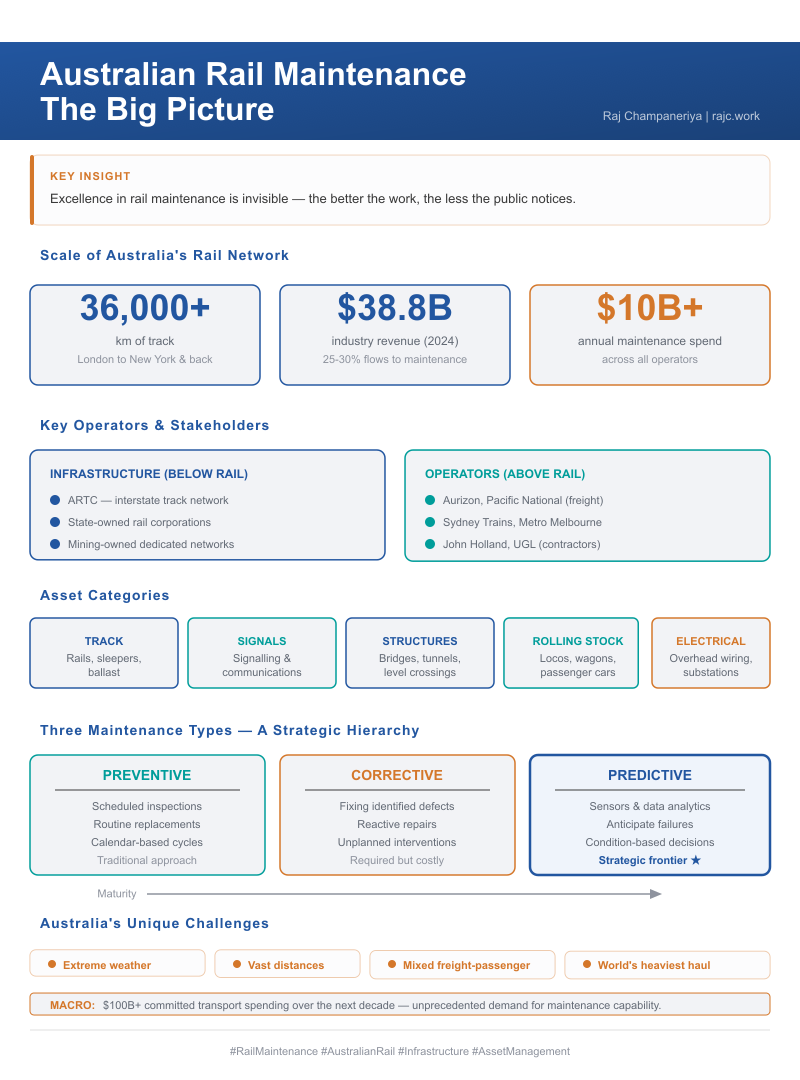
Australia’s best maintenance workers are the ones you’ve never heard of — because excellence, in rail, is invisible. Today we pull back the curtain on a $10+ billion challenge that most people walk past every morning without a second thought.
The Story
You’ve seen a railway track a thousand times. The dull gleam of steel, the weathered timber sleepers, the crunch of ballast underfoot if you’ve ever walked too close. It’s part of the scenery — as unremarkable as power lines or stormwater drains.
But have you ever noticed who keeps it there?
Not the steel itself — steel doesn’t care about you. The alignment of the rail. The precise gauge between the two running edges, maintained to within millimetres across 36,000 kilometres of track. The ballast tamped to the correct density so the sleeper sits just so. The rail profile ground smooth enough that a wheel rolling over it at 160 km/h doesn’t generate the harmonic resonance that cracks axles.
This is rail maintenance. And the strange secret of the profession is that the better the work, the less anyone notices. A perfectly maintained track is silent, smooth, and on time. The only time the public thinks about rail maintenance is when it fails — a “track fault” delay, a speed restriction, a derailment that makes the evening news.
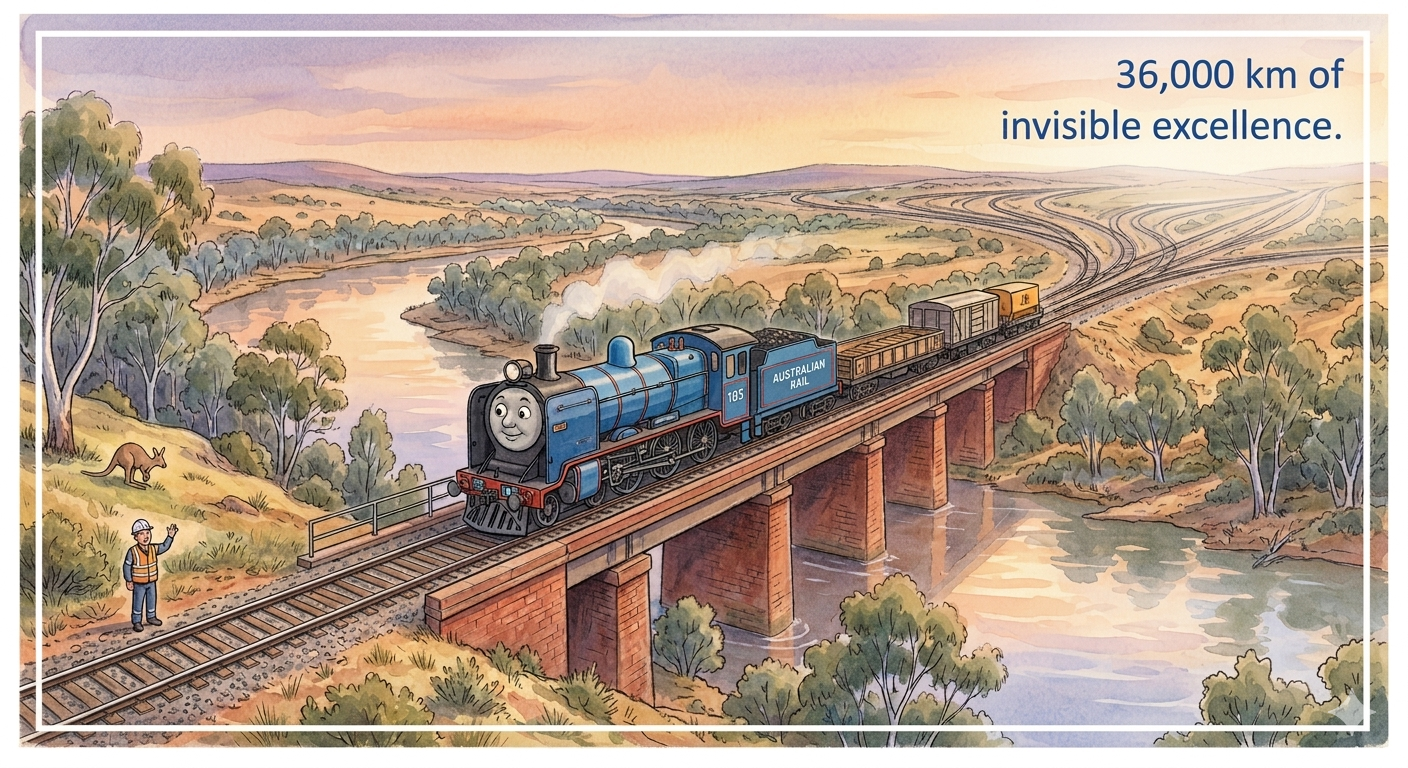
Excellence, in this industry, is invisible.
Industry studies suggest Australia spends several billion dollars annually on rail maintenance, and maintenance will be the largest share of total rail work by the 2030s.
Day 1 in pictures
A few visuals for post.
The Deep Dive — 8 Questions
Why is rail maintenance a several billion dollars annual challenge for Australia?
Because Australia doesn’t have a railway. It has a continent-spanning logistics system that happens to run on rails.
The network maintained to within millimetres across more than 31,000 kilometres of track — longer than the entire UK rail network. It connects mines in the Pilbara to ports in Western Australia, grain silos in the Darling Downs to export terminals in Queensland, and commuters in Sydney’s western suburbs to offices in the CBD. Maintaining this means inspecting, repairing, and replacing track, signalling, rolling stock, overhead wiring, bridges, tunnels, level crossings, and station facilities — continuously, often simultaneously, and mostly at night when the trains aren’t running.
What cascading failures occur when rail maintenance is neglected?
Rail doesn’t fail gracefully. It fails in cascades.
A deferred rail grinding allows micro-cracks to propagate. Micro-cracks become rolling contact fatigue. Fatigue becomes a rail break. A rail break at speed becomes a derailment. A derailment on a mixed-use corridor becomes a safety investigation, a service suspension, a parliamentary inquiry, and a career-ending headline for whoever signed off on the maintenance deferral.
In a country where the supply chain for iron ore, coal, and grain runs on rail, a single corridor shutdown doesn’t just delay trains — it delays ships, affects commodity pricing, and ripples through export earnings. After a sulphuric‑acid freight derailment near Julia Creek in 2015, the Mount Isa line was closed for several days, impacting mines that relied on the corridor to ship product. The cost wasn’t just the cleanup — it was the mines that couldn’t ship.
How does Australia’s fragmented operator landscape shape maintenance approaches?
Australia’s rail system was built by colonies, not a nation. Each state developed its own gauge, its own standards, its own operating culture. Federation in 1901 didn’t fix it. Standardisation efforts over the following century helped, but the legacy remains: a patchwork of operators, each with distinct maintenance philosophies.
The major players include:
- ARTC (Australian Rail Track Corporation) — manages the interstate standard-gauge network and is delivering the $31B Inland Rail project
- Aurizon — Australia’s largest rail freight operator, dominant in Queensland coal
- Sydney Trains / Metro Trains Melbourne — urban passenger networks with high-frequency maintenance demands
- John Holland, UGL, Downer — major maintenance contractors who do the hands-on work
- Rio Tinto, BHP, Fortescue — private heavy-haul networks in the Pilbara, including the world’s first fully autonomous heavy-haul railway
Each operator maintains assets differently. Some are advanced — Rio Tinto’s AutoHaul system in the Pilbara runs trains without drivers. Others still rely on paper-based inspection sheets and scheduled time-based replacement, regardless of actual asset condition.
Which asset categories create the greatest maintenance complexity and why?
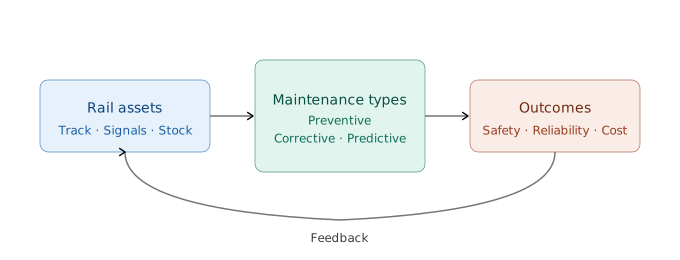
Rail assets aren’t a single thing — they’re an ecosystem. The complexity comes from the interdependencies:
| Asset Category | What It Includes | Why It’s Complex |
|---|---|---|
| Track infrastructure | Rails, sleepers, ballast, formation | Degrades at different rates depending on axle load, speed, and climate |
| Signalling systems | Interlockings, track circuits, ETCS | Legacy and modern systems coexist; failure means network shutdown |
| Overhead wiring | Catenary, contact wire, masts | Electrified corridors require specialised high-voltage crews |
| Structures | Bridges, tunnels, culverts | Long asset lives but catastrophic failure modes |
| Level crossings | Boom gates, signals, road surfaces | Interface between rail and road — highest public risk point |
| Rolling stock | Locomotives, wagons, passenger cars | Mobile assets maintained in depots on tight turnaround schedules |
For a system-level view of how these asset categories interact and are managed, see the UIC guidelines on asset management in railway infrastructure (PDF). The real complexity is that these assets interact. A track geometry defect changes the dynamic load on a bridge. A signalling failure forces manual operation that delays possession windows for track maintenance. Everything is connected.
Why do possession windows force trade-offs between maintenance quality and network availability?
You can’t maintain a track with trains running on it.
A “possession” is a scheduled period when a section of track is taken out of service for maintenance. Every possession is a negotiation between two competing goods: maintenance quality (which needs long, uninterrupted access) and network availability (which needs the track open for revenue services).
Urban networks like Sydney Trains face the sharpest trade-off. Services run from roughly 4:00 AM to 1:00 AM, leaving a maintenance window of barely three hours — much of which is consumed by safety setup and teardown. That’s why weekend trackwork shutdowns are common and deeply unpopular with passengers.
Freight networks have more flexibility but face a different constraint: every hour of possession is an hour of lost haulage revenue. Aurizon estimates that a single hour of unplanned downtime on a major coal corridor costs hundreds of thousands of dollars in deferred revenue.
The organisations that master possession planning — maximising productive maintenance minutes per possession hour — gain a structural cost advantage.
How do preventive, corrective, and predictive maintenance form a strategic hierarchy?
Three types. Three philosophies. Three very different cost profiles.
Preventive maintenance is time-based: inspect every 90 days, replace sleepers every 25 years, grind rails every X million gross tonnes. It’s reliable but blunt — you replace components that may have years of life left, and you miss defects that develop between inspection cycles.
Corrective maintenance is failure-driven: something breaks, you fix it. It’s reactive by definition. In safety-critical rail systems, it usually means an emergency response — expensive, disruptive, and often the result of a preventive gap.
Predictive maintenance is condition-based: sensors, analytics, and machine learning monitor asset health in real time and forecast when failure will occur. You intervene at the optimal moment — not too early (wasting asset life), not too late (risking failure). IBM’s Maximo Health and Predict platform is designed precisely for this: ingesting sensor data from track geometry cars, wheel impact load detectors, and rail flaw detection systems to generate condition-based maintenance triggers.
The hierarchy is clear. Preventive is the baseline. Corrective is the cost of getting preventive wrong. Predictive is the strategic frontier — and the organisations investing in it now will spend less, fail less, and know their assets better than competitors who wait.
What proportion of Australia’s $38.8B rail industry flows to maintenance, and is it enough?
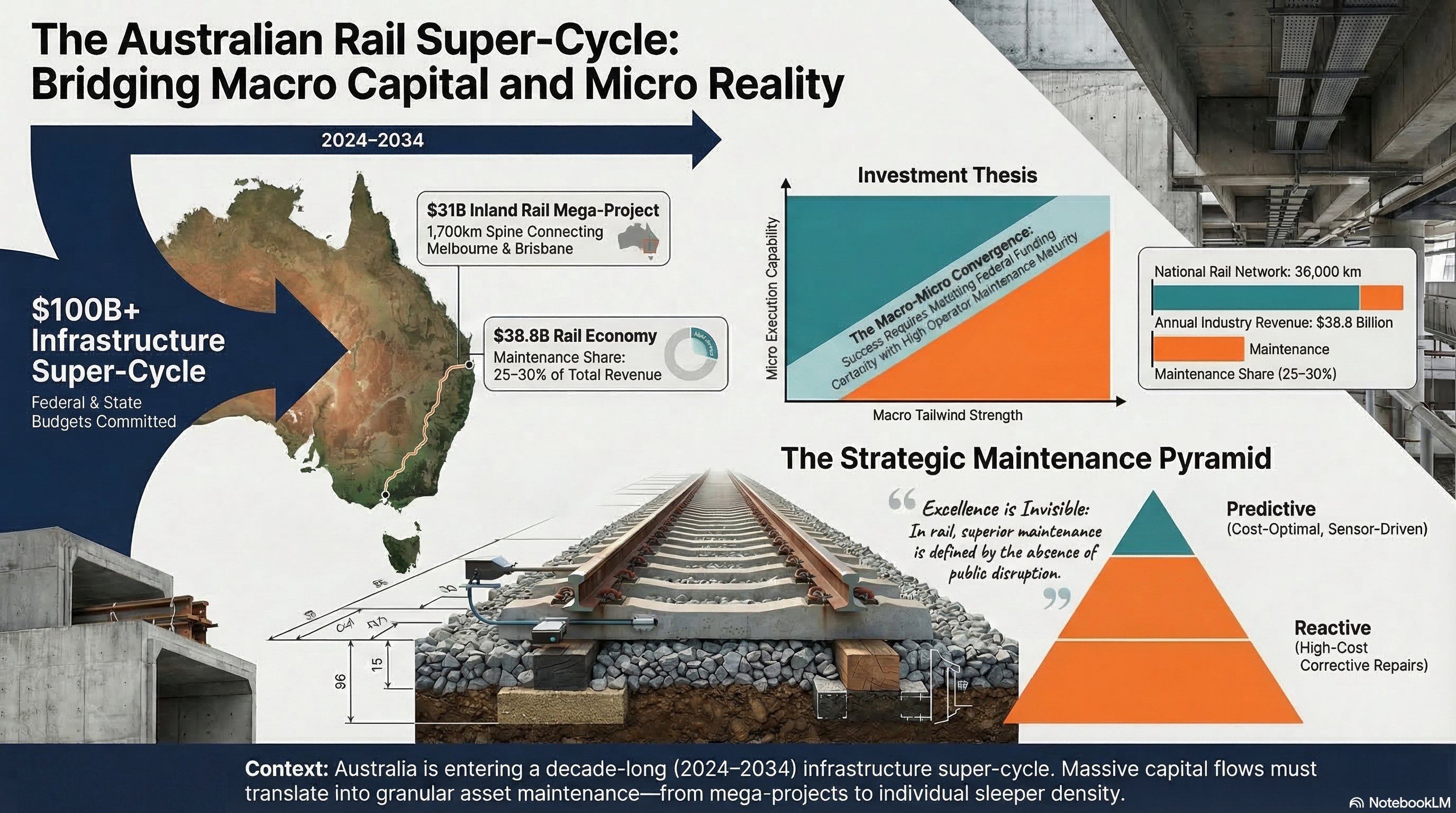
According to the Australasian Railway Association’s The Value of Rail 2025 report, rail generated $38.8 billion for the Australian economy in 2024. Industry analyses indicate that maintenance accounts for a substantial share of rail operating expenditure, often in the order of a quarter or more, depending on network and asset mix — a figure that translates to the $10+ billion annual spend noted earlier.
Is it enough? The answer depends on who you ask.
Asset managers will tell you deferred maintenance is a growing liability — every dollar not spent today becomes three dollars of corrective cost tomorrow. Finance teams will tell you maintenance budgets must compete with capital expansion, new rolling stock, and network extensions. Government will tell you there’s $100 billion committed to transport infrastructure over the next decade, but much of that is for new build, not sustaining existing assets.
The tension is structural. Australia is simultaneously building new rail infrastructure (Inland Rail, Sydney Metro, Cross River Rail) and struggling to maintain the ageing network already in service. The Inland Rail project alone will add 1,700 km of new track to the national asset register — track that will need maintenance from day one.
Why can’t Australian rail simply copy maintenance models from Europe or Japan?
Because Australia isn’t Europe or Japan. The constraints are fundamentally different.
Distance: Japan’s Shinkansen network covers ~3,000 km. Australia’s freight network covers 36,000+ km, much of it through remote, arid terrain where the nearest maintenance depot may be hundreds of kilometres away.
Axle loads: European passenger trains apply roughly 17 tonnes per axle. Australian heavy-haul trains in the Pilbara apply 40+ tonnes per axle — more than double. The track degradation rate is exponentially higher.
Climate: Australian rail operates across deserts (track buckling in 50°C heat), tropical monsoons (ballast washout), alpine conditions (frost heave), and coastal salt air (corrosion). No single European country faces that range.
Mixed corridors: Many Australian corridors carry both heavy freight and passenger services on the same track — a combination that creates competing maintenance demands and accelerated wear patterns that few overseas networks deal with at scale.
Australia needs maintenance models built for Australian conditions. That’s not insularity — it’s physics.
Synthesis
Australian rail maintenance is a $10+ billion annual endeavour that underpins the nation’s freight economy and urban mobility. The sector’s three maintenance types — preventive, corrective, and predictive — form a clear hierarchy where predictive maintenance represents the strategic frontier, promising significant cost reductions while improving safety outcomes.
What makes Australia unique is the convergence of three forces: extreme geography (36,000+ km of track across deserts, mountains, and tropics), the world’s heaviest haul operations in the Pilbara, and mixed freight-passenger corridors that create competing demands for every maintenance window.
Understanding this landscape is foundational. Every subsequent post in this campaign connects back to how rail assets are kept safe, reliable, and efficient.
Review Questions
- Evaluate: Given Australia’s unique combination of extreme distances, heavy haul freight, and urban passenger networks, which maintenance type should receive the highest investment priority — and why?
- Evaluate: How would you assess whether a rail maintenance organisation is effectively balancing safety outcomes against cost efficiency? What evidence would you examine?
- Create: If you were advising a new entrant to the Australian rail maintenance market, what three factors would you identify as the most critical competitive differentiators?
Vocabulary Spotlight
| Term | Definition |
|---|---|
| Preventive maintenance | Scheduled, time-based servicing of rail assets to prevent failures before they occur |
| Corrective maintenance | Unplanned repairs performed after an asset has failed or degraded |
| Heavy haul | Rail operations transporting bulk commodities in trains exceeding 10,000 gross tonnes — common in Australia’s Pilbara and Hunter Valley (ARA) |
| Possession | A scheduled period when a section of track is taken out of service for maintenance work (Railsafe) |
| Ballast | Crushed stone forming the track bed — provides drainage, distributes load, and allows geometry adjustment (track ballast) |
Macro Signal
Druckenmiller Macro: The force shaping Australian rail maintenance is the infrastructure investment super-cycle. Over $100 billion in committed transport spending across federal and state budgets for the next decade means more track to maintain, more assets to manage, and unprecedented demand for maintenance capability. The organisations that scale maintenance capacity — through technology, workforce, or both — will capture disproportionate value from this investment wave.
In the News
ARTC’s $31 billion Inland Rail project (Melbourne–Brisbane) is progressing, with key sections such as Narrabri–North Star under construction and portions entering service. This creates a generational freight maintenance challenge: 1,700 km of new track entering the asset management lifecycle — all of it needing inspection regimes, degradation models, and maintenance contracts from day one.
Sources
| Type | Source |
|---|---|
| IBM | IBM Maximo Application Suite — Enterprise Asset Management for Rail |
| Industry | Australasian Railway Association — The Value of Rail 2025 |
| Government | BITRE — Australian Infrastructure and Transport Statistics Yearbook 2024 |
| Government | Infrastructure Australia — Australian Infrastructure Plan 2024 |
| Government | ATSB — Rail investigation reports |
| Government | ATSB — Collisions at level crossings |
| Standards | UIC — Guidelines for asset management in railway infrastructure (PDF) |
| Standards | RSSB — Interlocking Principles (GKRT0060) |
| Project | ARTC — Inland Rail |
| Analysis | The Conversation — Buckling rails and lines underwater: Australia’s ageing train networks and climate |
Tomorrow: Follow the Money — How the Australian Rail Industry Makes Money The childhood sound of a freight train at night turns out to be the heartbeat of a $38.8 billion revenue engine.